
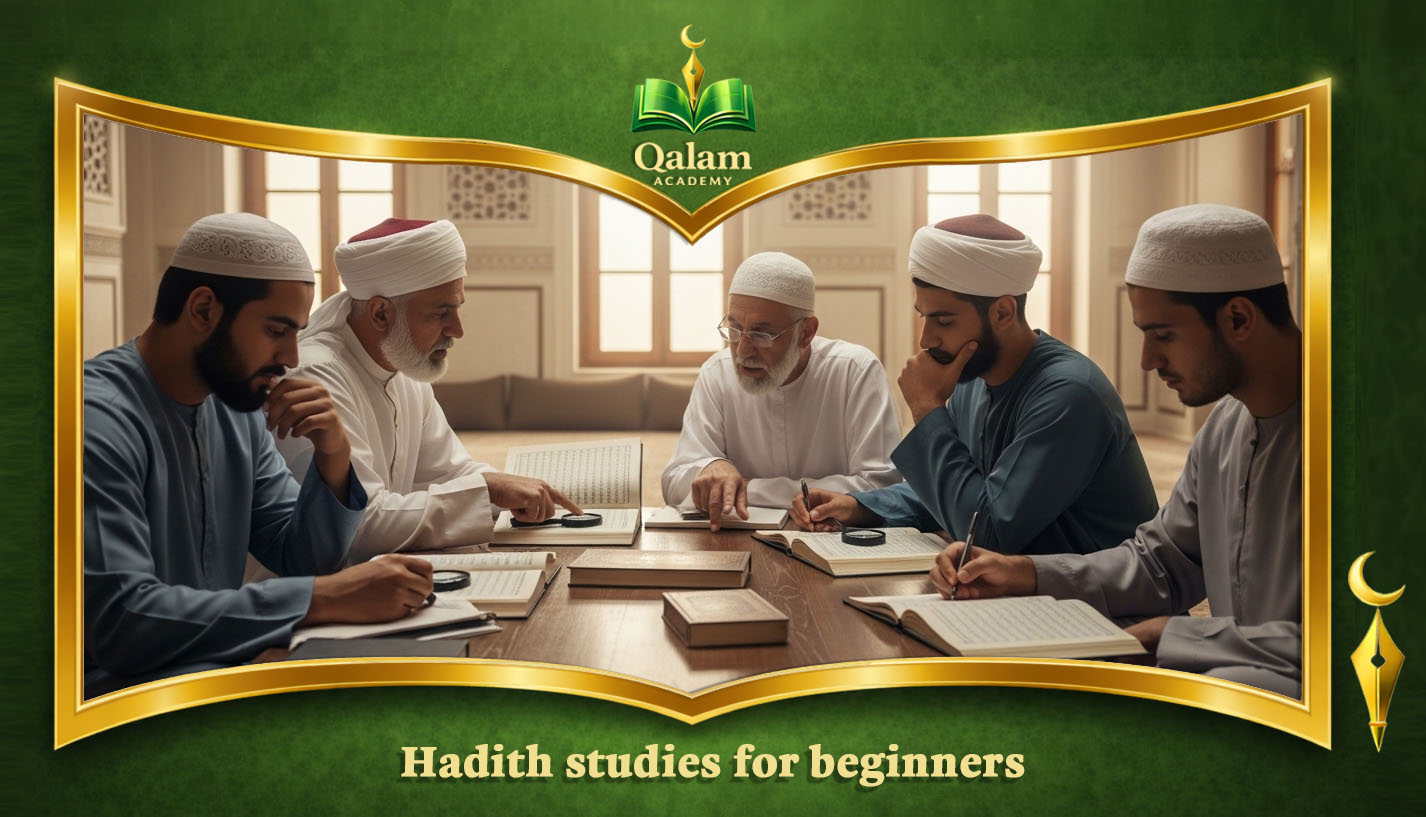
Hadith studies for beginners is an essential field of learning for anyone wishing to understand the teachings and practices of Prophet Muhammad (peace be upon him). These studies provide insight into the sayings, actions, and approvals of the Prophet, forming the foundation of Islamic law and guidance after the Quran.
At Online Quran Academy Qalam, we recognize the importance of mastering these foundational texts, which is why we offer a comprehensive approach for beginners to explore the science of hadith.
Whether you are new to Islamic studies or seeking to deepen your knowledge, our academy provides the tools and resources necessary to navigate the complexities of hadith with clarity and confidence. Through structured lessons, expert guidance, and a supportive learning environment, we aim to make hadith studies accessible and meaningful for all learners.
What is Hadith and Its Role in Islam?
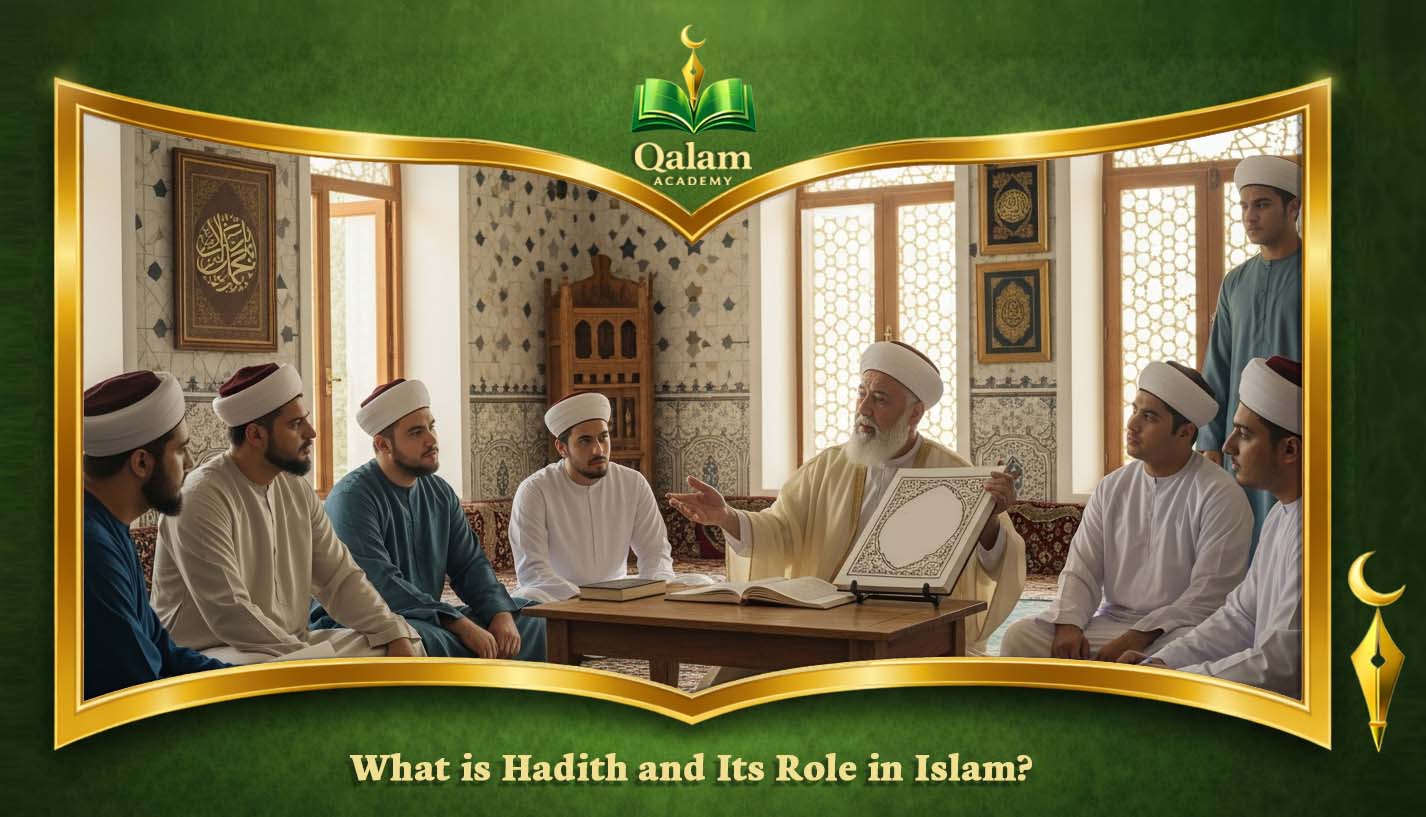
Hadith consists of the sayings, actions, and approvals of the Prophet Muhammad (PBUH), recorded by his companions. It plays a crucial role in guiding Muslims and complements the teachings of the Qur’an. Additionally, Hadith provides clear explanations and practical examples of Islamic principles.
The Role of Hadith in Islam
The Quran sets the foundation for Islamic teachings, while Hadith offers insights into how the Prophet Muhammad (PBUH) applied those teachings in daily life. It covers various aspects such as worship, ethics, and social behavior. For beginners, Hadith studies for beginners offer an excellent way to understand these principles and their real-life applications.
How Hadith Complements the Quran
The Qur’an and Hadith work together to provide a complete understanding of Islam. The Qur’an offers the core teachings, while Hadith provides detailed explanations and practical examples. Therefore, for beginners, learning Hadith is essential. It helps clarify the guidance in the Qur’an and shows how to live according to its teachings.
Learning Hadith with Online Quran Academy Qalam
If you’re interested in learning about Hadith, enrolling in a course at Online Quran Academy Qalam is a great option. The academy offers beginner-friendly courses that simplify the key concepts of Hadith. Whether you’re just starting Hadith studies for beginners or wish to deepen your knowledge, Online Quran Academy Qalam provides valuable resources to enhance your understanding of these important teachings.
Online Quran Academy
Online Quran Academy Qalam is a leading platform dedicated to providing accessible and structured Quranic and Hadith education. Whether you are a beginner or looking to expand your knowledge, the academy offers a range of courses tailored to different levels.
With a focus on authentic teachings, expert instructors, and interactive learning tools, Online Quran Academy Qalam ensures students gain a deep understanding of Islamic principles.
The academy’s flexible online format allows learners to study at their own pace, making it easier to incorporate religious learning into daily life while building a solid foundation in Quranic studies and Hadith.

The Historical Background of How Hadith Was Collected and Preserved
The process of preserving hadith began during the life of Prophet Muhammad, as his companions actively memorized and recorded his words and actions. After his passing, scholars organized the collection of hadith in a more structured way. They gathered these reports from oral sources and then compiled them into written collections.
Scholars applied strict criteria to ensure the authenticity of each hadith. They evaluated the credibility of the narrators (Isnad) and examined the consistency of the content (Matan). This meticulous approach allowed them to preserve only the true teachings of the Prophet, preventing any distortions from creeping in over time.
Hadith Studies for Beginners: A Simple Introduction
For those new to hadith studies for beginners, understanding the foundational concepts is essential. Beginners should start by learning about Isnad and Matan, as these elements play a crucial role in determining the authenticity of a hadith. Once they grasp these concepts, they will appreciate the careful efforts involved in the collection and preservation of the Prophet’s teachings.
Additionally, enrolling in an Online Quran Academy Qalam offers a great opportunity for beginners. The academy provides structured courses tailored to help students understand the history of hadith and its connection to the Quran.
The Role of Scholars in Hadith Preservation
Scholars played a vital role in preserving hadith after the Prophet’s death. They traveled widely to collect and verify reports. Their work involved evaluating narrators’ credibility and ensuring the consistency of the reported content. This careful process became a core part of hadith studies for beginners, allowing newcomers to see how much effort went into maintaining the accuracy of these teachings.
Moreover, an Online Quran Academy Qalam serves as an excellent resource for those who want to explore this subject in more detail. Through engaging courses and interactive lessons, students can learn about the methods used to collect and preserve hadith.
By understanding how scholars preserved hadith, beginners will not only develop a deeper connection with the sacred texts but also appreciate the rigorous process that ensured their authenticity.
Types of Hadith: Understanding Their Authenticity
Hadiths are classified based on their authenticity and reliability, allowing Muslims to distinguish between the strength of various narrations. The main categories are Sahih, Hasan, and Daeef, each representing a different level of credibility.
1. Sahih (Authentic)
Sahih hadiths are the most reliable. These narrations come from trustworthy narrators, and their content consistently reflects the true teachings of the Prophet Muhammad. Scholars regard Sahih hadiths as the strongest and most authoritative source for Islamic beliefs and practices. Therefore, these hadiths form the foundation of Islamic law and theology.
2. Hasan (Good)
Hasan hadiths are also reliable, but slightly weaker than Sahih. Although the narrators are trustworthy, there may be minor issues in the chain of transmission or slight doubts about their credibility. Nevertheless, Hasan hadiths remain widely accepted in Islamic practice. Scholars often use them to support religious teachings and everyday practices.
3. Daeef (Weak)
Daeef hadiths are considered less reliable. These narrations might have gaps in the chain of narrators or contain contradictions within their content. Because of these issues, scholars generally avoid using Daeef hadiths for legal rulings or theological guidance. However, in some cases, they may still be referenced, especially in encouraging good actions, provided they do not contradict established teachings.
Why Understanding These Categories is Important
Recognizing the different types of hadith helps Muslims evaluate the strength and relevance of a narration when shaping their beliefs and practices. Understanding whether a hadith is Sahih, Hasan, or Daeef enables believers to discern authentic teachings from weaker ones. Consequently, this knowledge ensures that Islamic practices stay true to the original teachings of the Prophet Muhammad.
For those eager to deepen their understanding, enrolling in an Online Quran Academy Qalam can be a great step. The academy offers specialized courses in hadith studies for beginners, providing students with the foundational knowledge to understand and apply these essential concepts in their faith.
Main Collections of Hadith
In Sunni Islam, the sayings and actions of Prophet Muhammad (peace be upon him) are preserved through a highly meticulous process. The most authentic collections of hadith are known as the Six Authentic Books. These books are considered primary sources of Islamic law and guidance, ranking just below the Quran. Here’s an overview of these collections and their significance:
Sahih al-Bukhari
Sahih al-Bukhari, compiled by Imam Muhammad al-Bukhari, is widely regarded as the most authentic collection of hadith. Imam al-Bukhari selected 7,275 hadiths from a pool of 600,000, ensuring that each narration met rigorous authenticity standards. Each hadith underwent a thorough verification process, with a strong focus on the reliability of the narrators.
Significance: Sahih al-Bukhari is considered an extremely trustworthy reference for prophetic traditions in Sunni Islam. It covers a wide range of topics, including faith, ethics, and Islamic jurisprudence.
Sahih Muslim
Sahih Muslim, compiled by Imam Muslim ibn al-Hajjaj, is the second most authentic collection of hadith, after Sahih al-Bukhari. While Imam Muslim used a slightly different methodology for selecting narrations, he also paid great attention to the reliability of the narrators. Sahih Muslim contains around 9,200 hadiths, many of which overlap with those found in Sahih al-Bukhari.
Significance: Sahih Muslim is noted for its thematic organization, which makes it easier for scholars and students to find hadith related to specific topics, such as prayer, charity, and fasting laws.
Sunan Abu Dawood
Sunan Abu Dawood, compiled by Imam Abu Dawood al-Sijistani, is the third book in the Six Authentic Collections. This book focuses on hadith related to Islamic law and practical issues, especially those concerning rituals, ethics, and legal rulings. Imam Abu Dawood selected approximately 4,800 hadiths from a pool of 500,000 that he reviewed.
Significance: Sunan Abu Dawood is a key source for Islamic jurisprudence, widely used by scholars to derive legal rulings.
Jami’ at-Tirmidhi
Jami’ at-Tirmidhi, compiled by Imam Abu Isa Muhammad al-Tirmidhi, contains not only the narrations but also the author’s commentary on the authenticity of the hadith, their reliability, and their applications. This unique aspect makes it both a collection of hadith and a critical work of hadith scholarship. Imam al-Tirmidhi selected around 3,956 hadiths from over 300,000 narrations.
Significance: Jami’ at-Tirmidhi is an important reference for studying the differences and agreements among scholars regarding various Islamic rulings.
Sunan al-Sughra (Sunan an-Nasa’i)
Sunan al-Sughra, compiled by Imam Ahmad ibn Shu’ayb an-Nasa’i, is another major hadith collection with a focus on Islamic law. Imam an-Nasa’i is known for his accuracy in selecting hadith and for excluding weak narrations. This collection contains around 5,760 hadiths.
Significance: Sunan an-Nasa’i is highly valued for its authenticity and meticulous selection process, and it remains an important source for Islamic jurisprudence.
Sunan Ibn Majah
Sunan Ibn Majah, compiled by Imam Muhammad ibn Yazid Ibn Majah, is the last of the Six Authentic Books. It contains 4,341 hadiths, some of which are unique to this collection and are not found in the other five books, giving it a special place in hadith literature.
Significance: Although some scholars consider certain narrations in Sunan Ibn Majah to be weak, it is still an important reference, especially in areas of jurisprudence and ethics.
Common Issues in Hadith
When studying hadith, it’s important to recognize certain issues that may affect the authenticity and reliability of a narration. These issues can arise from gaps in the chain of narrators, inconsistencies in the content, or even intentional fabrication. Here are some common problems found in hadith studies:
1. Munqati’ (The Broken Hadith)
A munqati’ refers to a hadith with a gap in the chain of narrators. This means that one or more narrators are missing between the person narrating the hadith and the Prophet Muhammad (peace be upon him). Such gaps in the chain can weaken the credibility of the hadith because the missing narrators may affect its authenticity.
Significance: Munqati’ hadiths are often viewed with caution, especially if the gap is substantial, making it difficult to establish the reliability of the narration. Understanding these issues is essential for hadith studies for beginners to distinguish between authentic and questionable narrations.
2. Mursal (The Detached Hadith)
A mursal hadith occurs when a successor (tabi’i) narrates a hadith directly from the Prophet Muhammad (peace be upon him), bypassing the companion (sahabi) who would have been the immediate source of the narration. While mursal hadiths can still be valuable, they are often seen as weaker because the direct link to the Prophet is broken.
Significance: Mursal hadiths can be useful for contextual understanding in hadith studies for beginners; however, scholars tend to scrutinize them more rigorously before considering them as valid sources for legal or theological matters.
3. Mudtarib (The Confused Hadith)
A mudtarib hadith is one that contains conflicting narrations or variations that make it difficult to determine the original version of the hadith. These discrepancies might arise from different narrators or misunderstanding during transmission, which can lead to confusion about the intended meaning or application.
Significance: Mudtarib hadiths present a challenge for scholars and students of hadith studies for beginners, as they require further investigation to identify the most accurate version of the narration. In many cases, multiple versions of a mudtarib hadith will be examined to determine which is the most reliable.
4. Mawdu’ (The Fabricated Hadith)
A mawdu’ hadith is a fabricated narration, often created intentionally to promote a particular agenda or view. These hadiths are considered completely unreliable because they have been invented or altered, sometimes with the intention of misleading others.
Significance: Mawdu’ hadiths are the most problematic in hadith studies for beginners, as they are entirely false and not based on the Prophet Muhammad’s (peace be upon him) teachings. Recognizing and avoiding such narrations is crucial for anyone studying hadith, especially when using them to form Islamic beliefs or practices.
Practical Tips for Beginners: How to Start Engaging with Hadith

Studying hadith is an enriching journey that helps deepen your understanding of Islamic teachings and positively influences your daily life. For beginners, using the right approach and tools can make this process easier and more meaningful. Here are some practical tips to help you start your hadith studies for beginners:
1. Start with Core Texts
To begin your hadith studies for beginners, it’s important to start with essential texts like the Quran: The English Translation of the Meanings, Riyad al-Salihin, and Al-Arba’in Hadith by Imam Nawawi. These texts provide a strong foundation for understanding the core teachings of Islam and the principles of hadith. Moreover, they offer a clear, beginner-friendly introduction to the world of hadith.
2. Understand the Context Behind Each Hadith
It’s vital to understand the context of each hadith, including the reasons for its revelation and the circumstances surrounding it. This will help you better understand how each hadith applies to different situations. For hadith studies for beginners, understanding the context is crucial to ensure you interpret the teachings accurately. By considering the context, you will be able to apply these teachings more meaningfully in your own life.
3. Seek Guidance from Scholars or Experts
If you’re new to hadith studies for beginners, seeking guidance from knowledgeable scholars or teachers can be incredibly beneficial. They can help clarify any doubts you may have and explain the nuances of different narrations. Additionally, scholars can offer insights into the different interpretations of hadith, helping you gain a deeper understanding of the material.
4. Apply What You Learn to Your Daily Life
To make your hadith studies for beginners more impactful, try to apply what you learn to your daily routine. For instance, incorporate the teachings into your prayers, personal behavior, and interactions with others. By doing so, you will start to see how the Prophet Muhammad’s teachings are relevant to your everyday life. Furthermore, enrolling in an Online Quran Academy Qalam will provide personalized guidance, helping you live in alignment with these teachings.
5. Set Manageable Learning Goals
As you begin your hadith studies for beginners, it’s helpful to set achievable goals. For example, you can focus on learning a few hadiths each week. This will allow you to progress steadily while avoiding overwhelm. Moreover, breaking down your study into smaller tasks makes the process more structured and easier to track.
6. Keep a Journal for Reflection
Another useful tool in your hadith studies for beginners is keeping a reflection journal. Write down your thoughts on how each hadith influences your behavior and decisions. This practice encourages you to internalize the teachings and understand their real-life application. It will also help you track your growth and deepen your engagement with the material.
7. Join Local Study Groups
Participating in local study circles at mosques or Islamic centers is a great way to enhance your learning. These groups provide a supportive community where you can ask questions, exchange insights, and learn from others. By joining such groups, your hadith studies for beginners will become more interactive, and you can deepen your understanding through group discussions.
8. Engage with Online Communities
If you’re more comfortable learning online, consider joining forums and communities dedicated to hadith studies for beginners. These platforms provide access to a wide range of resources, and you can engage with others who share similar interests. Engaging with these communities allows you to gain new perspectives and further your understanding of hadith.
9. Attend Workshops and Seminars
Attending workshops or seminars on hadith can be an excellent way to deepen your understanding. These events often involve interactive learning and provide opportunities to engage directly with scholars. As a result, attending workshops can enrich your hadith studies for beginners and help you connect with others who are also learning.
10. Take Advantage of Group Study
Group study is another powerful tool for beginners. Discussing hadith with others helps you gain new perspectives and reinforces your learning. Moreover, group study creates a sense of community and support, making your hadith studies for beginners more enjoyable and less isolating.
By following these tips, beginners can build a strong foundation in hadith studies for beginners. Additionally, enrolling in an Online Quran Academy Qalam will offer structured guidance and expert support to help you understand and apply hadith teachings in your daily life.
Frequently Asked Questions (FAQs) About Hadith Studies for Beginners
provide essential guidance for those starting their journey in understanding Hadith. These FAQs address common queries on topics like the types of Hadith, how to begin studying, and the importance of authentic narrations in Islamic teachings.
1.What is Hadith?
Hadith refers to the sayings, actions, and approvals of Prophet Muhammad (peace be upon him) and serves as a key source of guidance in Islam after the Quran.
2.How do I start studying Hadith?
Begin by exploring reliable collections like Sahih al-Bukhari and Sahih Muslim. You can also enroll in Online Quran Academy Qalam for structured learning.
3.What are the types of Hadith?
Hadiths are classified as Sahih (authentic), Hasan (good), Da’if (weak), and Mawdu’ (fabricated).
4.Why is studying Hadith important?
Hadith provides essential teachings on worship, ethics, and daily life, helping Muslims follow the example of the Prophet Muhammad (peace be upon him).
5.Can I study Hadith online?
Yes, you can study Hadith through online platforms like Online Quran Academy Qalam, which offer beginner-friendly courses and resources.
In conclusion, hadith studies for beginners is a vital aspect of Islamic scholarship that offers deep insights into the teachings and practices of Prophet Muhammad (peace be upon him). Whether you’re just starting or aiming to refine your understanding, a structured approach is key to mastering this important field.
At Online Quran Academy Qalam, we are dedicated to providing a comprehensive learning experience that simplifies the complexities of hadith, helping students build a solid foundation in both the theoretical and practical aspects of these sacred texts.
By engaging in hadith studies for beginners, learners gain the knowledge to apply the Prophet’s teachings in their daily lives and enhance their spiritual and ethical development. As you continue your journey in hadith studies, remember that understanding and preserving the authentic teachings of the Prophet is not just an academic pursuit but a transformative experience that shapes your faith and practice in meaningful ways.
read more: