

Quran recitation course options help learners improve their pronunciation, understand Tajweed rules, and recite the Holy Quran with greater accuracy and confidence. Learning to recite the Quran correctly requires more than recognising Arabic letters.
Students also need to understand how each letter sounds, where it originates, and how recitation rules affect connected words and verses. With structured lessons and consistent practice, beginners and experienced readers can gradually improve their recitation.
However, choosing suitable instruction depends on your current reading ability, learning goals, schedule, and need for individual feedback. Some learners need to begin with Arabic letters and basic reading skills, while others are ready to refine their Tajweed application.
Qalam Online Quran Academy offers an online learning approach for students who want to develop their Quran reading skills through guided lessons. Whether you are learning as an adult or looking for suitable instruction for your child, the right study plan can help make progress more manageable.
How Does a Quran Recitation Course Improve Your Reading?
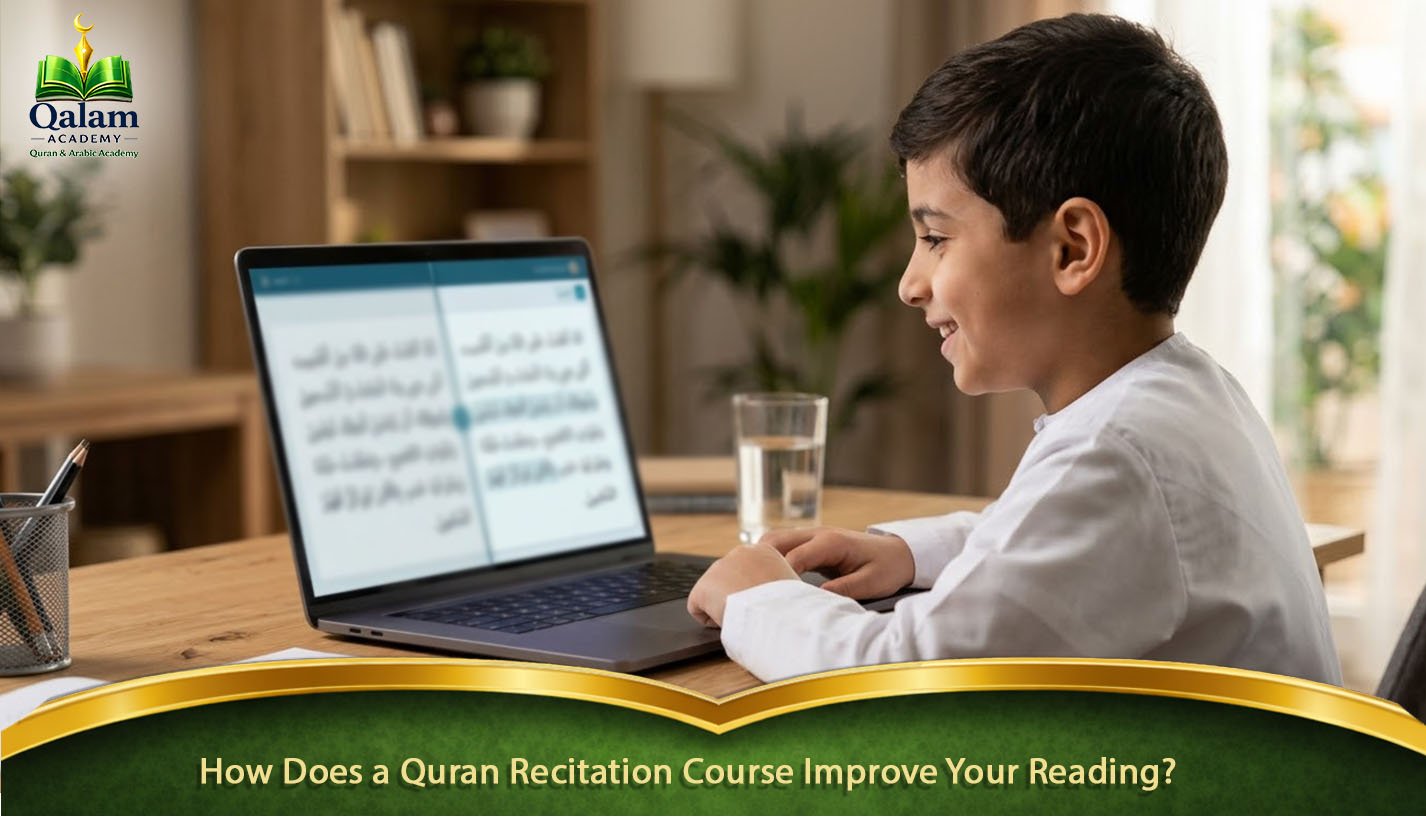
A Quran recitation course is a structured learning program that teaches students how to read and recite the Quran accurately. Depending on the learner’s level, lessons may cover Arabic pronunciation, foundational reading skills, Tajweed rules, and practical recitation exercises.
Unlike independent reading, guided instruction gives learners opportunities to hear correct pronunciation, practise unfamiliar sounds, and receive feedback on their mistakes. This support can be particularly helpful when a student struggles to distinguish between Arabic letters with similar sounds. A structured course may include the following elements:
- Arabic reading foundations: Recognising letters, vowel marks, and basic word patterns.
- Noorani Qaida: Learning foundational reading principles when appropriate for the student’s level.
- Tajweed rules: Understanding the principles that govern correct Quranic recitation.
- Pronunciation practice: Improving articulation and distinguishing between similar Arabic sounds.
- Guided recitation: Reading verses aloud while receiving corrections from a qualified teacher.
- Revision exercises: Revisiting previously studied rules to strengthen accuracy and consistency.
The purpose is not simply to finish lessons quickly. Instead, students should develop skills they can apply when reading different passages of the Quran.
Start Learning with Qalam Online Quran Academy Today
Take the first step toward a stronger connection with the Quran and Islamic knowledge. At Qalam Online Quran Academy, our qualified teachers provide personalised one-on-one classes for children, adults, and beginners. Enjoy flexible schedules, interactive lessons, and a supportive learning environment designed to help you achieve your goals. Begin your Quran learning journey with confidence.

Who Should Join a Quran Recitation Course?
Learners have different starting points, so instruction should reflect their existing knowledge rather than assume everyone needs the same curriculum. A suitable course can support beginners, children, adults, and students who already read Arabic but want to improve their recitation.
Beginners Learning to Read the Quran
Beginners may recognise a few Arabic letters but struggle to combine them into words or read vowel marks correctly. For these students, lessons should establish a reliable foundation before introducing more advanced recitation rules.
A teacher may begin with letter recognition, short vowels, sukoon, and basic word formation. Once the student becomes more comfortable reading Arabic, the lessons can gradually introduce Quranic passages and relevant Tajweed principles. Starting with the basics is not a disadvantage. In fact, correcting foundational mistakes early can make later learning easier.
Children Developing Quran Reading Skills
Children benefit from lessons that match their attention span, reading ability, and stage of development. Short exercises, repetition, and supportive feedback can help them remain engaged without feeling overwhelmed.
Parents should look for instruction that balances structured learning with sufficient practice. Teachers can also help identify recurring pronunciation difficulties and explain how children can practise them between sessions. Additionally, a predictable learning schedule may help children establish a regular Quran reading habit.
Adults Improving Their Recitation
Adults often balance Quran learning with employment, family responsibilities, and other commitments. As a result, flexible online instruction can make it easier to maintain consistent study without travelling to a learning centre.
Some adults need to revisit Arabic reading foundations, while others can already read fluently but want to improve their Tajweed. A suitable Quran recitation course should therefore begin with an assessment of the learner’s current ability. Adults should not assume they are too old to improve. Regular practice, clear explanations, and realistic learning targets can support gradual progress at any age.
Students Who Already Know Arabic
Reading Arabic fluently does not automatically mean that every Tajweed rule is being applied correctly. Some learners need help with articulation points, letter characteristics, elongation, nasalisation, or stopping and restarting appropriately.
For these students, lessons can focus on identifying specific weaknesses rather than repeating material they already understand. This approach makes practice more relevant and helps learners concentrate on the skills that need improvement.
Why Learn Through an Online Quran Recitation Course?
Online learning allows students to receive instruction from home while maintaining direct communication with a teacher. When lessons include active recitation and individual feedback, students can work on specific mistakes instead of relying entirely on self-study.
Learn at a Suitable Pace
Students do not necessarily learn pronunciation rules at the same speed. One learner may quickly understand a rule but need more practice applying it, whereas another may need several explanations before recognising the difference between two sounds.
A suitable learning plan allows the teacher to adjust the pace according to these differences. Consequently, students can spend additional time on difficult topics without feeling pressured to follow a schedule designed for someone else.
Receive Individual Pronunciation Feedback
Listening to recordings can help learners become familiar with correct recitation. Nevertheless, recordings cannot independently identify the mistakes a student makes while reading. A teacher can listen to the learner, identify inaccurate sounds, explain the relevant rule, and provide a practice example. This process helps connect theoretical knowledge with actual recitation.
Study Without Daily Travel
Online lessons remove the need to commute to a physical classroom. This can be particularly useful for families managing school schedules, working adults, and students living far from suitable local teachers. However, convenience alone does not guarantee effective learning. Students still need a quiet environment, a stable internet connection, and sufficient time to practise between lessons.
Maintain a More Consistent Routine
A realistic study schedule is often easier to maintain than an ambitious plan that leaves little room for other responsibilities. Short, focused practice sessions can help students revisit difficult sounds and rules between their scheduled classes.
For example, a learner might review a previous lesson, practise a short passage, and note questions to discuss with the teacher during the next session. Over time, this routine can support more consistent learning.
What Will You Learn in a Quran Recitation Course?

The curriculum should depend on the learner’s current reading ability and educational goals. Nevertheless, several core skills commonly contribute to accurate Quran recitation.
Arabic Letters and Pronunciation
Correct pronunciation begins with understanding how Arabic letters are produced. Learners need to recognise the differences between letters that may sound similar to someone unfamiliar with Arabic phonetics.
For example, certain letters require different tongue positions or articulation points even when their sounds seem close to a beginner. A teacher can demonstrate these differences and help students practise them in words and verses. Students may also review vowel marks, sukoon, shaddah, and other reading signs needed to pronounce words correctly.
Makharij Al-Huruf: Points of Articulation
Makharij Al-Huruf refers to the articulation points from which Arabic letters are produced. Learning these points helps students distinguish between letters and avoid replacing one sound with another.
During lessons, a teacher may explain the relevant position of the tongue, lips, or throat and demonstrate how the sound should be formed. Students can then repeat the sound in isolation before practising it within words. Because some articulation mistakes become habits through repetition, receiving feedback early can be helpful.
Sifat Al-Huruf: Characteristics of Letters
Sifat Al-Huruf describes the characteristics associated with Arabic letters. These characteristics help explain how particular sounds should be produced and distinguished during recitation. Students may learn about qualities such as heaviness, lightness, and other sound characteristics relevant to specific letters. The teacher can then demonstrate how these qualities affect actual Quranic words. Rather than memorising definitions alone, learners should practise recognising and applying the characteristics while reciting.
Essential Tajweed Rules
Tajweed provides the principles used to guide correct Quranic recitation. Its rules help learners pronounce letters accurately, observe appropriate elongations, and apply the required characteristics of particular letter combinations. Depending on the student’s level, lessons may cover:
- Noon sakinah and tanween: Rules governing their pronunciation before different letters.
- Meem sakinah: Rules affecting the pronunciation of a silent meem in specific contexts.
- Ghunnah: Nasalisation where required by the applicable recitation rule.
- Madd: Appropriate elongation of vowel sounds according to the relevant rule.
- Qalqalah: The characteristic sound associated with particular letters under specific conditions.
- Heavy and light pronunciation: Applying the appropriate quality to letters in their Quranic context.
- Waqf and ibtida: Understanding where to stop and how to resume recitation appropriately.
Students should learn these principles through explanation, demonstration, listening, and repeated application. The goal is to understand the rules well enough to use them while reading, rather than merely recalling their names.
Practical Quran Reading and Recitation
Once learners understand the relevant foundations, they need opportunities to apply them in actual Quranic passages. A teacher may ask students to read selected verses, listen for particular pronunciation issues, and repeat sections that require correction.
This process helps learners recognise the difference between knowing a rule and applying it consistently. As their skills develop, students can work toward smoother reading, better control of pronunciation, and more confident recitation.
How Can Qalam Online Quran Academy Support Your Learning?
Qalam Online Quran Academy can be a learning option for students seeking guided Quran instruction online. When evaluating an academy, consider its teaching approach, curriculum, individual feedback, and lesson flexibility. Learners can also develop a consistent worship routine by understanding how to perform salah step by step, alongside improving their Quran recitation. The most appropriate program addresses your current abilities and provides a clear path toward your learning goals.
Choose Lessons That Match Your Level
A beginner should not be expected to apply advanced Tajweed rules before developing the reading skills needed to understand Quranic words. Similarly, an experienced reader may benefit more from targeted corrections than from repeating basic material.
Qalam Online Quran Academy can support learners who want to identify their starting level and establish suitable objectives. Before enrolling, ask how the teacher assesses your reading ability and adapts lessons to your needs.
Focus on Guided Practice
Reading aloud is essential for developing accurate recitation. Therefore, learners should ensure that their lessons provide enough time to practise rather than relying mainly on theoretical explanations.
During each lesson, students should have opportunities to read, receive corrections, repeat difficult sections, and ask questions. In addition, understanding the etiquette of reading the Quran can help learners approach their recitation with appropriate respect and attention.
Set Clear Learning Goals
Progress becomes easier to evaluate when students know which skills they want to improve. Instead of setting a vague goal, such as becoming better at recitation, learners can focus on specific outcomes. Possible goals include:
- Reading Arabic words more accurately.
- Distinguishing between letters with similar sounds.
- Applying selected Tajweed rules correctly.
- Reducing recurring pronunciation mistakes.
- Reading familiar passages with greater consistency.
- Understanding where pauses are appropriate.
Qalam Online Quran Academy should be evaluated according to how well its teaching arrangements support these objectives. Confirm the available curriculum and lesson format before making assumptions about specific services.
What to Look for in a Qualified Quran Teacher?

The quality of instruction matters because students need accurate explanations and useful corrections to develop their recitation. A teacher should have appropriate Quranic knowledge, understand Tajweed principles, and explain difficult concepts clearly.
When comparing learning options, consider the following factors.
Relevant Knowledge and Teaching Ability
A teacher should demonstrate a sound understanding of Quran recitation and Tajweed. However, subject knowledge alone is not enough; effective instruction also requires the ability to identify mistakes and explain how to correct them.
Ask how lessons are structured and whether the teacher adapts explanations to the learner’s age and reading level.
Clear and Respectful Feedback
Corrections should explain what needs to change and how the student can practise the correct pronunciation. General comments such as “read more carefully” are less useful than specific guidance about the letter, sound, or rule involved.
A supportive learning environment also allows students to ask questions without feeling embarrassed about mistakes. Learners can clarify practical questions about preparation, including whether it is permissible to read Quran without wudu, when relevant to their circumstances.
Regular Assessment
Periodic assessment helps students understand which skills have improved and which still need attention. It may involve reading a familiar passage, applying a recently studied rule, or demonstrating a specific pronunciation.
Useful feedback should identify practical next steps rather than focusing only on general praise or criticism.
A Suitable Lesson Schedule
Consistency is easier when lessons fit the student’s responsibilities. Before starting, clarify the available times, lesson duration, attendance expectations, and arrangements for rescheduling.
These details can help families and individual learners decide whether a program is practical for long-term study.
How to Choose the Right Quran Recitation Course for Your Needs?
Not every course is suitable for every learner. Before choosing a program, compare the curriculum, teaching format, level of individual attention, and opportunities to practise recitation. The following checklist can help you make a more informed decision.
Identify your starting level: Determine whether you need Arabic reading foundations or more advanced Tajweed practice.
Define your main goal: Decide whether you want to improve pronunciation, apply Tajweed, or develop more consistent reading.
Review the curriculum: Check whether the lessons cover the skills you need to learn.
Ask about teacher qualifications: Understand the instructor’s relevant training and experience.
Confirm the lesson format: Find out whether you will receive individual or group instruction.
Check scheduling arrangements: Make sure the timetable fits your daily routine.
Understand assessment methods: Ask how the teacher tracks progress and identifies recurring mistakes.
Clarify the learning requirements: Confirm whether you need prior Arabic reading knowledge or can begin with foundational lessons.
When comparing Qalam Online Quran Academy with other learning arrangements, use these criteria to determine whether its actual offerings match your needs. Avoid choosing solely on the basis of broad promises; clear information about teaching methods and student support is more useful.
Beginner and Advanced Quran Recitation Levels
Learners generally need different types of instruction depending on how comfortably they can read Arabic and apply Tajweed. A level-based approach helps ensure that students practise relevant skills instead of moving forward before they are ready.
Beginner Level: Build the Foundations
At this stage, students may need to learn or review Arabic letters, vowel marks, and basic reading patterns. Lessons can also introduce the first Tajweed concepts when the learner is ready to apply them. Practice should emphasise accuracy before speed. Reading slowly and correcting mistakes can help students develop a more reliable foundation. Typical learning activities include:
Recognising Arabic letters and their sounds.
Reading combinations of letters with vowel marks.
Practising simple words and short Quranic passages.
Identifying common pronunciation difficulties.
Reviewing previously learned material.
For children who need additional support with memorisation, parents may also benefit from learning how to help a child memorise the Quran with a weak memory. This guidance addresses memorisation challenges that may require a different approach from recitation practice. A student may need to spend more time on certain skills than others. Progress should therefore depend on demonstrated understanding rather than an arbitrary deadline.
Intermediate Level: Apply Tajweed Rules
Learners who can read Arabic comfortably may be ready to study more detailed Tajweed principles. At this level, the teacher can introduce specific rules and help students recognise where they apply in Quranic passages.
Students should practise each rule in context and receive corrections when their reading does not reflect the required pronunciation. Regular revision is also useful because learners may understand a rule during explanation but forget to apply it while reading continuously.
Advanced Level: Refine Accuracy and Consistency
More experienced readers may need to focus on subtle pronunciation issues, consistent application of Tajweed, and appropriate stopping points. Lessons can target recurring mistakes and passages that require particular attention. Students may also benefit from discussing why a rule applies in a specific context instead of memorising isolated examples.
Advanced learning should remain practical. Even a reader who knows many rules may need continued feedback to apply them consistently. For learners interested in developing broader language skills alongside Quran study, exploring the best way to learn Arabic conversation online may help them identify a suitable approach to spoken Arabic.
Common Mistakes to Avoid When Learning Quran Recitation
- Reading Quickly Before Mastering Pronunciation
Speed should not be the main measure of progress. Reading quickly while repeating incorrect sounds can reinforce mistakes and make them harder to correct later.
Instead, practise at a pace that allows you to pronounce each word carefully. Increase your speed gradually as accuracy becomes more consistent. - Memorising Tajweed Rules Without Applying Them
Knowing a rule’s definition does not necessarily mean you can recognise and apply it while reciting. Students need repeated practical examples to connect theoretical explanations with actual reading. During lessons, ask the teacher to demonstrate the rule and identify examples in the passage you are studying. - Ignoring Small Pronunciation Differences
Arabic contains letters that may sound similar to inexperienced readers but require different articulation. Treating these sounds as interchangeable can affect the accuracy of recitation. Listen carefully to demonstrations, practise the relevant sounds, and request specific feedback whenever the distinction remains unclear. - Practising Without Reviewing Previous Corrections
Moving to new material without revisiting earlier mistakes can make progress less consistent. Short review sessions help reinforce the corrections made during class. Before beginning a new passage, spend a few minutes practising the sounds and rules that previously caused difficulty. - Expecting Immediate Mastery
Every learner has different strengths, challenges, and opportunities to practise. Some concepts may become familiar quickly, while others require repeated explanation and correction.
Set realistic goals and evaluate progress through improved accuracy and more consistent application of the rules. Avoid judging your ability solely by how quickly you complete a course.
How to Practise Between Quran Recitation Course Lessons?
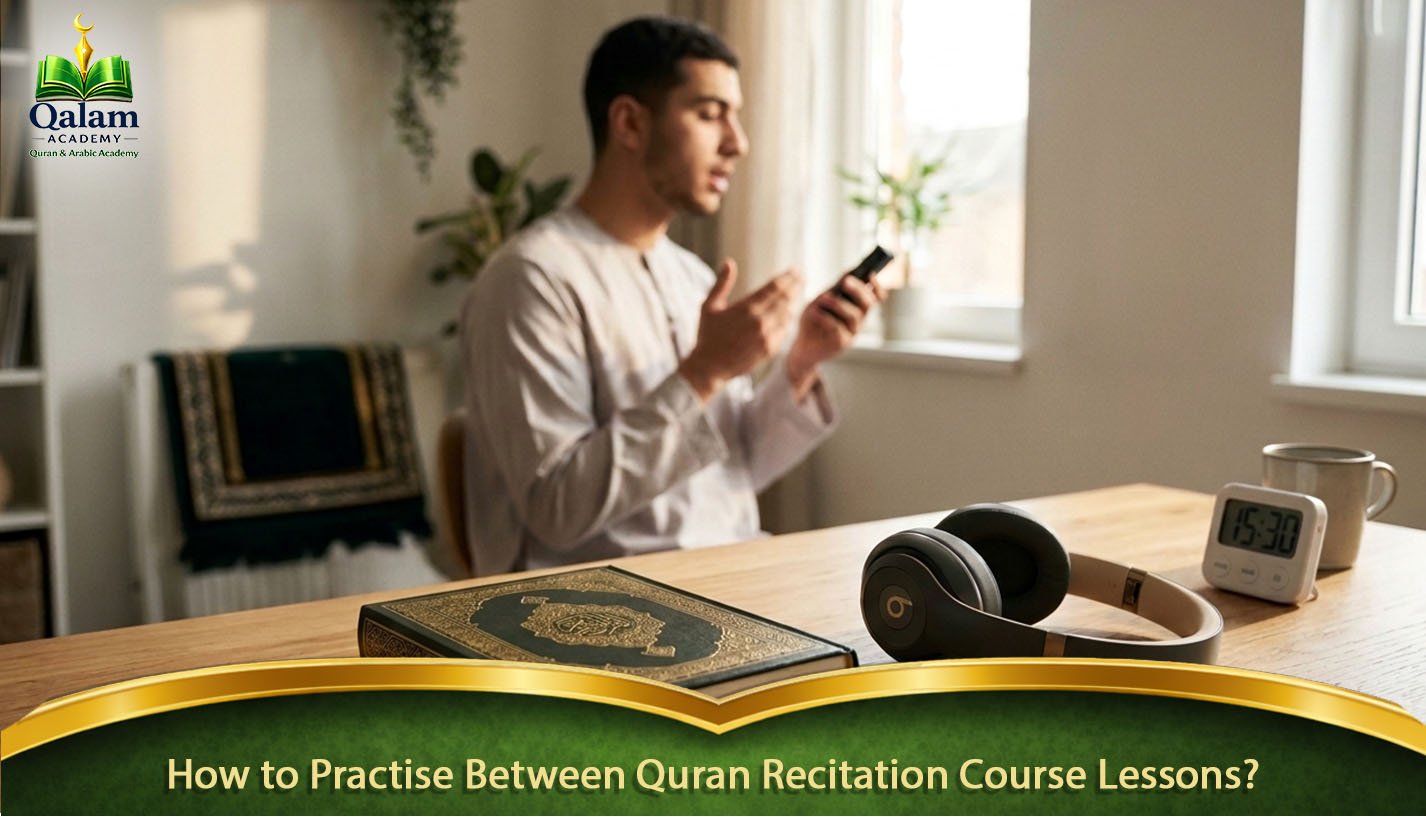
Progress depends not only on attending classes but also on how students use the time between lessons. A short, focused routine can help reinforce new skills without making Quran study feel difficult to maintain.
Review Previous Quran Recitation Course Lessons
Begin by revisiting the rule or pronunciation point covered in your most recent class. Read the teacher’s notes, listen to any permitted reference recording, and identify the part that requires additional practice. This review helps keep earlier material familiar while you learn new concepts.
Practise Quran Recitation with Manageable Passages
Choose a passage that fits your current reading ability. Read it slowly and pay attention to the specific rule you are practising. If you repeatedly make the same mistake, isolate the difficult word or sound and practise it before returning to the full passage. Avoid rushing simply to complete more verses.
Improve Quran Recitation by Listening and Comparing
Listening to reliable Quran recitations can help you become familiar with accurate pronunciation and rhythm. Nevertheless, listening should complement active reading rather than replace it. Try to identify the rule being applied, then practise the same passage yourself. Ask your teacher to clarify any sound or rule you cannot confidently reproduce.
Track Mistakes During Quran Recitation Practice
Write down the errors your teacher identifies and revisit them during practice. For instance, you might record difficulty distinguishing two letters or forgetting a particular elongation rule. Reviewing this list before each lesson can make feedback more focused. Over time, you may notice that certain mistakes become less frequent while other skills require additional attention.
Build a Consistent Quran Recitation Course Schedule
A consistent routine is generally more practical than occasional, lengthy practice sessions. Choose a time that fits your responsibilities and set a manageable target. The ideal schedule depends on your circumstances and the amount of guidance you need. If you struggle to maintain your routine, discuss a more realistic practice plan with your teacher.
Frequently Asked Questions About Quran Recitation Courses
Find answers to common questions about Quran recitation courses, including Tajweed learning, pronunciation, lesson preparation, and progress.
1. Can I learn Quran recitation if Arabic is not my first language?
Yes. Non-Arabic speakers can learn Quran recitation through structured instruction that explains Arabic letters, pronunciation, and reading patterns. The time needed to develop these skills depends on the learner’s starting level, practice routine, and access to useful feedback.
2. Should I learn one Tajweed rule at a time?
Learning one rule at a time can make the material easier to understand, especially for beginners. However, students should gradually practise previously learned rules alongside new ones so they can apply them together during continuous recitation.
3. How can I tell whether my Quran recitation is improving?
Look for practical changes, such as fewer repeated pronunciation mistakes, more accurate application of studied rules, and greater consistency when reading familiar passages. Feedback from a qualified teacher can help you identify improvements that may be difficult to notice independently.
4. What should I prepare before my first online Quran lesson?
Prepare a quiet place, a stable internet connection, and any Quran or learning materials requested by your teacher. If you already read Arabic, be ready to demonstrate your current ability so the instructor can identify an appropriate starting point.
In conclusion, A Quran recitation course can help you improve pronunciation, apply Tajweed rules correctly, and develop greater confidence when reading the Quran. With regular practice and guidance from a qualified teacher, you can identify mistakes, strengthen your recitation, and build a consistent learning routine that fits your schedule.
At Qalam Online Quran Academy, learners can receive structured instruction and personalised feedback based on their current level and learning goals. Whether you are a beginner or looking to refine your recitation, choosing the right course can help you make steady progress. Start your learning journey with Qalam Online Quran Academy and take a practical step toward more accurate, confident, and mindful Quran recitation.