


The virtues of Surah Al-Kahf on Friday are a topic that many Muslims search for when they want to understand why this particular Surah is associated with Jumu’ah and how they can make its recitation part of their weekly worship. At Qalam Online Quran Academy, learners can explore the meaning and guidance of Surah Al-Kahf while developing a deeper connection with the Quran. Surah Al-Kahf is the eighteenth chapter of the Quran, and it contains powerful stories about faith, trials, knowledge, wealth, and authority.
For many families, Friday provides a valuable opportunity to slow down, reconnect with the Quran, and create meaningful Islamic routines. Therefore, reading Surah Al-Kahf can become more than a weekly reading habit. It can also encourage reflection, discussion, and a stronger relationship with Allah.
This guide explains the virtue of Surah Al-Kahf on Friday, the evidence for its recitation, the major lessons throughout the Surah, and practical ways adults and children can benefit from it.
Why Is the Virtue of Surah Al-Kahf on Friday Important?
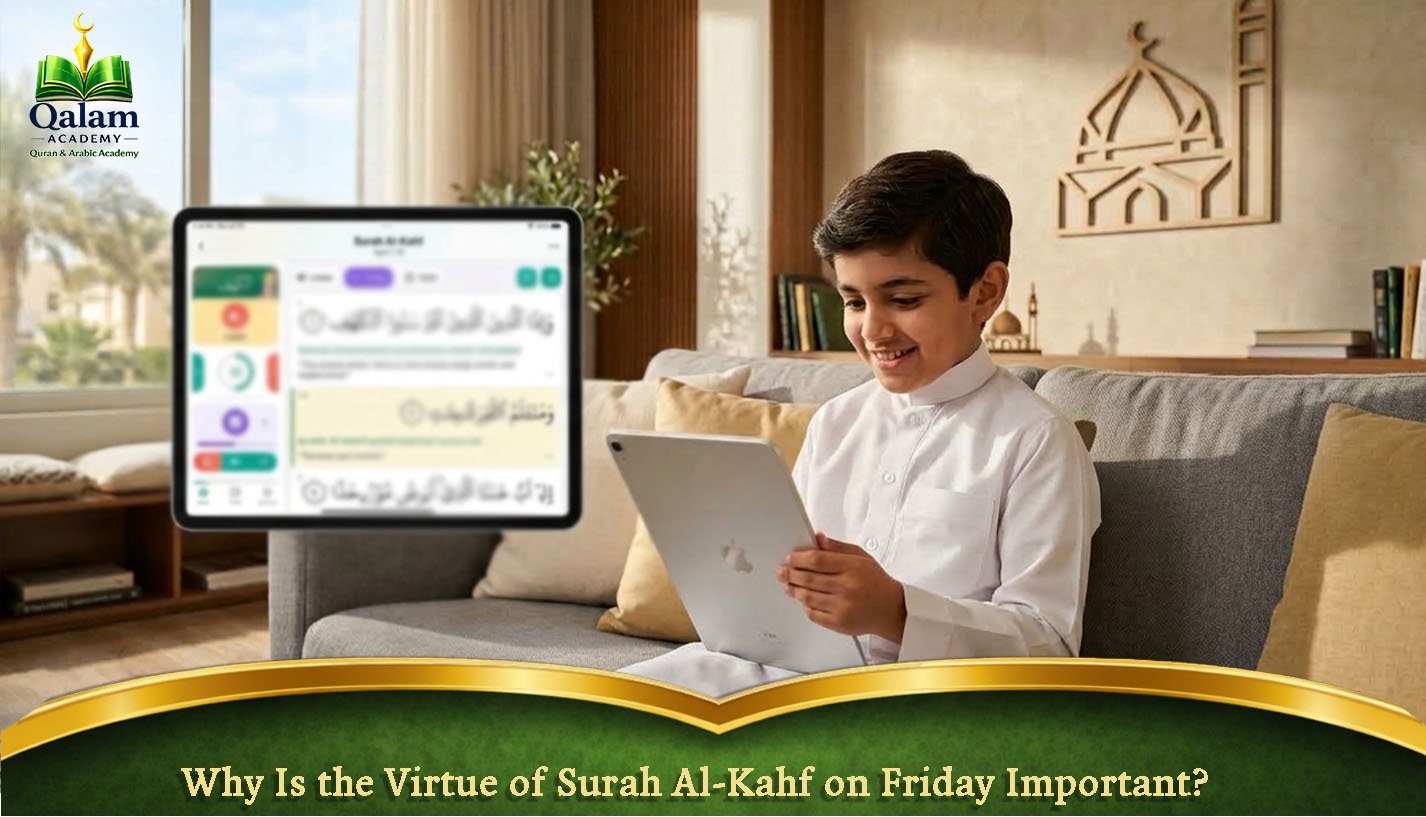
The virtue of Surah Al-Kahf on Friday is connected to reports about reciting this Surah during the period associated with Friday. Muslims have traditionally given special attention to Surah Al-Kahf because authentic and accepted scholarly discussions mention a special light associated with its recitation.
Moreover, Friday itself has a special position in Islam. It is the day of Jumu’ah, when Muslims gather for congregational prayer, remember Allah, send blessings upon the Prophet Muhammad ﷺ, and increase their acts of worship.
Consequently, adding Quran recitation to this day creates a meaningful spiritual routine. Instead of treating Friday as only a weekly break from work or school, a Muslim can use it as an opportunity for reflection and renewal.
For families, this practice can also become educational. Parents can explain the stories of the Surah, discuss their lessons, and encourage children to approach the Quran with curiosity rather than seeing recitation as a task that must simply be completed.
Start Learning with Qalam Online Quran Academy Today
Take the first step toward a stronger connection with the Quran and Islamic knowledge. At Qalam Online Quran Academy, our qualified teachers provide personalized one-on-one classes for children, adults, and beginners.
Enjoy flexible schedules, interactive lessons, and a supportive learning environment designed to help you achieve your goals. Begin your Quran learning journey with confidence.

What Is the Main Virtue of Surah Al-Kahf on Friday?
One of the most frequently mentioned aspects of the virtue of Surah Al-Kahf on Friday is the narration concerning light between two Fridays. A report attributed to the Prophet ﷺ states that whoever recites Surah Al-Kahf on Friday will have light between the two Fridays.
This narration gives Muslims a reason to maintain the practice while remembering that the Quran should be approached with sincerity and reflection. The objective is not merely to finish a specific number of pages as quickly as possible. Instead, the reader should seek guidance, remember Allah, and consider how the Quran applies to real situations.
At the same time, Muslims should distinguish between established virtues and claims that are not supported by reliable evidence. The special merit associated with Surah Al-Kahf should therefore be discussed carefully.
Light Between Two Fridays
The description of light is one of the most recognizable elements associated with this practice. Rather than understanding the concept only in a physical sense, Muslims can reflect on the broader spiritual meaning of guidance, clarity, and steadfastness.
The Quran repeatedly describes divine guidance as light. Therefore, weekly recitation can remind a believer to seek Allah’s guidance when making decisions, facing difficulties, or dealing with uncertainty.
A Weekly Opportunity for Reflection
Another important benefit is the opportunity to create a recurring moment for reflection. Modern life can easily become crowded with work, study, family responsibilities, and digital distractions.
However, setting aside time for Surah Al-Kahf every Friday creates a simple spiritual checkpoint. A person can pause, recite, think about the meanings, and evaluate whether their actions reflect the values taught by the Quran.
What Does Surah Al-Kahf Teach About Life’s Trials?
The virtue of Surah Al-Kahf on Friday becomes easier to appreciate when readers examine its major narratives. The Surah presents several stories that deal with different forms of testing.
These stories are not simply historical accounts. Instead, they encourage readers to think about how faith can be affected by pressure, wealth, knowledge, power, and uncertainty.
Among the central themes are:
- The trial of faith.
- The trial of wealth.
- The trial of knowledge.
- The trial of power.
- The importance of humility.
- Dependence upon Allah.
- Patience during difficult circumstances.
- Awareness of the temporary nature of worldly life.
As a result, reading the Surah can become an exercise in self-reflection. A reader can ask which of these trials appears in their own life and whether they respond to it with faith, patience, and gratitude.
The People of the Cave and the Trial of Faith
The story of the People of the Cave is one of the most recognizable narratives in Surah Al-Kahf. A group of young believers faced a society in which their faith was threatened, so they sought refuge in a cave and placed their trust in Allah.
Their story highlights the seriousness of protecting one’s faith. It also demonstrates that remaining committed to religious principles can require courage when circumstances become difficult.
For young Muslims, this story can be especially meaningful. Parents and teachers can use it to discuss peer pressure, personal values, and the importance of making principled decisions.
Furthermore, the story demonstrates that young age does not prevent someone from having strong faith. The Quran presents these young believers as people who stood firmly for what they believed.
The Two Gardens and the Trial of Wealth
The story of the two gardens introduces another kind of test: material success. The wealthy man becomes impressed by what he owns and fails to maintain the humility and gratitude expected from a believer.
This narrative offers an important reminder for modern readers. Wealth itself is not presented as inherently evil. Rather, the problem arises when possessions create arrogance, ingratitude, or an illusion of permanent security.
Therefore, the story encourages Muslims to ask how they view their possessions.
- Do they see them as gifts from Allah?
- Do they remember that worldly success can change?
- Do they use what they have responsibly?
These questions make the story highly relevant to contemporary life. Social media often encourages people to compare homes, careers, cars, travel, and lifestyles. Surah Al-Kahf reminds readers that outward success does not determine a person’s true worth.
Musa and Khidr: Lessons About Knowledge and Patience
The encounter between Musa (peace be upon him) and Khidr provides another profound lesson. It demonstrates that human knowledge has limits and that people may not immediately understand the wisdom behind certain events.
Although Musa (peace be upon him) was a great prophet, this story teaches readers the importance of patience and reminds them that a person may not always understand the full wisdom behind what happens at a particular moment.
This lesson is particularly useful when someone experiences an event that seems confusing or unfair. A believer may not understand every reason behind a situation, but faith encourages patience and trust in Allah’s wisdom.
For students, this story also presents an important attitude toward learning. Knowledge should encourage humility rather than arrogance. A person who knows a great deal still has much to learn.
Dhul-Qarnayn and the Trial of Power
The account of Dhul-Qarnayn introduces another major theme: authority. He was given means and power, yet the story portrays his response through justice, responsibility, and recognition of Allah’s favor.
This provides an important contrast with the misuse of power. Authority can be used for personal advantage, or it can become a means of protecting and helping others.
Consequently, the story is valuable for parents teaching children about leadership. A child can learn that being a leader does not mean controlling everyone. Instead, responsible leadership involves fairness, accountability, and service.
The narrative also reinforces a central Quranic principle: success should lead to gratitude rather than pride.
How Does the Surah Help Muslims Deal With Modern Temptations?

The virtue of Surah Al-Kahf on Friday is not limited to a historical setting. Its themes remain relevant because the human challenges described in the Surah continue to appear in different forms.
For example, the trial of wealth can appear through consumerism. The trial of faith can appear through social pressure. The trial of knowledge can appear through intellectual pride. Likewise, the trial of power can appear in family relationships, workplaces, communities, or positions of authority.
Because of this, reading the Surah regularly can encourage believers to recognize these challenges before they influence their decisions.
A useful approach is to connect each story to a practical question:
- Am I grateful for what Allah has given me?
- Do I protect my faith when others pressure me?
- Am I patient when I do not understand something?
- Do I use authority fairly?
- Do I remember that worldly life is temporary?
These questions transform recitation into reflection.
Virtue of Surah Al-Kahf on Friday and Protection From Dajjal
The connection between Surah Al-Kahf and the trial of the Dajjal is another important reason Muslims study this Surah. Authentic hadith reports mention the protection connected with memorizing the opening verses of Surah Al-Kahf in relation to the trial of the Dajjal.
This subject should be presented carefully. The reports concerning the opening and closing verses have specific wording, while the narration about reciting the Surah on Friday concerns the special light associated with that practice.
Therefore, Muslims should avoid combining different narrations into one claim.
Nevertheless, studying Surah Al-Kahf can strengthen a believer’s awareness of deception and trials. Its stories repeatedly encourage people to distinguish truth from appearance and faith from worldly temptation.
How Can Families Practice Surah Al-Kahf on Friday?
The virtue of Surah Al-Kahf on Friday can become part of a family routine without turning the experience into a stressful obligation.
Parents can choose a calm period during the Friday window and make Quran recitation part of the household atmosphere. Younger children may listen first, while older children can participate in reading.
A practical family routine may include:
- Choose a regular time for Quran recitation.
- Read a manageable portion together.
- Allow children to take turns.
- Explain unfamiliar vocabulary.
- Discuss one lesson from the Surah.
- Encourage children to connect the lesson with everyday situations.
- End with a short dua.
This approach makes Quran learning interactive. More importantly, it helps children associate Friday with worship, family connection, and reflection.
Making Surah Al-Kahf Meaningful for Children
Children may sometimes struggle with long Quranic passages because they focus on pronunciation before understanding the broader message. Parents can make the experience more engaging by introducing the stories before discussing detailed explanations.
For instance, ask a child what they think makes someone strong in faith. Later, connect their answer to the People of the Cave.
Similarly, discuss gratitude before introducing the story of the two gardens. When discussing Musa and Khidr, ask why patience can be difficult when we do not understand what is happening.
These conversations allow children to discover lessons naturally.
Qalam Online Quran Academy can also support families that want structured Quran education. A consistent learning environment can help children improve recitation while gradually developing a deeper understanding of Quranic teachings.
How Can Qalam Online Quran Academy Support Quran Learning?
For families seeking structured Quran education, Qalam Online Quran Academy can provide a learning environment where students work on their Quran skills with organized lessons.
Rather than treating Quran learning as something limited to a single day, students can build regular habits throughout the week. Then, Friday recitation can become part of a broader relationship with the Quran.
Qalam Online Quran Academy can also be relevant for parents who want their children to develop confidence in reading Quran. Regular practice, appropriate instruction, and encouragement can make a significant difference in a child’s progress.
Furthermore, parents can reinforce what children learn in lessons by asking them about Quranic stories at home. This creates continuity between formal learning and family life.
Virtue of Surah Al-Kahf on Friday: Recitation or Understanding?
Some Muslims wonder whether the main objective should be completing the Surah or understanding its meanings. Ideally, both should have a place.
Recitation is an act of worship, while reflection allows the reader to benefit from the guidance contained in the verses. Therefore, a Muslim should not think of these as competing goals.
If time is limited, a person can still establish a meaningful habit by reciting the Surah and returning later to study its explanations.
Additionally, listening to a qualified reciter can help someone who is still improving their reading skills. However, listening should not be presented as identical to personally reciting the Surah when discussing the specific virtue associated with recitation.
The most valuable routine is one that encourages consistency without sacrificing sincerity or understanding.
Is Surah Al-Kahf Only for Adults?
No. The themes of Surah Al-Kahf can be introduced to children in age-appropriate ways. However, parents should avoid overwhelming young children with complex explanations.
Instead, focus on simple ideas such as:
- Staying firm when faith is challenged.
- Being grateful for blessings.
- Avoiding arrogance.
- Being patient when answers are not immediate.
- Using power responsibly.
- Remembering Allah during difficult situations.
Older children can explore more detailed interpretations and discuss the relationship between the stories. Parents can also introduce related Islamic learning topics, such as the 99 names of Allah and their meanings, to help children build a broader understanding of Islamic teachings.
With proper guidance, the weekly practice can become a family tradition that grows with the child.
How to Build a Consistent Friday Quran Routine?

The virtue of Surah Al-Kahf on Friday becomes easier to appreciate when recitation is connected to a realistic routine. Many people begin with enthusiasm but stop because they choose a time that does not fit their schedule.
A better strategy is to attach Quran recitation to an existing Friday habit.
For example, a family might read after breakfast, before leaving for Jumu’ah, or during a quiet period later in the day. The exact time can vary according to the household. Those developing a regular Quran routine may also benefit from learning whether you can you really learn quran online effectively through structured lessons and consistent practice.
Consistency matters more than creating an elaborate routine.
A simple weekly plan could look like this:
- Thursday evening: Prepare the Quran and choose a quiet time.
- Friday morning: Recite individually or as a family.
- Before Jumu’ah: Reflect on one lesson.
- After prayer: Discuss how the lesson applies to daily life.
- During the week: Revisit one memorable verse or story.
This method helps keep the practice connected to everyday faith.
Common Mistakes When Discussing the Virtue of Surah Al-Kahf on Friday
When researching Islamic topics online, readers may encounter statements that combine authentic reports with unsupported claims. Therefore, it is important to verify religious information before sharing it.
Some common mistakes include:
- Claiming that every benefit mentioned online is established by hadith.
- Presenting personal experiences as religious evidence.
- Confusing the virtue of Friday recitation with the hadith about memorizing verses for protection from Dajjal.
- Treating listening as exactly equivalent to recitation.
- Focusing entirely on rewards while ignoring reflection.
- Using weak or unsourced narrations without clarification.
A careful article should distinguish between established religious evidence, scholarly interpretation, and personal advice.
For learners, Qalam Online Quran Academy can be part of a broader educational approach in which Quran reading is accompanied by proper instruction and understanding. Those interested in beginning a new Islamic journey can also explore how to convert to Islam step by step for further guidance.
Virtue of Surah Al-Kahf on Friday and the Meaning of Jumu’ah
Friday is not simply another day on the Islamic calendar. Jumu’ah provides Muslims with a recurring opportunity to gather, worship, listen to the khutbah, pray, remember Allah, and renew their spiritual priorities.
Within that atmosphere, Quran recitation has a natural place.
The practice of reading Surah Al-Kahf can therefore complement other Friday acts of worship. Muslims can combine it with sending salawat upon the Prophet ﷺ, making dua, attending Jumu’ah prayer, and maintaining other established Sunnah practices. Preparing for other important acts of worship can also encourage Muslims to learn how to perform umrah step by step when planning their pilgrimage.
Importantly, the Quran should not be approached as a checklist. The purpose of worship is to develop sincerity and strengthen the relationship between the servant and Allah.
Can Surah Al-Kahf Change the Way We Think About Worldly Life?
One of the strongest themes running through the Surah is the temporary nature of worldly possessions and achievements. The story of the two gardens makes this especially clear.
A person may possess wealth, status, knowledge, or influence today, yet circumstances can change quickly.
Therefore, the Surah encourages a balanced outlook. Muslims can work, study, earn money, build families, and pursue beneficial goals while remembering that worldly life is not the final destination.
This perspective can reduce unhealthy attachment to material success.
For young people especially, such lessons are valuable because modern culture often measures success through appearance, popularity, possessions, or financial achievement. Quranic guidance offers a different standard based on faith, gratitude, responsibility, and righteous action.
Virtue of Surah Al-Kahf on Friday: A Practical Reflection Guide
After completing the Surah, readers can spend a few minutes answering simple questions. This turns weekly recitation into an opportunity for personal growth.
Consider asking:
- What trial am I facing right now?
- Perhaps it is financial pressure, family difficulty, uncertainty about the future, or pressure from other people.
- Which story in Surah Al-Kahf relates most closely to my situation?
- Identifying a connection can make the Quran feel more relevant to everyday life.
- What attitude should I develop?
- The answer may be patience, gratitude, humility, courage, or reliance upon Allah.
- What action can I change this week?
- Reflection becomes more powerful when it leads to practical improvement.
For learners who want to strengthen their Quran study habits, exploring whether they can memorize the Quran without a teacher can also help them think about the role of structured guidance and personal practice in their learning journey.
Why Should Parents Teach Children the Meaning Behind Quran Stories?
Simply asking children to repeat words may help with memorization, but understanding gives those words a stronger place in their lives.
Surah Al-Kahf offers several stories that are suitable for meaningful family discussions. Parents can explain the characters, challenges, decisions, and lessons without making the conversation feel like a school assignment.
For example, a parent might ask, “What would you do if everyone around you disagreed with your faith?” Another question could be, “Why should a person remain grateful when they become successful?”
Such questions help children think about Quranic values rather than merely memorizing information.
With structured Quran education from Qalam Online Quran Academy, parents can reinforce this approach by encouraging children to connect their lessons with their Friday routine.
Virtue of Surah Al-Kahf on Friday: Building a Lifelong Habit
A weekly Quran habit can have value beyond the immediate act of recitation. Over time, it can create a rhythm that children and adults associate with Friday.
The goal is not to make the practice complicated. Instead, consistency should be simple enough to continue during busy weeks.
A family can begin with a calm reading environment, remove unnecessary distractions, and encourage every member to participate according to their ability.
Older children may read independently. Younger children may listen or read selected portions with help. Adults can take responsibility for explaining unfamiliar concepts.
Eventually, Friday Quran time can become a cherished family tradition.
How Qalam Online Quran Academy Fits Into a Family Quran Journey?
Qalam Online Quran Academy can complement a family’s efforts by giving learners a structured place to improve their Quran reading and develop stronger learning habits.
However, formal lessons should not replace family involvement. Parents still play an important role in creating an environment where Quran recitation feels meaningful.
A child who sees parents reading, reflecting, and respecting the Quran is more likely to understand that Quran learning is part of everyday life.
Therefore, combining regular instruction with family practice can create a balanced approach. During the week, students can work on their skills. On Friday, the family can create additional time for Quran recitation and reflection.
Virtue of Surah Al-Kahf on Friday: Final Takeaway
The virtue of Surah Al-Kahf on Friday gives Muslims an opportunity to combine regular Quran recitation with reflection on some of the most important tests human beings face.
The Surah discusses faith, wealth, knowledge, power, patience, humility, and the temporary nature of worldly life. These themes remain relevant because Muslims continue to encounter similar challenges in different forms.
Most importantly, the weekly practice should not become a race to finish the Surah. Instead, Muslims can approach it with sincerity, careful recitation, reflection, and a desire to apply its lessons.
Parents can also turn Friday recitation into a meaningful educational experience for their children. By discussing the stories and encouraging questions, they can help young learners develop a deeper relationship with the Quran.
For families seeking structured Quran education throughout the week, Qalam Online Quran Academy can support the broader goal of developing consistent Quran learning habits.
Frequently Asked Questions About the Virtue of Surah Al-Kahf on Friday
cover common questions about its virtues, the best time to read it, and the guidance Muslims can gain from reciting it on Friday.
1. Is there a specific dua to say after completing Surah Al-Kahf?
No universally established dua must be recited specifically after completing Surah Al-Kahf. A Muslim may make personal dua and ask Allah for guidance, forgiveness, steadfastness, and beneficial knowledge.
2. Does reading Surah Al-Kahf have to be done from a physical Mushaf?
No. A person may recite the Quran from a Mushaf or an electronic device. What matters is maintaining proper respect for the Quran and focusing on sincere worship rather than the type of device used.
3. Can someone who is learning Arabic still benefit from reading Surah Al-Kahf?
Yes. A learner can recite the Surah while gradually improving pronunciation and understanding. Studying vocabulary and a reliable translation can also help the learner appreciate its meanings more deeply.
4. How can a busy Muslim avoid turning Friday Quran reading into a rushed task?
Planning ahead can help. Choosing a suitable period, reducing distractions, and dividing learning and reflection throughout the day can make the practice more manageable. The aim should be sincere worship rather than simply completing a reading as quickly as possible.
In conclusion, the virtue of Surah Al-Kahf on Friday is closely connected with the special place of this Surah in Friday worship and with narrations describing light between one Friday and the next. Beyond the reported virtue, the Surah offers profound guidance about the trials of faith, wealth, knowledge, and power.
Its stories encourage believers to remain humble, patient, grateful, and conscious of Allah. Furthermore, they provide parents with valuable opportunities to teach children how Quranic guidance relates to real-life situations.
In conclusion, Friday can become a weekly opportunity to reconnect with the Quran rather than simply another day of the week. Reading Surah Al-Kahf, reflecting on its lessons, and maintaining consistent Quran learning can help families build a stronger spiritual routine.
Whether you read independently, practice with your family, or continue structured learning through Qalam Online Quran Academy, the most important goal is to approach the Quran with sincerity, respect, and a willingness to live according to its guidance.