


Online Quran classes in the UK offer a convenient way for children, adults, and beginners to learn Quran recitation, improve pronunciation, understand Tajweed, and build a consistent learning routine from home. With live online lessons, learners can receive direct guidance, practise regularly, and work toward goals that match their current abilities.
Choosing suitable Quran lessons involves more than finding an available teacher. Learners also need a clear curriculum, constructive feedback, an appropriate lesson pace, and enough opportunities to practise between sessions. Parents may prioritise a supportive learning environment for their children, while adult students often look for flexible lessons that fit around work and family responsibilities.
At Qalam Online Quran Academy, learners can explore an approach to Quran education that focuses on individual needs, steady progress, and the development of sound recitation habits. Whether you are starting with Arabic letters or refining your existing recitation, a structured learning plan can help you understand what to practise and how to improve.
How Do Online Quran Classes in the UK Support Learners?

Learning the Quran online gives students access to guided instruction without requiring regular travel to a physical learning centre. Consequently, families can organise lessons around school schedules, and adults can study alongside their professional and personal commitments.
However, convenience alone does not determine the quality of a learning experience. Students benefit most when lessons include active participation, opportunities to read aloud, and feedback that addresses their specific difficulties. The main advantages of online Quran learning include:
- Learning from home: Students can attend lessons in a familiar environment with a suitable device and reliable internet connection.
- Individual attention: One-to-one instruction allows the teacher to focus on a learner’s pronunciation, reading level, and learning pace.
- Structured practice: A clear plan helps students balance new material with revision.
- Flexible scheduling: Lesson arrangements can be discussed according to availability and the learner’s routine.
- Access to different learning goals: Students can focus on Quran reading, Tajweed, memorisation, or revision according to their needs.
For these reasons, Online Quran classes in the UK can be particularly useful for families who want to introduce their children to Quran learning while maintaining their regular home routines.
Nevertheless, students should consider the teaching approach, communication arrangements, and expected learning outcomes before choosing a course. A convenient schedule is valuable, but consistent instruction and practice remain essential.
Start Learning with Qalam Online Quran Academy Today
Take the first step toward a stronger connection with the Quran and Islamic knowledge. At Qalam Online Quran Academy, our qualified teachers provide personalised one-on-one classes for children, adults, and beginners.
Enjoy flexible schedules, interactive lessons, and a supportive learning environment designed to help you achieve your goals. Begin your Quran learning journey with confidence.

Online Quran Classes in the UK for Children
Children often need a different teaching approach from adult learners. Their lessons should reflect their reading ability, attention span, confidence, and familiarity with Arabic letters. Therefore, parents should look for a programme that introduces new concepts gradually rather than expecting children to master several skills at once.
At Qalam Online Quran Academy, parents can explore Quran learning options that suit their children’s starting levels and educational goals.
Building Arabic Reading Foundations
Children who are unfamiliar with Arabic should begin by recognising letters and understanding their different sounds. After that, they can practise letter combinations, short vowels, and the basic patterns needed to read Arabic words. A suitable learning sequence may include:
- Recognising Arabic letters and distinguishing similar-looking shapes.
- Practising the sounds of individual letters.
- Learning short vowels and other essential reading signs.
- Joining letters to form simple words.
- Reading short Quranic passages with guidance.
- Revisiting difficult letters and combinations regularly.
Importantly, children should have enough time to practise each skill before moving forward. If a child repeatedly confuses two letters, additional examples and focused listening practice may be more helpful than introducing a large amount of new material.
Helping Children Stay Engaged During Lessons
Online learning works best when children participate actively. Rather than listening for the entire session, they should have opportunities to repeat sounds, read short passages, answer questions, and demonstrate what they have learned.
Parents can support this process by preparing a quiet study space, checking the internet connection, and helping the child arrive on time. Younger learners may also benefit from appropriate parental supervision, especially when they need help using the learning device.
At the same time, encouragement should focus on effort and improvement rather than perfection. A child who feels comfortable asking questions is more likely to communicate difficulties and develop confidence gradually.
Online Quran Classes in the UK for Adults and Beginners
Adults may start learning the Quran for several reasons. Some have never studied Arabic reading, while others can read familiar passages but want to correct pronunciation or improve their understanding of Tajweed.
A useful starting point is an assessment of the learner’s current ability. This helps identify whether the first priority should be Arabic letters, reading fluency, pronunciation, or more advanced recitation practice.
Starting from the Basics
Adult beginners do not need to feel embarrassed about learning fundamental skills later in life. Instead, they can approach the process as a series of manageable steps. A beginner’s learning plan may cover:
- Recognising Arabic letters and their sounds.
- Understanding short vowels and basic reading signs.
- Combining letters and reading simple words.
- Practising connected Arabic reading.
- Applying the foundations to short Quranic passages.
- Reviewing mistakes and strengthening reading fluency.
Although progress varies from one learner to another, regular practice can help reinforce the relationship between written Arabic and its pronunciation.
Improving Existing Reading Skills
Learners who already read the Quran may need more targeted instruction. For example, they might struggle with particular letter articulation points, vowel lengths, or the consistent application of Tajweed rules.
In these circumstances, the teacher can listen to the learner’s recitation, identify recurring errors, and recommend specific exercises. As a result, practice becomes more purposeful than simply repeating an entire passage without understanding which aspects require attention.
Online Quran classes in the UK can accommodate both starting points when the course is organised around the learner’s actual level rather than a fixed assumption about previous knowledge.
How to Choose the Right Online Quran Teacher in the UK?

Selecting a suitable teacher is an important part of the learning process. A teacher should be able to explain concepts clearly, listen carefully to recitation, identify errors, and adjust instruction when a learner needs more practice.
Before enrolling, consider the following points.
1. Teaching qualifications and experience
Ask about the teacher’s Quranic education, Tajweed knowledge, teaching experience, and ability to work with the relevant age group. If you require a particular qualification or recitation tradition, clarify this before lessons begin.
2. Assessment of the learner’s level
A suitable learning plan should reflect what the student can already do. Beginners may need foundational reading instruction, whereas experienced readers may require detailed correction.
3. Clear feedback
Students should understand what they did correctly, which mistakes need attention, and how to practise between lessons. General praise is encouraging, but specific feedback makes improvement easier to follow.
4. A suitable teaching pace
Lessons should provide enough challenge to support progress without introducing too many unfamiliar concepts at once. Children, adult beginners, and advanced readers may need different approaches.
5. Communication and scheduling
Confirm how lessons are arranged, how schedule changes are handled, and what happens if a student cannot attend. Families should also understand how parents can communicate with the teacher about a child’s progress.
6. A clear curriculum
Ask what the course covers and how progress is reviewed. A structured programme should make the learning objectives understandable rather than relying on vague promises.
When comparing Online Quran classes in the UK, these practical details offer a more reliable basis for decision-making than promotional claims alone.
What Can You Learn in Online Quran Classes in the UK?
The right course depends on the learner’s objectives. Before registering, it is helpful to distinguish between reading instruction, recitation improvement, Tajweed, memorisation, and revision. Although these areas overlap, each requires a slightly different learning focus.
Quran Reading and Recitation
Quran reading lessons help students develop the skills needed to read Arabic text accurately. Beginners may focus on letters, vowels, and connected words, whereas more experienced readers can work on fluency and pronunciation.
Reading aloud is an important part of this process because it allows the teacher to hear errors that may not be apparent from silent reading. In addition, repeated practice helps learners recognise difficult combinations and become more familiar with Quranic text.
Tajweed Rules and Practical Application
Tajweed concerns the principles that guide correct Quranic recitation. Students may learn about articulation points, characteristics of letters, elongation, and rules governing how certain letters and sounds are pronounced in context.
However, memorising definitions is not enough. Learners also need to apply the rules while reciting actual verses and receive feedback when their application is inaccurate.
A structured Tajweed programme should therefore combine explanation, demonstration, guided reading, and revision. The pace should reflect the student’s existing knowledge and ability to apply each rule.
Quran Memorisation and Revision
Memorisation requires a balance between learning new verses and retaining previously memorised material. Without revision, students may find that familiar passages become difficult to recall over time.
A practical routine may involve listening to a passage, reading it several times, memorising a manageable portion, and reciting it without looking at the text. Later, the learner should return to the same passage and connect it with previously studied material.
The amount of new material should remain realistic. For some learners, a few verses may be appropriate, while others can manage longer portions depending on their experience and available practice time.
Arabic Skills for Quran Learners
Some students need additional support with Arabic because unfamiliar letters, vocabulary, or sentence structures make Quran reading more difficult.
Arabic instruction can help learners recognise written forms, understand basic vocabulary, and become more comfortable with the language used in Quranic passages. Nevertheless, Arabic language study and Quran recitation are related but distinct objectives, so students should clarify which skills they want to develop.
How Do Online Quran Classes in the UK Work?
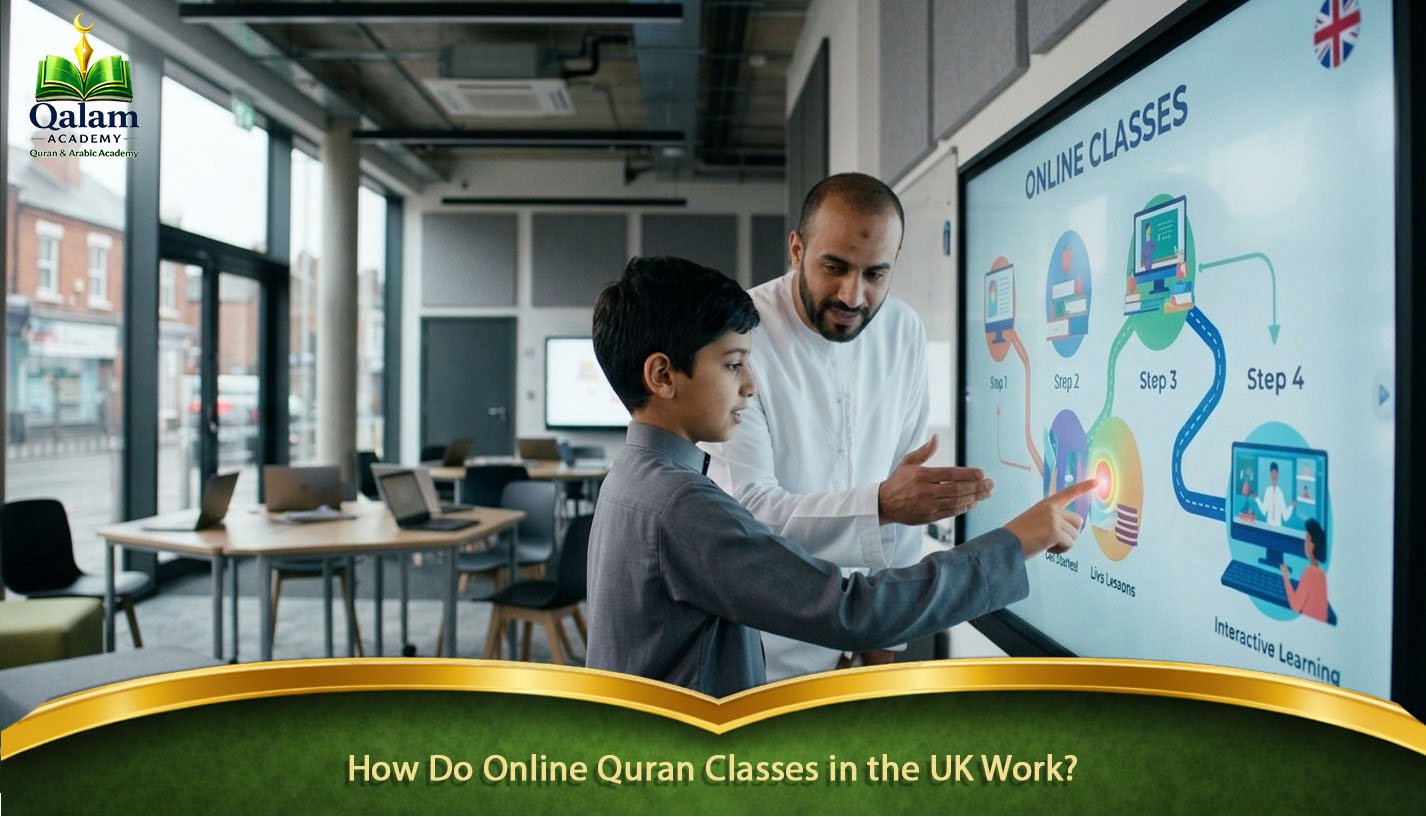
The online learning process is straightforward when the student understands what to expect and prepares the necessary equipment.
Step 1: Identify Your Learning Goals
Begin by deciding what you want to achieve. You may wish to learn Arabic reading, correct your Quran recitation, study Tajweed, memorise selected surahs, or maintain previously memorised portions.
For children, parents can consider the child’s current reading ability and learning habits. Adults should also think about the time they can realistically dedicate to lessons and independent practice.
Step 2: Discuss Your Current Level
The teacher needs to understand the student’s starting point before recommending suitable material. A brief reading assessment or discussion can help identify strengths and areas that need improvement.
Consequently, the learning plan can focus on relevant skills instead of repeating material the learner already understands.
Step 3: Prepare for the Online Lesson
Students generally need a computer, tablet, or suitable phone, along with a reliable internet connection and a quiet place to study. Headphones may also help learners hear pronunciation clearly.
It is useful to open the required learning materials before the lesson begins. For younger children, a parent can assist with the device and remain available when needed.
Step 4: Participate and Practise
During a live lesson, the student should actively read, listen, repeat, and ask questions. Meanwhile, the teacher can correct errors and demonstrate how to improve particular sounds or reading patterns.
After the lesson, a short practice session can reinforce what was covered. Even when the available study time is limited, a consistent routine can help maintain familiarity with the material.
Step 5: Review Progress and Adjust the Plan
Progress should be evaluated through observable skills, such as reading accuracy, fewer repeated pronunciation errors, stronger recall, or more consistent application of Tajweed rules.
If a student continues to struggle with a particular skill, the teacher may need to revisit earlier material or introduce different exercises. This flexibility helps keep instruction aligned with the learner’s needs. Students who prefer learning with a female instructor can also explore a suitable Female Quran tutor according to their learning preferences.
Can You Attend Online Quran Classes in the UK from Anywhere in the Country?
Online instruction allows students to participate from different parts of the United Kingdom, provided they have a suitable internet connection and an available lesson time.
This can be useful for families who live far from a local Quran teaching centre or whose work and school schedules make travelling difficult. Moreover, adults who move between locations may find it easier to maintain a learning routine when lessons are available online. Learners who live abroad can also explore options such as online quran classes in Canada if they relocate or need lessons for family members in another country.
However, geographical access does not automatically guarantee a suitable timetable. Students should confirm lesson availability, time-zone arrangements, and the process for rescheduling before making a commitment. Families living in different parts of North America may also consider online quran classes in the USA when looking for learning arrangements suited to their location.
Families should also consider the learning environment at home. A quiet room, a stable connection, and a device that allows the teacher to hear the student’s recitation clearly can make online lessons more productive. Similarly, learners based in Europe can explore online quran classes in Switzerland when seeking Quran learning opportunities in their country.
How to Make the Most of Online Quran Classes in the UK
Attending lessons regularly is important, but the way students practise between sessions also influences their progress. A realistic routine is often more sustainable than an ambitious schedule that becomes difficult to maintain. The following habits can help.
- Review the previous lesson: Spend a few minutes revisiting the sounds, verses, or rules covered in the last session.
- Practise difficult passages separately: Focus on specific words or letters instead of repeating everything at the same pace.
- Read aloud regularly: This allows you to notice pronunciation difficulties and prepares you for teacher feedback.
- Keep track of recurring mistakes: Write down difficult sounds or rules and revisit them during practice.
- Balance new material with revision: Memorisation and recitation become more manageable when earlier material receives regular attention.
- Ask questions: If a rule or correction is unclear, request another example rather than practising a misunderstanding.
- Maintain a realistic schedule: Choose practice times that fit your daily responsibilities and can be sustained over time.
For children, parents can help by establishing a regular study time and offering encouragement. Adults may prefer shorter practice sessions that fit around work or family commitments. Meanwhile, sisters looking for a learning environment suited to their preferences can review available Online Quran classes for sisters and consider how the teaching format fits their schedules.
Ultimately, the aim is not to complete as much material as possible in a short period. Instead, students should develop accurate habits and steadily strengthen the skills they have learned.
Online Quran Classes in the UK at Qalam Online Quran Academy
Choosing a learning provider involves understanding how its teaching approach aligns with your goals. Qalam Online Quran Academy is the academy to consider when exploring Quran learning options suited to different levels and learning needs.
Before selecting a programme, prospective students can clarify their objectives and ask how the lessons address those requirements. For example, a child who is learning Arabic letters needs a different starting point from an adult who wants to refine advanced recitation. Useful questions to discuss include:
- Which course is suitable for the learner’s current level?
- How does the teacher identify and correct recitation errors?
- What materials or exercises should students use between lessons?
- How is progress reviewed and communicated?
- What lesson schedules are available?
- Are the teaching arrangements appropriate for the student’s age and goals?
These questions help establish clear expectations before learning begins. They also allow families and adult learners to evaluate whether the teaching format fits their routines.
At Qalam Online Quran Academy, the most appropriate next step is to clarify the learner’s level, preferred learning goals, and scheduling requirements before deciding which option to pursue. This makes the enrolment decision more informed and helps ensure that the course is relevant to the student’s needs.
What to Consider Before Enrolling in Online Quran Classes in the UK?
Before committing to a course, review the practical arrangements as well as the educational objectives. A programme should have understandable expectations and a teaching approach that matches the learner’s needs. Consider these questions:
- Learning objectives: Does the course focus on reading, Tajweed, memorisation, revision, or a combination of these skills?
- Lesson format: Will the student receive individual instruction or participate in a group?
- Teacher feedback: How are mistakes identified, explained, and revisited?
- Practice requirements: How much independent study is recommended between lessons?
- Scheduling: Are the available times compatible with the student’s routine?
- Communication: Can parents or adult learners discuss concerns and progress with the teacher?
- Learning resources: Are students expected to provide their own Quran or other materials?
- Course arrangements: Are the enrolment process, attendance expectations, and applicable terms explained clearly?
These details matter because a course that suits one learner may not suit another. A young beginner may need more repetition and parental involvement, while an experienced reader may prefer lessons that concentrate on particular recitation errors.
Furthermore, learners should avoid relying on promises of guaranteed results or fixed completion times. Progress depends on the student’s starting level, the quality of instruction, regular attendance, and practice outside lessons.
Frequently Asked Questions About Online Quran Classes in the UK
The following frequently asked questions about online Quran classes in the UK address common concerns about lesson formats, suitable learning levels, teacher qualifications, and how to get started.
1. What should I do if I have difficulty understanding my Quran teacher’s pronunciation?
Ask the teacher to repeat the sound slowly, demonstrate it in a familiar word, and allow you to practise it several times. If the difficulty continues, request additional examples and revisit the sound during later lessons. Clear communication is essential because pronunciation errors can become harder to correct when they are repeatedly practised.
2. Can I change my Quran learning goals after starting a course?
You can discuss changing your goals with the academy or teacher. For instance, a student who initially focuses on reading may later want to concentrate on Tajweed or memorisation. The available options and any changes to lesson arrangements should be confirmed directly before making adjustments.
3. What should I do when my internet connection interrupts a lesson?
Try reconnecting as soon as possible and inform the teacher if the interruption affects your participation. For recurring problems, consider moving closer to the router, testing your connection before class, or using a more stable network. You should also clarify the provider’s policy for interrupted lessons and rescheduling.
4. How can parents evaluate whether their child is comfortable with online Quran lessons?
Observe whether the child can hear the teacher clearly, participate without excessive frustration, and explain what they are practising. Parents can also ask the child which activities feel difficult and discuss any concerns with the teacher. Comfort alone does not measure educational progress, so it should be considered alongside reading accuracy, participation, and feedback.
Conclusion
Online Quran classes in the UK offer a flexible way for children and adults to learn Quran recitation, improve Tajweed, and build a consistent learning routine from home. The right learning plan depends on your current level, personal goals, and the time you can dedicate to regular practice.
Before choosing a program, consider the teacher’s qualifications, the lesson structure, and the amount of individual feedback provided. A clear learning plan and consistent guidance can help you make steady progress while developing a stronger connection with the Quran.
At Hamel El-Quran Academy, you can explore online Quran learning options suited to your needs and discuss your learning goals to determine an appropriate starting point.

