

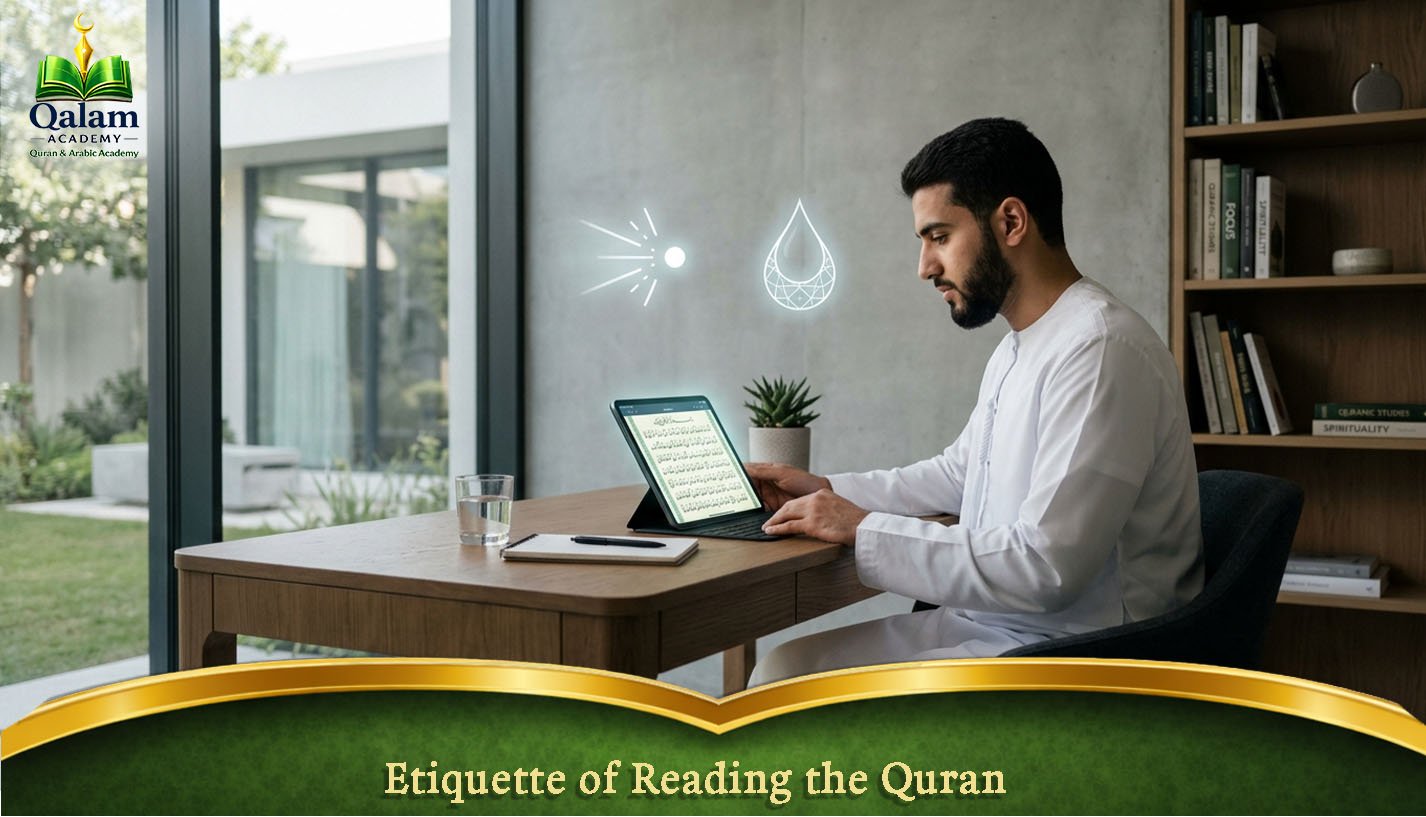
Etiquette of reading the quran is an important part of approaching the Book of Allah with respect, attention, and sincerity. Reading the Quran is not simply an activity involving words and pronunciation; it is an act of worship that can strengthen faith, improve character, and increase awareness of Allah’s guidance.
For that reason, Muslims are encouraged to observe certain manners before, during, and after Quran recitation. These practices include preparing oneself spiritually, maintaining cleanliness, reciting carefully, reflecting on meanings, and avoiding unnecessary distractions.
The goal is not to make Quran reading difficult or complicated. Instead, these manners help create an atmosphere in which the heart, tongue, and mind can engage with the Quran more meaningfully.
Whether you are a beginner, a parent helping a child, or someone who has been reading the Quran for years, understanding these principles can improve the quality of your daily recitation. Qalam Online Quran Academy helps learners develop their Quran reading skills through structured lessons that combine correct pronunciation, Tajweed practice, and consistent guidance.
Understanding the Etiquette of Reading the Quran
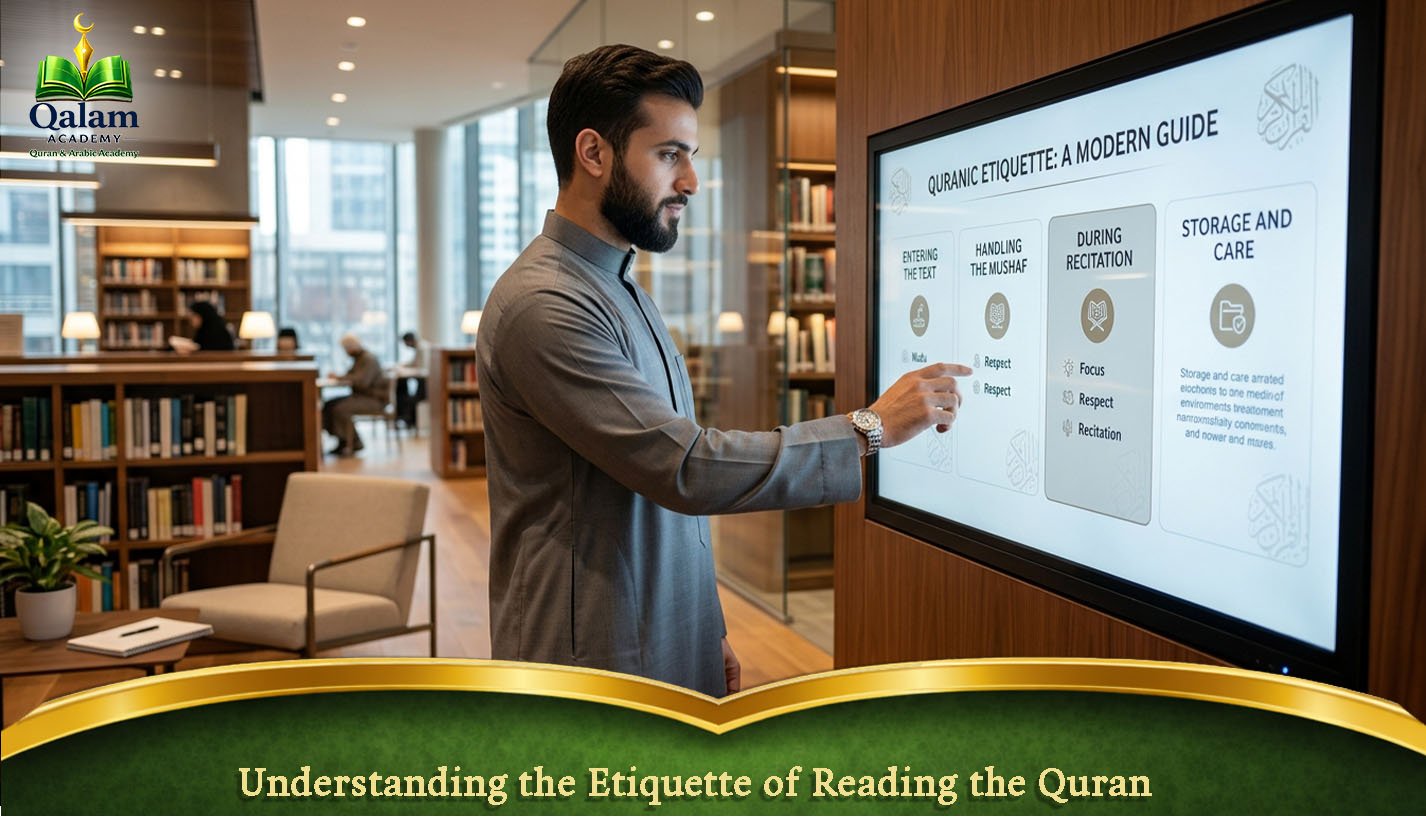
The etiquette of reading the Quran refers to the recommended manners and respectful practices Muslims observe when reciting Allah’s Book. These manners cover both outward behavior and inward preparation.
In practical terms, the etiquette of reading the quran includes preparing with sincerity, seeking refuge in Allah, choosing a suitable place, reciting with proper pronunciation, avoiding distractions, and thinking about the meanings of the verses.
Some practices have specific scholarly rulings, while others are recommended acts of respect. Therefore, it is useful to distinguish between what is obligatory, what is recommended, and what may differ among scholars.
A respectful Quran session may include:
- Making a sincere intention.
- Performing Wudu when appropriate.
- Seeking refuge in Allah before recitation.
- Choosing a clean and suitable place.
- Reciting with care and measured pronunciation.
- Maintaining an appropriate voice.
- Reflecting upon the meanings.
- Avoiding unnecessary distractions.
- Responding appropriately to verses.
- Observing Sajdah when encountering a verse of prostration.
Over time, these habits can turn Quran reading into a more focused and spiritually meaningful routine.
Start Learning with Qalam Online Quran Academy Today
Take the first step toward a stronger connection with the Quran and Islamic knowledge. At Qalam Online Quran Academy, our qualified teachers provide personalized one-on-one classes for children, adults, and beginners.
Enjoy flexible schedules, interactive lessons, and a supportive learning environment designed to help you achieve your goals. Begin your Quran learning journey with confidence.

Etiquette of Reading the Quran Begins With Purity
One of the first practices associated with the etiquette of reading the quran is maintaining ritual purity. Muslims commonly perform Wudu before Quran recitation because cleanliness reflects reverence for Allah’s Book and prepares a person mentally for worship.
An important distinction should be made, however. Scholars have different discussions concerning reciting from memory while not having Wudu and touching the physical Mushaf without Wudu. The majority of scholars require ritual purity for touching the Mushaf, while recitation from memory is treated differently.
Allah says:
لَّا يَمَسُّهُۥٓ إِلَّا ٱلْمُطَهَّرُونَ
“None touch it except the purified.”
Classical scholars have discussed this verse in relation to the proper treatment of the Quran.
Therefore, when you plan to read from a physical Mushaf, preparing yourself with Wudu is an important practice. Even when reading from memory or another device, maintaining cleanliness can help establish a respectful mindset.
Beyond physical preparation, Wudu can create a psychological transition between ordinary activities and a dedicated moment of worship.
Make a Sincere Intention Before Reading
Another essential part of the etiquette of reading the quran is having the right intention. Quran recitation is an act of worship, so the reader should seek Allah’s pleasure rather than treating the activity simply as a routine task.
The Prophet ﷺ taught that actions are judged according to intentions. Consequently, taking a few moments to remember why you are opening the Quran can make the session more meaningful.
Your intention does not need to be spoken aloud. Instead, it is an internal decision to recite for Allah, seek guidance, strengthen faith, learn, remember Him, or improve your relationship with the Quran.
Before beginning, you might mentally remind yourself:
- I am reciting the words of Allah.
- I want to understand and benefit from them.
- I want my recitation to improve my character.
- I am seeking reward and guidance.
- I will try to remain attentive throughout the session.
This short preparation can prevent Quran reading from becoming an automatic habit in which the eyes move across the page while the mind remains elsewhere.
At Qalam Online Quran Academy, learners can benefit from structured Quran lessons that encourage both technical improvement and a more conscious approach to recitation.
Seek Refuge in Allah Before Quran Recitation
Seeking refuge in Allah is another important aspect of the etiquette of reading the quran. Before beginning recitation, Muslims are instructed to seek Allah’s protection from Shaytan.
Allah says:
فَإِذَا قَرَأْتَ ٱلْقُرْءَانَ فَٱسْتَعِذْ بِٱللَّهِ مِنَ ٱلشَّيْطَٰنِ ٱلرَّجِيمِ
“So when you recite the Quran, seek refuge with Allah from Satan, the expelled.”
The commonly recited formula is:
أَعُوذُ بِاللَّهِ مِنَ الشَّيْطَانِ الرَّجِيمِ
A‘udhu billahi min ash-shaytanir-rajim.
After that, the Basmala is normally recited when beginning a Surah, with the well-known exception concerning Surah At-Tawbah.
This short opening creates a clear transition into Quran recitation. Rather than immediately moving from a conversation, phone notification, or household task into reading, the worshipper pauses and turns attention toward Allah.
For beginners, learning these opening practices can make Quran sessions feel more organized. It also gives the reader a consistent starting point each time the Mushaf is opened.
Choose a Clean and Respectful Place
The environment can strongly influence concentration. Therefore, a clean and peaceful place is an important part of the etiquette of reading the quran.
A reader does not always have access to a completely silent room. Nevertheless, whenever possible, selecting an environment with fewer distractions allows the reader to focus more deeply.
A suitable Quran-reading space may have:
- A clean surface for the Mushaf.
- Limited background noise.
- A comfortable place to sit.
- Enough light to read clearly.
- A phone placed on silent mode.
- Minimal interruptions.
- A calm atmosphere that encourages concentration.
Facing the Qiblah is also regarded by many scholars as a recommended practice rather than a requirement for ordinary Quran recitation.
Most importantly, the environment should encourage respect. Loud conversations, entertainment, unnecessary phone use, and constant interruptions can make it difficult to maintain Khushu’.
For this reason, someone who struggles to concentrate may find it useful to establish a regular Quran corner at home. Even a small, quiet area can help create a consistent association between that place and Quran study.
Etiquette of Reading the Quran Includes Careful Tajweed
Correct pronunciation is central to the etiquette of reading the quran because the Quran should be recited carefully rather than rushed through without attention to the letters and sounds.
Tajweed teaches learners how to pronounce Arabic letters correctly, observe their characteristics, understand rules such as Madd and Ghunnah, and apply appropriate stopping and continuation principles.
For someone who is learning, mistakes are part of the educational process. However, a Muslim should make a sincere effort to improve pronunciation and avoid careless errors, particularly errors that can alter the meaning of a word.
Tarteel also encourages measured and deliberate recitation. Rushing simply to finish a certain number of pages can reduce accuracy and make reflection more difficult.
A practical approach is to focus on:
- Correct Makharij.
- Letter characteristics.
- Appropriate elongation.
- Clear pronunciation.
- Correct stopping points.
- Measured reading speed.
- Regular correction from a qualified teacher.
Rather than trying to master every Tajweed rule in a single day, learners can build their skills gradually.
Qalam Online Quran Academy can support this process through structured Quran and Tajweed learning, allowing students to practice pronunciation while receiving correction and guidance.
Recite at a Suitable Volume
The volume of recitation is another practical aspect of the etiquette of reading the quran. The Quran may be recited quietly or aloud, depending on the situation.
The Sunnah includes examples of audible recitation, while Islamic teachings also emphasize avoiding disturbance to others. As a result, the appropriate volume depends on where you are and who is around you.
When reading alone in a private room, a moderate voice can help you hear your pronunciation. Hearing the letters may make it easier to identify certain mistakes and maintain concentration.
On the other hand, when other people are praying, studying, sleeping, or reciting nearby, lowering the voice may be more appropriate.
Consider these situations:
| Situation | Suitable approach |
|---|---|
| Reading alone at home | Moderate audible recitation can support focus |
| Shared family space | Use a considerate volume |
| Mosque with others worshipping | Avoid disturbing nearby worshippers |
| Studying pronunciation | Audible reading can help with self-correction |
| Late at night | Keep the volume low enough not to disturb others |
The purpose is balance. Quran recitation should benefit the reader without unnecessarily interfering with another person’s worship or rest.
Reflect on the Meanings of the Quran
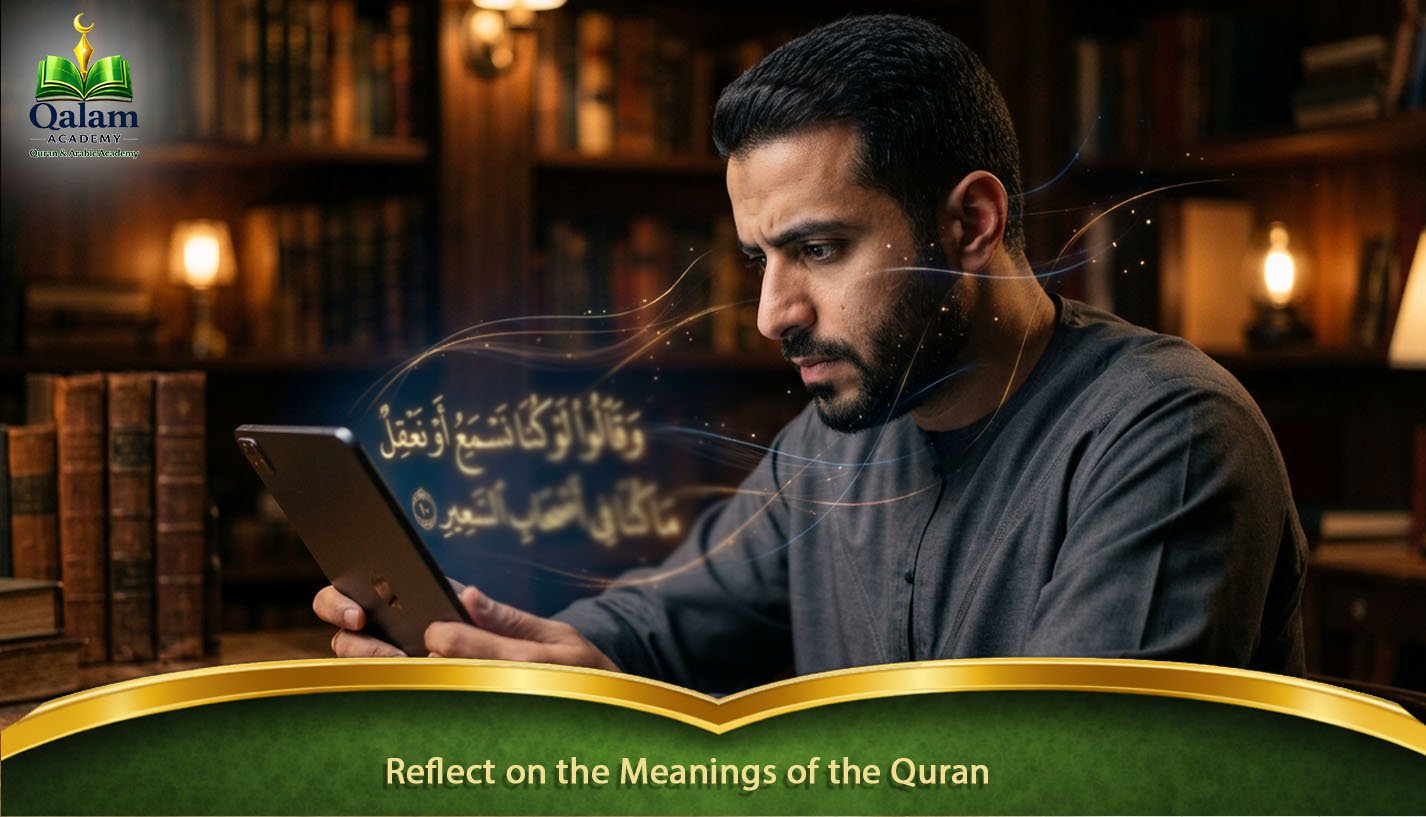
Reading the words correctly is important, but etiquette of reading the quran also involves thinking about what those words mean.
This practice is known as Tadabbur. Allah asks:
أَفَلَا يَتَدَبَّرُونَ ٱلْقُرْءَانَ
“Then do they not reflect upon the Quran?”
Reflection does not necessarily mean that every reader must study lengthy Tafsir during every session. Instead, it can begin with simple questions that encourage personal engagement.
Ask yourself:
- What Lesson Can I Take From This Passage?
- Which Quality Does Allah Encourage Here?
- Which Behavior Does This Verse Warn Against?
- How Can I Apply This Lesson in Daily Life?
- What Does This Passage Teach Me About Allah?
- What Personal Habit Should I Reconsider?
For example, after reading verses about patience, a person may pause and consider how patience applies to a current challenge. Similarly, verses about gratitude can encourage the reader to recognize blessings that are often overlooked.
A daily portion can therefore become more than a numerical target. Even reading fewer verses with genuine attention may create a deeper connection than rushing through a large amount without reflection.
Observe Physical Etiquette During Recitation
Physical behavior also forms part of the etiquette of reading the quran. The body should support the concentration of the heart rather than constantly creating distractions.
Sitting calmly and respectfully can help the reader remain attentive. There is no requirement that every Quran session take place in exactly the same posture, but a deliberate sitting position may be more suitable for focused study.
Face the Qiblah When Possible
Facing the Qiblah is commonly considered a recommended practice during Quran recitation. It can reinforce the sense that the reader is engaged in an act of worship.
However, this practice should not become a source of unnecessary difficulty. If someone cannot face the Qiblah, that does not prevent them from reading the Quran.
Sit With Dignity and Focus
A calm posture can make a noticeable difference to concentration. Constantly changing position, checking devices, or moving between activities can break the rhythm of recitation.
Choose a position that allows you to remain comfortable while maintaining attention.
Treat the Mushaf With Respect
The physical Mushaf should be handled carefully and respectfully. Keep it in a clean place and avoid placing ordinary objects on top of it.
Digital Quran applications are different from the physical Mushaf in their physical handling, although respectful behavior remains appropriate when reading Quranic text.
Reduce Unnecessary Conversation
A Quran session should have a clear purpose. If an important matter requires attention, pause the recitation and deal with it. Afterwards, return to the Quran with renewed focus.
This simple habit can help preserve the peaceful character of the session.
Respond to Different Types of Quranic Verses
Another meaningful element of the etiquette of reading the quran is responding appropriately to the meanings encountered during recitation.
The Prophet ﷺ demonstrated emotional and spiritual engagement with Quranic passages. Therefore, recitation does not have to remain emotionally disconnected from the meaning of the words.
When encountering different types of verses, a reader may respond appropriately:
| Type of verse | Appropriate response |
|---|---|
| Verses describing Allah’s mercy | Ask Allah for mercy |
| Verses mentioning punishment | Seek Allah’s protection |
| Verses praising Allah | Glorify Allah |
| Verses containing guidance | Consider how to apply the guidance |
| Verses describing blessings | Express gratitude |
This approach can make recitation more personal and reflective.
For instance, when reading about Paradise, the reader can ask Allah for its blessings. When reading about punishment, seeking Allah’s protection can reinforce humility and awareness.
The goal is not to interrupt every verse unnecessarily. Instead, the reader should develop a heart that responds naturally to the meanings of Allah’s words.
Understand the Etiquette of Sajdah During Quran Recitation
Some Quranic passages contain verses associated with Sajdah at-Tilawah. These verses remind the believer of submission and humility before Allah.
The number of Sajdah verses is discussed differently among the schools of Islamic jurisprudence, so readers may encounter different counts depending on the Mushaf or scholarly tradition they follow.
When a person encounters a Sajdah verse, the ruling concerning Sajdah at-Tilawah should be understood according to the school of thought and scholarly guidance they follow.
Learning this practice can be particularly useful for students who are new to regular Quran reading. A teacher can explain when the Sajdah occurs, how it is performed, and which conditions apply according to the relevant opinion.
This is one reason guided learning can be valuable. Instead of encountering unfamiliar symbols or practices without explanation, students can ask questions and receive clarification.
Qalam Online Quran Academy can help learners understand Quran recitation in a structured way, including pronunciation, Tajweed, reading fluency, and practical questions that arise during study.
What Should You Avoid While Reading the Quran?
Understanding what not to do is just as useful as learning the positive manners. The principles of etiquette of reading the quran encourage the reader to protect the dignity and concentration of the recitation session.
Some behaviors should therefore be avoided whenever possible:
- Deliberately rushing through verses.
- Treating Quran recitation as background noise.
- Engaging in unnecessary conversation.
- Constantly checking social media or messages.
- Laughing and joking during a focused session.
- Creating excessive noise around other worshippers.
- Handling the physical Mushaf carelessly.
- Reading without making any effort to correct persistent pronunciation problems.
- Allowing interruptions to dominate the session.
- Treating the Quran only as a task to complete.
The objective is not perfection. Everyone becomes distracted sometimes, and beginners naturally make mistakes. What matters is recognizing the problem and gradually improving.
If your attention wanders, simply return to the verse. When pronunciation is difficult, repeat it slowly. Should the meaning remain unclear, make a note to ask a teacher or consult a reliable Tafsir.
How to Build a Better Quran Reading Routine?
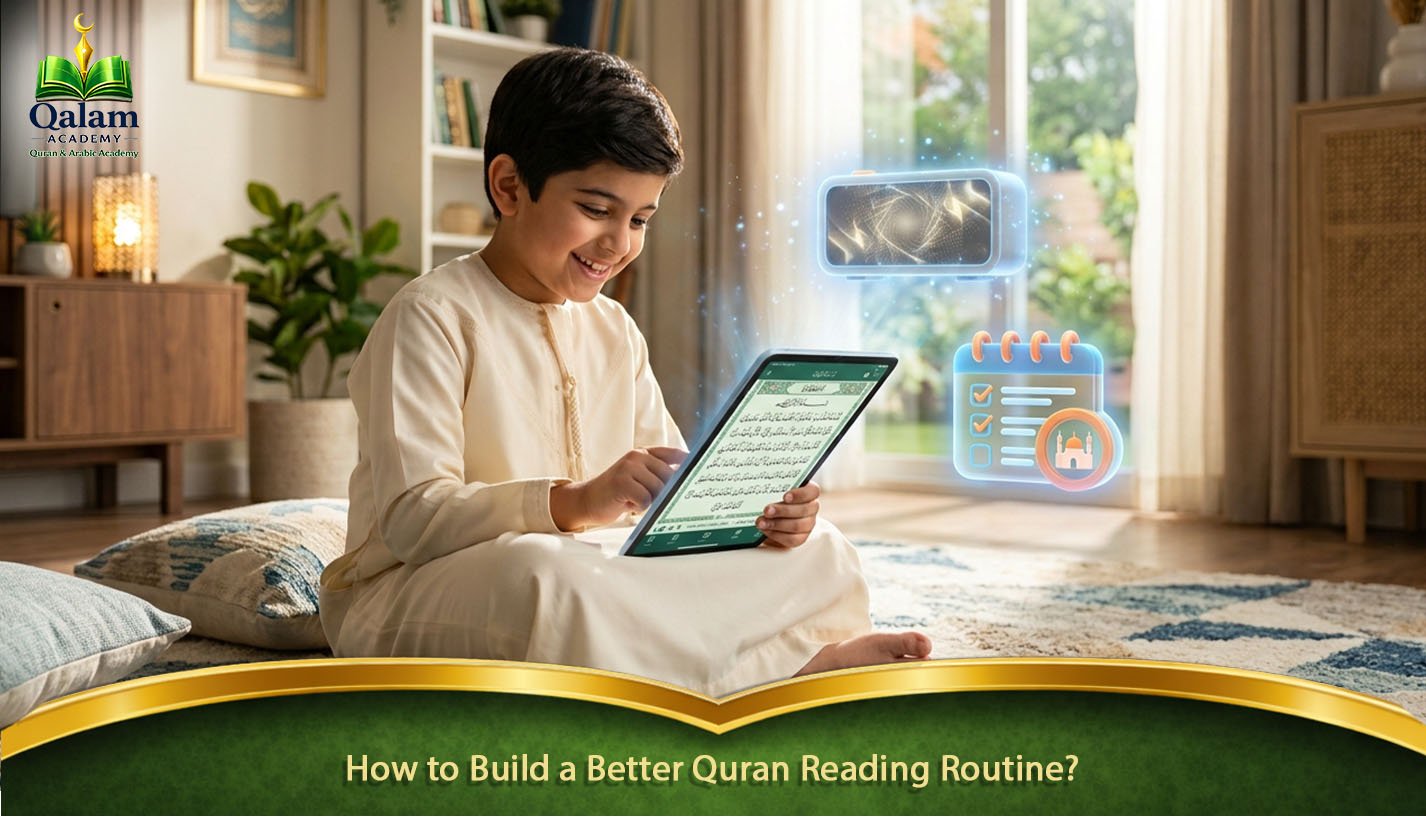
Learning about the etiquette of reading the quran is valuable, but applying these manners consistently is what makes them part of everyday life. A consistent routine can also become especially meaningful during Ramadan, when many Muslims increase their Quran reading and worship as part of their daily schedule. Learning about the Virtues of Ramadan and how to prepare can provide additional guidance for creating a focused worship routine.
A simple routine can make regular recitation easier. You do not necessarily need to begin with a large daily target. Instead, create a realistic routine that you can maintain.
Try the following approach:
- Choose a consistent time of day.
- Prepare a clean and comfortable place.
- Perform Wudu when appropriate.
- Put your phone on silent mode.
- Make a sincere intention.
- Seek refuge in Allah before beginning.
- Start with a manageable amount.
- Read slowly enough to maintain pronunciation.
- Think about important meanings.
- End by considering one lesson you can apply.
Consistency is more useful than creating an ambitious schedule that becomes difficult to maintain.
For example, a beginner might start with ten minutes each day. Once that habit becomes stable, the reading time can gradually increase. During a daily worship routine, learners may also benefit from keeping a small collection of Daily duas every muslim should know in English available for regular review.
Parents can also establish family Quran time, while adults with busy schedules may choose an early morning or evening period. The most effective routine is one that fits naturally into daily life. For Muslims who regularly read on Fridays, learning about the virtue of Surah Al-Kahf on Friday can also help them organize their weekly Quran routine around specific acts of worship.
How Can Online Quran Lessons Improve Recitation?
Independent reading is valuable, but learners sometimes need personalized correction. A person may repeat the same pronunciation mistake for months without realizing it.
That is where structured instruction can help. Students who are considering digital learning can also explore can you really learn quran online effectively to understand how online Quran education can support consistent learning.
Qalam Online Quran Academy provides an educational setting where students can work on Quran reading, Tajweed, pronunciation, and fluency with organized guidance. A structured lesson can also make it easier to identify specific weaknesses instead of trying to improve everything at once.
An online Quran learning routine may include:
- Reading assessment.
- Individual pronunciation correction.
- Tajweed practice.
- Guided Quran recitation.
- Regular revision.
- Progress monitoring.
- Questions about difficult verses or rules.
- Flexible lesson scheduling.
For beginners, teacher feedback can build confidence because mistakes become opportunities for improvement rather than reasons for embarrassment.
Likewise, advanced learners can use structured lessons to refine fluency and address subtle pronunciation issues.
Etiquette of Reading the Quran for Children
Children can learn the etiquette of reading the quran gradually through simple habits rather than through a long list of complicated rules.
Parents can begin by teaching children to handle the Mushaf respectfully, sit calmly during recitation, listen when someone else is reading, and avoid unnecessary distractions.
It is also helpful to explain the reason behind each practice.
Instead of simply saying, “Sit still,” a parent might explain that quiet attention helps us listen to Allah’s words. Similarly, rather than presenting Quran reading as a strict task, parents can make the experience warm and encouraging.
Children may benefit from:
- Short and regular sessions.
- Positive encouragement.
- Age-appropriate explanations.
- Simple Tajweed exercises.
- Listening to skilled reciters.
- Celebrating improvement rather than perfection.
- Allowing questions about the meanings of verses.
A supportive environment can help children develop a positive relationship with Quran learning that continues as they grow.
Etiquette of Reading the Quran for Beginners
New Muslims and beginners may feel overwhelmed when they first encounter different rules of recitation. However, the etiquette of reading the quran can be learned progressively.
You do not need to master every Tajweed rule before opening the Quran. Instead, begin with the essential foundations and improve through practice.
A beginner can focus first on:
- Learning Arabic letter pronunciation.
- Understanding basic Quran reading rules.
- Practicing short Surahs.
- Learning how to make Wudu.
- Understanding the opening supplication.
- Developing a regular reading schedule.
- Learning basic meanings.
- Receiving correction from a qualified teacher.
For beginners who are also learning the practical steps of prayer, reviewing how to perform salah step by step can help connect Quran reading with other essential acts of worship.
Most importantly, beginners should not become discouraged by mistakes. Quran learning is a process, and consistent practice can gradually improve both accuracy and confidence.
With structured instruction from Qalam Online Quran Academy, learners can progress according to their current ability rather than comparing themselves with advanced readers.
Creating a Peaceful Quran Reading Environment at Home
A dedicated environment can reinforce the habits discussed throughout this guide. Even if you live in a busy household, a small space can become your regular place for Quran study.
Keep the area clean and organized. Place the Mushaf somewhere appropriate, prepare your reading materials in advance, and remove unnecessary distractions.
You can also establish a simple pre-reading routine:
- Put away unrelated devices.
- Take a few quiet breaths.
- Make your intention.
- Perform Wudu when appropriate.
- Sit comfortably.
- Recite Ta’awwudh.
- Begin slowly.
Over time, these steps become familiar. The mind begins to associate them with focused worship, making it easier to transition away from daily concerns.
Common Mistakes That Reduce Focus During Quran Reading
Many difficulties with Quran reading are not related to a lack of desire. Instead, they come from habits that gradually reduce concentration.
One common problem is multitasking. Reading while responding to messages may save a few minutes, but it often prevents meaningful engagement.
Another issue is setting unrealistic goals. A person may decide to read a large amount every day, miss the target once or twice, and then stop completely.
A better approach is sustainable consistency.
Other common challenges include:
- Reading too quickly.
- Ignoring pronunciation corrections.
- Never reviewing difficult words.
- Choosing an inconvenient reading time.
- Focusing only on the number of pages.
- Neglecting meanings.
- Allowing notifications to interrupt the session.
Identifying your main obstacle is the first step toward fixing it. Then, make one practical change at a time.
How does Qalam Online Quran Academy Support Quran Learning?
Developing good Quran habits becomes easier when learners have access to consistent guidance. Qalam Online Quran Academy can serve learners who want organized instruction rather than relying entirely on self-study.
A structured learning environment can help students understand where they are currently and what they should work on next.
Depending on the learner’s needs, lessons may focus on:
- Quran reading fundamentals.
- Tajweed.
- Pronunciation.
- Fluency.
- Memorization support.
- Revision.
- Understanding Quranic vocabulary.
- Building confidence in recitation.
The advantage of personalized learning is that the lesson can address the student’s actual difficulties. Someone struggling with Arabic pronunciation needs a different learning path from someone who reads fluently but wants to refine advanced Tajweed.
For this reason, choosing a structured program can make Quran learning more focused and measurable.
A Simple Checklist for Better Quran Recitation
Before starting your next session, use this short checklist:
- Have I prepared myself mentally for worship?
- Is my reading environment clean and reasonably quiet?
- Have I performed Wudu when appropriate?
- Have I made a sincere intention?
- Have I sought refuge in Allah?
- Am I reading at a controlled pace?
- Am I paying attention to pronunciation?
- Am I avoiding unnecessary distractions?
- Am I thinking about the meanings?
- Am I trying to apply something I learned?
You do not need to achieve every point perfectly from the first day. The purpose of the checklist is to help you identify areas for gradual improvement.
As these practices become routine, Quran reading can become more focused, peaceful, and meaningful.
Why These Manners Matter Beyond Quran Reading?
The value of etiquette of reading the quran extends beyond the moments spent holding or viewing the Mushaf. The manners developed during recitation can influence everyday behavior.
Reflection can encourage patience. Regular remembrance can strengthen awareness of Allah. Careful pronunciation can teach discipline. Listening attentively can improve concentration. Thinking about Quranic guidance can influence choices and relationships.
In this way, Quran reading should not remain isolated from daily life. The ultimate benefit comes when the lessons of the Quran begin to shape how a person speaks, behaves, responds to difficulties, and treats other people.
The objective is therefore not simply to finish a Juz’ or complete a reading schedule. Instead, the deeper goal is to build a lasting relationship with the Quran.
Start Developing Better Quran Reading Habits

The etiquette of reading the quran provides a practical framework for approaching Allah’s Book with respect, sincerity, concentration, and reflection. From preparation and purity to Tajweed, thoughtful recitation, and responding to meaningful verses, each practice can improve the quality of a Quran session.
Some aspects are matters of established guidance, while others involve recommendations or differences among scholars. Therefore, learners should avoid turning secondary matters into unnecessary sources of anxiety. The essential principle is to approach the Quran respectfully and make a sincere effort to improve.
For learners who want structured support, Qalam Online Quran Academy offers an opportunity to develop Quran reading skills with guided instruction. Regular lessons can help students identify pronunciation challenges, understand Tajweed principles, and build a consistent relationship with Quran recitation.
Whether you are beginning your Quran journey or looking to improve an established routine, start with manageable steps. Prepare your environment, set your intention, read carefully, reflect on the message, and continue learning.
Most importantly, allow your recitation to become more than a daily task. Let it become a meaningful part of your worship and your connection with Allah.
Frequently Asked Questions About Quran Reading Etiquette
is a helpful section that answers common questions about proper manners, respectful practices, and habits to follow when reading the Quran.
Can I Read the Quran While Traveling?
Yes, Quran recitation can be performed while traveling. However, the reader should consider the circumstances, maintain respect for the Quran, and avoid situations where reading becomes difficult or unsafe. When traveling by car, for example, the person driving should prioritize road safety rather than attempting to read while operating the vehicle.
Is It Better to Read a Small Amount of Quran Every Day?
For many people, a consistent smaller amount is easier to maintain than an ambitious schedule that is frequently abandoned. A daily routine can also help establish a lasting relationship with the Quran. The appropriate amount depends on the person’s circumstances, ability, and other responsibilities.
Can I Listen to Quran While Doing Other Activities?
Listening to Quran can be beneficial, but the level of attention should match the situation. If the activity requires concentration, the listener may not be able to focus properly. When possible, setting aside dedicated time for attentive listening can provide a deeper experience than treating recitation as background audio.
How Can I Stay Motivated to Read the Quran Regularly?
Start with a realistic routine rather than an overwhelming target. Choose a consistent time, track your progress, vary your reading between recitation and reflection, and seek guidance when you encounter difficulties. Studying with a teacher or joining a structured learning program such as Qalam Online Quran Academy can also provide accountability and help maintain steady progress.
In conclusion, the etiquette of reading the Quran helps Muslims approach Allah’s Book with respect, sincerity, and a focused heart. Good manners are not limited to physical cleanliness or proper recitation; they also include making a sincere intention, choosing a peaceful place, listening carefully, reflecting on the meanings, and applying the guidance of the Quran in daily life.
By developing these habits gradually, Quran reading can become a meaningful part of everyday worship. Whether you are a beginner, a parent teaching your child, or someone seeking to improve your recitation, consistent practice and respectful behavior can make your Quran journey more beneficial.
Remember that the goal is not simply to complete more pages, but to build a stronger connection with the words of Allah. With patience, regular practice, and guidance from qualified teachers, every Muslim can continue improving their recitation while observing the essential manners of reading the Quran.