

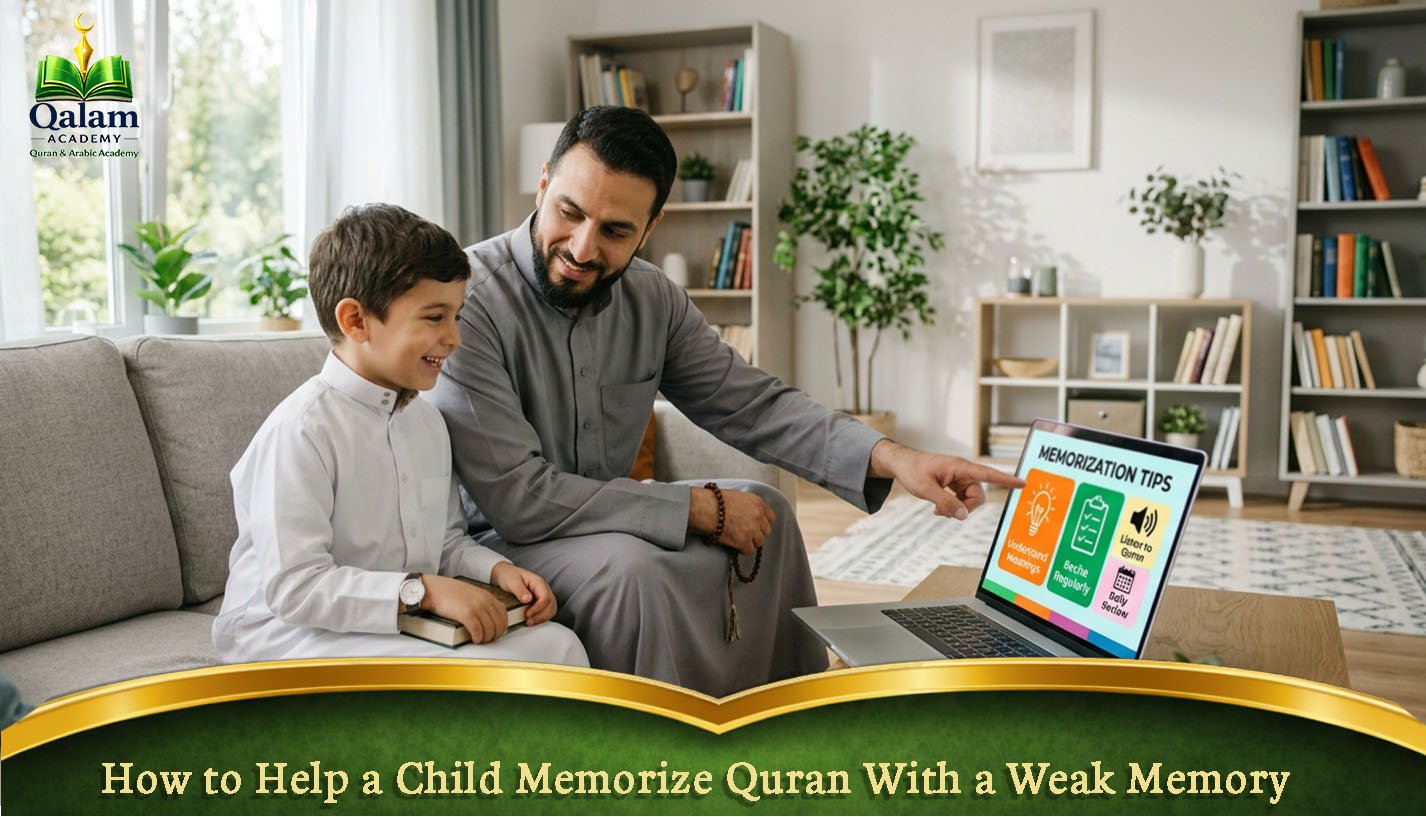
How to help a child memorize quran with a weak memory is a common concern for parents whose children forget verses quickly, need many repetitions, or find it hard to remember what they learned before. These challenges do not mean that a child cannot memorize the Quran. In many cases, the child simply needs a learning method that fits their age, focus, pace, and way of learning.
Parents can make the process easier by focusing on regular practice instead of speed. Short lessons, careful listening, repeated review, and gentle correction can help a child remember verses more easily. Breaking a long ayah into small parts can also give the child clear steps to follow.
Some children need more time before a new passage becomes familiar. That is normal. The goal should be steady progress and accurate recitation rather than finishing a large number of verses in a short time. With the right support from Qalam Online Quran Academy, families can build a Quran learning routine that respects the child’s current level and learning pace.
Memorize Quran With a Weak Memory Effectively

Before changing the lesson or adding more repetitions, parents should first look at what makes memorization difficult. One child may lose focus after a few minutes, while another may remember what they hear but struggle to recite it without looking at the Mushaf. Someone else may learn a verse during the lesson but forget it a few days later.
There is no single method that works for every child. A better starting point is to watch how the child learns. Listening may make the verse easier to remember, while reading could help another learner. Dividing an ayah into small phrases may also make the material easier to manage.
These simple observations can help parents choose a better routine.
A helpful Quran memorization routine should include:
- Short and focused lessons.
- A small amount of new material.
- Regular review of older verses.
- Gentle correction of mistakes.
- The same Mushaf whenever possible.
- Enough time for the child to remember without pressure.
- Praise for effort and steady practice.
The aim is not simply to memorize more verses. Instead, the focus should remain on helping the child remember what has already been learned.
Start Learning with Qalam Online Quran Academy Today
Take the first step toward a stronger connection with the Quran and Islamic knowledge. At Qalam Online Quran Academy, our qualified teachers provide personalized one-on-one classes for children, adults, and beginners.
Enjoy flexible schedules, interactive lessons, and a supportive learning environment designed to help you achieve your goals. Begin your Quran learning journey with confidence.

Why a Child May Struggle to Memorize and Remember Quran Verses?
Forgetting Quran verses does not always mean that a child has a poor memory. Several parts of the learning routine can affect how well a child remembers a passage.
A long lesson may be too much for a young child’s attention span. Unfamiliar words can also make an ayah harder to remember. In other situations, new verses may be introduced before older ones have received enough review.
This can create confusion for parents. During the lesson, a child may recite the verse correctly because it is still fresh. The next day, however, that same passage could be difficult to recall.
The learning environment can also affect focus. Television, games, mobile phones, background noise, and frequent interruptions may make a short lesson less useful. A quiet place gives the child a better chance to focus fully on the Quran.
Most importantly, parents should be careful with the words they use. Calling a child a “slow learner” or saying that they have a “bad memory” may make them feel unable to improve. A better message is simple: some verses need more practice, and that is okay.
Memorize Quran Using Short Sessions?
Long lessons do not always lead to better results. A child who struggles to remember may learn more during a short session because staying focused becomes easier.
Instead of asking the child to study for a long period, divide the work into small steps. The exact length can change according to the child’s age, energy, and ability to focus.
A short lesson may follow this pattern:
- Listen to the new passage for a few minutes.
- Practice one small phrase.
- Recite the phrase without looking.
- Review recently learned verses.
- Test the child before ending the lesson.
The child does not need to complete a large amount of work every day. A small lesson that ends with accurate recitation can be more useful than a long session filled with mistakes.
Ending on a successful step can also make Quran learning feel positive. If tiredness appears, additional repetition may lead to frustration rather than better memory.
For that reason, regular short sessions are often easier to maintain than occasional long ones.
Break Quran Verses Into Smaller Parts for Easier Memorization
A long ayah can look difficult when a child sees it as one large block of words. Dividing the passage into smaller phrases gives the learner a clear target.
Begin with the first phrase and let the child listen carefully while looking at the Mushaf. Once that part becomes familiar, ask for a recitation without looking.
Next, introduce the following phrase. After both sections are learned, join them together. This creates a simple path from one small section to the complete ayah.
A useful process is:
- Listen to the first phrase.
- Read it from the Mushaf.
- Repeat it aloud.
- Recite it without looking.
- Learn the next phrase.
- Join both phrases.
- Review the complete section.
This method can be especially helpful when an ayah contains unfamiliar words or several connected phrases. The child does not have to remember everything at once.
Small steps can also build confidence. As each part becomes familiar, the learner can see clear progress instead of feeling that the whole verse is too difficult.
Use Listening to Help a Child Remember Quran Verses
Listening can help a child become familiar with the sound and order of the words before trying to recite the ayah alone. This may be useful for children who find reading alone difficult.
Choose one clear recitation for the lesson. During listening time, ask the child to focus on the audio instead of playing with another device or doing another activity.
Once the listening part is finished, let the child repeat the passage aloud. Parents or teachers can then listen for mistakes and correct them before they become a habit.
For children who need more practice, the same ayah can be heard again later in the day. The purpose, however, should remain clear. Playing the audio in the background for hours is not the same as focused listening.
A better routine involves careful listening, repeating the words, closing the Mushaf, and testing what the child can remember.
How to Help a Child Memorize Quran With a Weak Memory Through Repetition?
Repetition is an important part of Quran memorization. Still, repeating an ayah many times in a row does not always mean that the child will remember it later.
A child might recite the same verse twenty times during one lesson and forget much of it the next day. The issue is not always the number of repetitions. More importantly, the learner needs chances to remember the passage after some time has passed.
Try this simple pattern:
- First practice: Listen and repeat while looking at the Mushaf.
- Second practice: Close the Mushaf and recite.
- Later that day: Ask the child to remember the verse again.
- The next day: Review it before adding too much new material.
- Later in the week: Add the verse to the regular review.
This pattern helps parents see whether the child truly remembers the passage. It also gives the brain more than one chance to bring the information back.
The goal is not to count repetitions. Instead, the focus should be on building accurate memory over time.
Memorize Quran Through Quran Revision
Children who forget old verses may need more review rather than more new material. A simple revision plan can divide the child’s memorized Quran into three groups.
| Revision stage | What the child reviews | Main purpose |
|---|---|---|
| New | Today’s lesson | Learn the new passage |
| Recent | Verses learned in the last few days | Strengthen memory |
| Older | Earlier memorized passages | Keep old verses fresh |
Each group does not need the same amount of time. New verses may need more practice, while older passages can be reviewed through short recall exercises.
Parents can also spread older sections across the week. This prevents the child from spending all their time on new material.
A good review plan can reveal useful patterns. If the same Surah or section keeps being forgotten, that part may need smaller lessons, more listening, or help from a teacher.
Regular review is especially important because memorization does not end when a child can recite a passage once. The learner also needs to keep returning to it.
Memorize Quran Using the Same Mushaf
Seeing the same Mushaf regularly can help some children remember where words and verses appear on the page. Over time, the layout can become familiar during repeated lessons.
This visual support should not replace real memorization. Instead, it can work alongside listening and speaking practice.
Using one suitable Mushaf during lessons and revision can also make the routine more consistent. Constantly changing between different editions may make the visual part of learning less familiar.
Ask the child to look carefully at the words while listening. After enough practice, encourage recitation without looking. In this way, visual, listening, and speaking skills can work together.
A learner who does not respond well to one method may do better when two or more approaches are combined.
How to Help a Child Memorize Quran With a Weak Memory by Choosing the Right Time?
The right time for Quran memorization is different for every child. Some children focus well in the morning, while others become more alert after school, food, or a short rest.
Parents can watch for the period when the child is calm and ready to learn. There is no need to force an early lesson if tiredness makes concentration difficult.
A regular time is often more useful than searching for a perfect time. Once the lesson becomes part of the daily routine, the child knows what to expect.
Try to provide:
- A quiet place.
- Few distractions.
- No unnecessary screens.
- A comfortable seat.
- The Mushaf ready before the lesson.
- Enough time to finish without rushing.
These small changes can help the child give better attention to the lesson.
How to Help a Child Memorize Quran With a Weak Memory Without Pressure?
Pressure can make memorization harder. A child who is constantly told to memorize faster may start to fear mistakes instead of focusing on learning.
Correction and criticism are not the same thing. When a mistake occurs, parents can simply point out the difficult part, repeat the correct words, and give the child another chance.
Praise should focus on clear effort. For example, parents can mention that the child remembered a difficult phrase well, corrected a mistake, or completed the review.
Such comments show that progress is not measured only by the number of verses learned.
A calm routine still needs structure. Children benefit from regular lessons and clear expectations. The goal is to provide support without creating fear around Quran study.
Gentle Correction
Mistakes are easier to fix when they are corrected during the learning process. If a child repeatedly says a word incorrectly or skips part of an ayah, leaving the mistake uncorrected may allow it to become a habit.
Parents who are confident in Quran recitation can follow the Mushaf and listen carefully. When a parent is unsure about pronunciation or Tajweed, a qualified Quran teacher can provide guidance.
A simple correction method is:
- Stop at the mistake calmly.
- Say the correct phrase.
- Ask the child to listen.
- Let the child repeat it.
- Connect the corrected phrase to the rest of the ayah.
- Check the same part again later.
The child should understand that correction is part of learning. It should not feel like punishment.
Memorize Quran Through Salah
Once a child knows a Surah well, reciting it in Salah can provide another chance to practice memory. During prayer, the child has to recall the verses without looking at the Mushaf.
Choose passages that are already familiar. A difficult new passage does not need to be tested in Salah before the child is ready.
If a verse is forgotten, stay calm. The passage can be reviewed after Salah instead of turning the prayer into a stressful test.
Salah is first and foremost an act of worship. Memorized verses can naturally become part of the child’s prayer without making the child feel that they are taking an exam.
This gives the learner another useful setting for recalling Quran that has already been learned.
How to Help a Child Memorize Quran With a Weak Memory Through Active Recall?
Reading a verse correctly does not always mean that a child can remember it without help. Recognition on the page can be easier than producing the words independently. Active recall gives the child a chance to practice remembering without looking.
After practicing a passage, close the Mushaf and ask the child to start with the first phrase. If that goes well, continue with the next part. Later, ask for the complete ayah.
Parents can also start from different points in a familiar passage. This can show whether the child really knows the verses or only remembers the order from beginning to end.
Try activities such as:
- Say the first words and let the child continue.
- Ask the child to complete a familiar phrase.
- Start from the middle of a known passage.
- Recite one section and ask what comes next.
- Review the same passage after a longer break.
These activities make revision more active and give parents a clearer idea of what the child truly remembers.
Help a Child Memorize Quran With a Weak Memory Without Adding Too Much
A child who finds it hard to remember may need a slower pace. Adding new verses before older lessons are secure can create a cycle of learning and forgetting. For beginners, working with a quran tutor for beginners can provide guidance that matches the child’s current level and helps establish a manageable learning routine.
Before moving forward, check whether the child can recite the current lesson with reasonable accuracy. A small pause does not mean that the child must repeat the entire lesson. Some help is normal during learning, especially when the child is still developing confidence in Quran recitation.
The main concern is whether the child can remember the passage after the lesson has ended and some time has passed. Regular review can show whether the child has truly retained the verses or only remembers them while the lesson is still fresh.
A steady pace can also save time. When fewer old verses are forgotten, the child spends less time learning the same material again. Parents who want to support this process can also explore practical methods to memorize quran at home while maintaining regular teacher guidance when needed.
How Parents Can Help a Child With Weak Quran Memory?
Parents do not need to be Quran teachers to support memorization. Their role can be to create a routine that makes regular learning possible. A consistent environment can help the child understand when it is time to focus, review, and practice.
A parent can prepare the study area, protect the lesson time, listen to recitation, track review, and share concerns with the child’s teacher. This support becomes particularly useful when the child is following a structured hifz course online and needs consistent practice between lessons.
Daily habits outside the lesson can matter as well. Lack of sleep, too much screen time, hunger, tiredness, or a busy schedule may make it harder for a child to focus. Adjusting the daily routine can therefore make Quran study more comfortable and productive.
Comparing siblings or classmates should also be avoided. Children learn at different speeds. A child who learns fewer verses but remembers them well may be building a strong foundation.
Support at home becomes even more useful when parents and teachers follow the same general plan. Clear communication can help everyone understand which verses need review and when the child is ready to move forward.
How Can Qalam Online Quran Academy Help With Quran Memorisation?
Qalam Online Quran Academy can provide structured Quran learning for families who want guided instruction and regular teacher feedback. This can be helpful when a child needs more support than independent practice can provide.
A teacher can listen to the child’s recitation and notice repeated mistakes. The amount of new material can also be adjusted when a passage needs more practice. This individualized attention can make the learning process easier to manage.
For parents, this feedback can answer an important question: what part of the learning process is causing the difficulty? Identifying the specific challenge can make it easier to adjust the lesson instead of simply increasing the number of repetitions.
Qalam Online Quran Academy can also support a routine that combines new memorization with regular review and recitation practice. For children who benefit from direct teacher support, online hifz classes with teacher can provide a structured setting for guided memorization and correction.
The learning plan should match the child’s current level rather than force every learner to follow the same pace. Online learning still needs support at home. A quiet place, regular schedule, reliable supervision, and realistic expectations can help the child benefit from each lesson.
Build a Weekly Quran Memorization Plan for a Child With Weak Recall
A weekly plan can make Quran memorization easier to organize. It also gives the child a clear idea of what will happen each day. A predictable routine can reduce confusion and help parents balance new lessons with revision.
A simple weekly routine may look like this:
- Day 1: Learn a small new passage.
- Day 2: Review the previous passage before adding new material.
- Day 3: Join the earlier sections and test memory.
- Day 4: Add new verses only if the previous lesson is secure.
- Day 5: Give more time to revision.
- Day 6: Review older memorized passages.
- Day 7: Have a lighter review and note difficult sections.
The schedule should change when needed. A younger child may need shorter lessons and more review, while an older child may be able to handle more material. When planning lessons for children, a structured hifz course for kids can provide a useful framework while still allowing the pace to be adjusted.
The key is balance. New memorization should have a place, but it should never completely replace revision. A weekly plan should give the child enough opportunities to strengthen previous lessons before moving too far ahead.
How to Help a Child Memorize Quran With a Weak Memory Over the Long Term?
Sometimes a child continues to struggle even with regular practice. Repeating the same method more often may not solve the problem. Instead, parents can observe which parts of the learning process create the most difficulty.
Look at how the child responds to different ways of learning. Listening may help one child, while another may learn better by looking at the words and reciting them aloud. Trying small adjustments can reveal which approach helps the child retain information more effectively.
A different approach may be useful when:
- The same passage is forgotten again and again.
- The child can recite only when the Mushaf is open.
- The lesson becomes difficult before it ends.
- New lessons cause older verses to be forgotten.
- The child cannot focus during the chosen lesson time.
- The same mistakes continue after correction.
A qualified Quran teacher can help parents look at the source of the problem. It may relate to lesson size, pronunciation, attention, revision, or the way the material is presented. The aim should be to identify the child’s needs rather than simply increasing the amount of memorization.
How to Help a Child Memorize Quran With a Weak Memory Over the Long Term?
Quran memorization is not only about finishing today’s lesson. Keeping old verses strong is also an important part of the process. A child may memorize new material successfully but still need a consistent system to preserve earlier passages.
As the child’s memorized portion grows, the review plan may need to change. A child with only a few Surahs can review them often. Later, a larger amount of memorized Quran may need to be divided across several days.
Some days will feel easier than others. Progress may slow down at times, and that does not mean that the child has failed. Temporary difficulty can be a normal part of a long learning journey.
Over time, children can also learn to review some passages on their own. Teacher guidance can remain important, but the child can gradually take more responsibility for daily practice.
The long-term goal is a routine that the child can continue without feeling overwhelmed. Consistency, realistic expectations, regular revision, and patient encouragement can help turn Quran memorization into a sustainable habit.
Practical Daily Quran Memorization Checklist for Parents
A simple daily checklist can help parents keep lessons organized.
Before the lesson
- Choose a quiet place.
- Prepare the same Mushaf.
- Remove unnecessary distractions.
- Decide which passage needs review.
- Make sure the child is comfortable and ready.
During the lesson
- Listen carefully to the new passage.
- Divide difficult verses into smaller sections.
- Ask the child to recite aloud.
- Correct mistakes gently.
- Test memory without immediately showing the text.
After the lesson
- Review the new passage later.
- Connect it with recent memorization.
- Write down difficult words or sections.
- Keep the next lesson realistic.
- Praise the child’s effort.
The checklist does not need to be complicated. Its purpose is to make the routine easy to repeat.
Common Quran Memorization Mistakes Parents Should Avoid

Many parents want to see fast progress. However, some common habits can make memorization harder. One mistake is adding a large amount of new material after one successful recitation. A child may perform well during the lesson and still forget the passage later.
Another mistake is measuring success only by speed. Finishing many verses means little if the child cannot remember them after a short break.
Changing the method every few days can also create confusion. Children often need time to become comfortable with a routine before parents can judge whether it works.
The same applies to changing Mushafs or audio sources too often without a clear reason. A steady learning environment can make practice easier.
Finally, correction should never become shame. Mistakes are part of learning. The child needs to know that careful practice can lead to improvement.
Frequently Asked Questions About How to Help a Child Memorize Quran With a Weak Memory
Answer common questions about effective memorization methods, repetition, routines, and motivation.
1. Should a Child With a Weak Memory Memorize Quran Every Day?
Daily practice can help a child maintain a regular connection with memorization. However, the amount of work should match the child’s ability. A short lesson may be enough on a difficult day, while more time can be used when the child is focused.
2. What Should Parents Do to Help a Child Memorize Quran With a Weak Memory?
Start by finding the part of the routine that causes difficulty. Check the lesson length, amount of new material, review pattern, and learning environment. If the problem continues, a qualified Quran teacher can watch the child’s recitation and suggest changes.
3. Can Memory Activities Help a Child Memorize Quran With a Weak Memory?
Simple recall activities can make revision more active. Parents can ask the child to complete a familiar phrase, continue after the first few words, or start a known passage from a different point. The activity should support Quran learning rather than distract from it.
4. When Should Parents Get Individual Help to Memorize Quran With a Weak Memory?
Individual instruction may be useful when a child keeps struggling despite regular practice at home. It can also help when pronunciation, Tajweed, recall, or lesson planning remains difficult. A teacher can listen directly and help the family adjust the learning routine.
In conclusion, how to help a child memorize quran with a weak memory is not about finding a quick trick that makes every child memorize rapidly. A better approach is to create a simple system that respects the child’s pace while keeping practice regular.
Short lessons can be easier than long sessions. Breaking verses into small phrases can reduce the amount of information the child has to handle at one time. Listening, repetition, active recall, and regular review can then give the learner more chances to remember what was learned.
Parents also have an important role. A calm learning space, steady encouragement, and realistic expectations can make Quran study feel more positive. Comparing the child with siblings or classmates is less useful than noticing individual progress.
For families who want guided learning, Qalam Online Quran Academy can offer a structured setting where children receive teacher feedback while continuing to practice at home. The exact routine should still reflect the child’s level and pace.
The goal is not simply to finish more verses. Instead, the focus should be on helping the child develop accurate recitation, stronger memory, confidence, and a lasting connection with the Quran. With patience, regular review, and suitable guidance, Quran memorization can become a steady and meaningful part of the child’s life.