

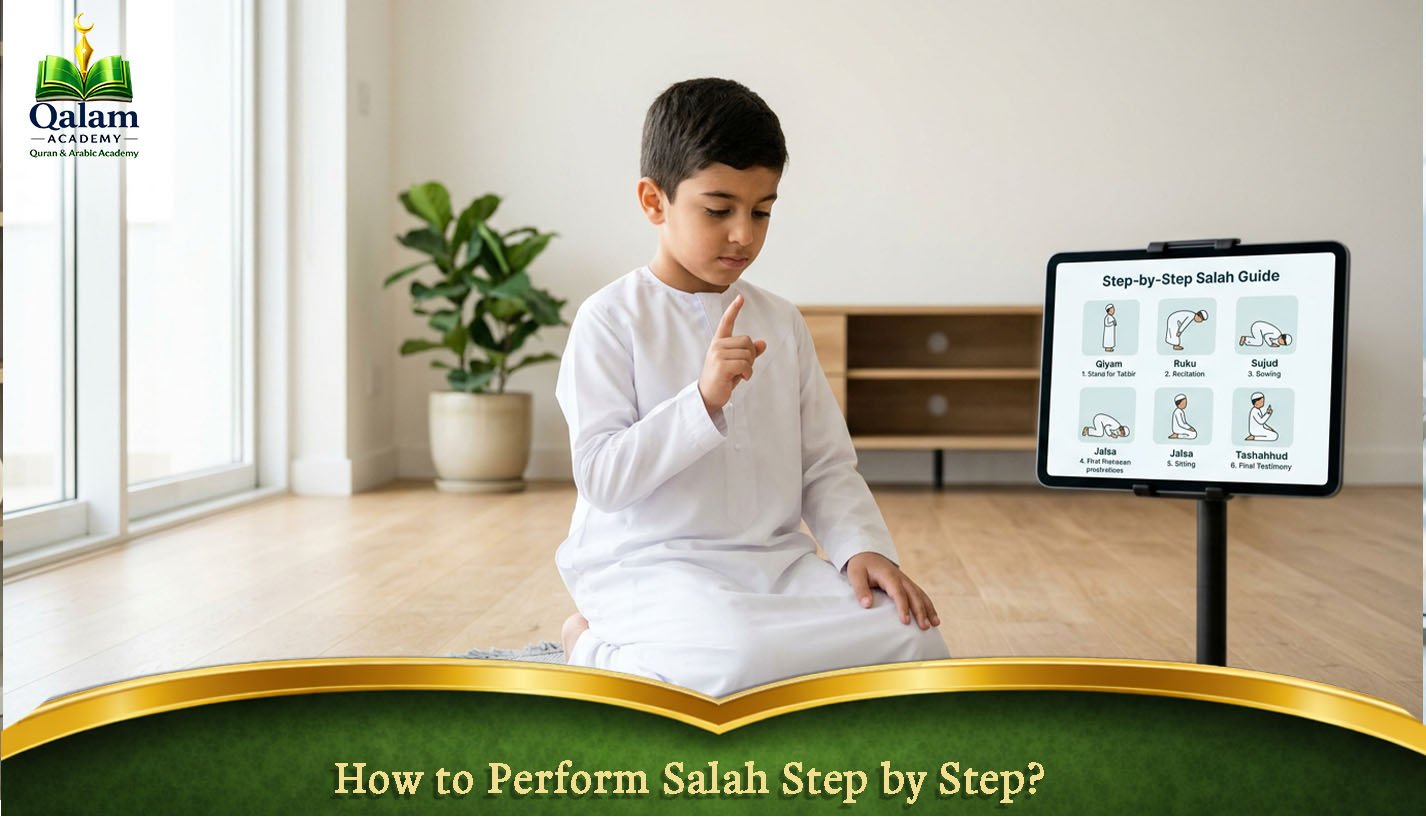
How to perform salah step by step is an important question for every Muslim who wants to learn how to pray correctly, confidently, and with greater concentration. Salah is one of the most important acts of worship in Islam, and learning its basic sequence helps beginners develop a consistent prayer routine.
For someone who is praying for the first time or trying to correct their technique, the process can initially seem difficult. There are several positions, recitations, movements, and sitting portions to learn. However, the prayer follows a clear structure. Once each part is understood individually, putting the complete salah together becomes much easier.
This guide from Qalam Online Quran Academy explains how to perform salah step by step in a practical way. It covers preparation, intention, standing, recitation, bowing, prostration, sitting, Tashahhud, and ending the prayer. The goal is not simply to memorize movements but to understand what happens during each part of salah and why concentration matters.
What Is Salah and Why Is Learning It Important?
Salah is the obligatory prayer performed by Muslims at specific times throughout the day and night. It provides a regular opportunity to worship Allah, remember Him, seek His guidance, and step away from everyday distractions.
For beginners, learning how to perform salah step by step is about more than memorizing Arabic phrases. A person also needs to understand the order of the prayer so that the movements and recitations become natural over time.
Regular salah can help establish discipline because the five obligatory prayers are connected to specific times. Moreover, prayer encourages mindfulness and gives Muslims an opportunity to turn their attention toward Allah throughout the day.
A beginner may need time to memorize the required recitations. Therefore, patience is essential. Rather than trying to learn everything in one session, it is usually easier to divide the prayer into smaller sections and practice each one repeatedly.
Start Learning with Qalam Online Quran Academy Today
Take the first step toward a stronger connection with the Quran and Islamic knowledge. At Qalam Online Quran Academy, our qualified teachers provide personalized one-on-one classes for children, adults, and beginners.
Enjoy flexible schedules, interactive lessons, and a supportive learning environment designed to help you achieve your goals. Begin your Quran learning journey with confidence.

How to Prepare Before You Perform Salah?
Before focusing on how to perform salah step by step, a beginner should understand the basic conditions and preparation required before prayer.
The exact legal details can vary according to circumstances and schools of Islamic jurisprudence. In general, preparation includes:
- Performing wudu when purification is required.
- Making sure the body, clothing, and prayer place are appropriately clean.
- Covering the required parts of the body.
- Facing the direction of the Ka’bah.
- Waiting until the appropriate prayer time begins.
- Having the intention to perform the specific prayer.
- Choosing a suitable place where the prayer can be performed with concentration.
Preparation matters because salah is not simply a sequence of physical exercises. It is an act of worship that deserves attention and respect.
If a beginner is unsure about purification, clothing requirements, prayer times, or the direction of prayer, learning these subjects alongside the actual movements can make the entire process easier.
How Many Rak‘ahs Are in the Five Daily Prayers?
Understanding the number of rak‘ahs makes how to perform salah step by step much easier because every prayer consists of one or more units.
The five obligatory prayers are commonly summarized as follows:
- Fajr: 2 obligatory rak‘ahs.
- Dhuhr: 4 obligatory rak‘ahs.
- Asr: 4 obligatory rak‘ahs.
- Maghrib: 3 obligatory rak‘ahs.
- Isha: 4 obligatory rak‘ahs.
A rak‘ah contains a recognizable sequence of standing, recitation, bowing, returning to standing, prostration, sitting, and another prostration.
The main difference between the five prayers is therefore not that they have completely different movements. Instead, the number of rak‘ahs and some details of recitation distinguish them.
Once a student understands one complete rak‘ah, learning the structure of the longer prayers becomes considerably easier.
How to Perform Salah Step by Step?
The following sections explain the basic prayer sequence in an organized way. Beginners can study one stage at a time instead of trying to memorize the entire prayer at once.
Step 1: How to Perform Salah Step by Step With the Right Intention
The first stage in learning how to perform salah step by step involves understanding the intention, or niyyah.
Make the intention in your heart before starting the prayer. A Muslim intends to perform the specific prayer for Allah. You do not need to turn the intention into a complicated verbal statement.
For example, before Fajr, you know in your heart that you will perform the obligatory Fajr prayer. The same principle applies to Dhuhr, Asr, Maghrib, and Isha.
The intention distinguishes the act of worship and confirms that you perform the prayer sincerely for Allah.
Beginners sometimes worry unnecessarily about whether they formed the intention correctly. Instead, keep your intention clear in your heart and then begin the prayer.
Step 2: How to Perform Salah Step by Step With Takbir
After making the intention, stand properly for prayer and begin with Takbirat al-Ihram.Raise your hands according to the practice you follow and say:
Allahu Akbar
This means that Allah is greater. This opening Takbir marks the beginning of the formal prayer. From this moment, focus your attention on salah and avoid ordinary activities that do not belong in prayer.
For anyone learning how to perform salah step by step, this moment creates a clear transition from daily activities to worship.
Stand calmly instead of rushing into the next movement. Take a moment to become mentally present and remember that you stand before Allah.
Step 3: How to Perform Salah Step by Step While Standing
After the opening Takbir, place your hands according to the practice taught by your qualified teacher or the school of jurisprudence you follow.
Recognized Islamic traditions differ on the exact position of the hands. Therefore, beginners should not feel confused when they see Muslims standing in slightly different ways.
Focus on maintaining a respectful standing position and continue with the appropriate recitation.
A calm posture can also improve concentration. Instead of constantly worrying about whether every movement looks perfect, focus on learning the essential sequence correctly.
Step 4: How to Perform Salah Step by Step During Qiyam
Standing during prayer is known as qiyam. During this position, recite from the Quran.
Direct your gaze toward an appropriate point to help maintain concentration. Also, minimize unnecessary movements throughout the recitation.
Learning how to perform salah step by step becomes easier when you understand the purpose of every position.
Qiyam gives you an opportunity to listen to the words you recite and reflect on their meaning. Beginners who understand the translation of the short surahs they recite may find it easier to remain attentive.
Rather than repeating the words mechanically, try to connect each passage with its meaning.
Step 5: How to Perform Salah Step by Step With Surah Al-Fatihah
The next major part of the prayer involves reciting Surah Al-Fatihah.
The surah begins with:
Bismillahir-Rahmanir-Raheem
It includes praise of Allah, recognition of His mercy, acknowledgment of His authority, and a request for guidance to the straight path.
Gradually learn the correct Arabic pronunciation instead of relying permanently on transliteration. Correct pronunciation matters when you recite the Quran during salah.
After Al-Fatihah, recite an additional passage from the Quran in the relevant rak‘ahs according to the prayer and the practice you follow.
If you are still learning the Arabic text, work with a qualified Quran teacher. A teacher can listen to your recitation and correct pronunciation as you practice.
Step 6: How to Perform Salah Step by Step in Ruku
Once you complete the standing recitation, move into ruku, the bowing position.
Say:
Allahu Akbar
as you move into ruku.
In ruku, keep your back stable and respectful as much as reasonably possible. Place your hands on your knees according to the commonly taught method.
The standard glorification commonly recited in this position is:
Subhana Rabbiyal-Azeem
This phrase praises Allah as the Magnificent.
Do not rush through ruku. Allow enough time to settle into the position and complete the required remembrance with composure.
Learning how to perform salah step by step also means learning to move calmly between positions. Salah should not feel like a race from one movement to another.
Step 7: How to Perform Salah Step by Step When Rising From Ruku
After ruku, return to an upright standing position.
Say:
Sami‘Allahu liman hamidah
This phrase expresses that Allah hears those who praise Him.
After you reach the standing position, praise Allah with an appropriate phrase such as:
Rabbana wa lakal-hamd
which means, “Our Lord, to You belongs all praise.”
Settle your body before moving into the next position.
For beginners, this transition matters because each position should remain distinct. Taking a brief moment to become stable can improve both physical form and concentration.
Step 8: How to Perform Salah Step by Step in Sujud
The next movement is sujud, or prostration.
Say:
Allahu Akbar
as you move into prostration.
During sujud, place the relevant parts of your body on the ground according to the established method of prayer. These include the forehead and nose, hands, knees, and feet.
Sujud represents humility and submission before Allah and holds a special place in salah.
A commonly recited phrase during prostration is:
Subhana Rabbiyal-A‘la
This phrase praises Allah as the Most High.
When learning how to perform salah step by step, pay particular attention to the difference between ruku and sujud. Ruku means bowing, while sujud means full prostration.
Step 9: How to Perform Salah Step by Step While Sitting
After the first sujud, rise into the sitting position while saying:
Allahu Akbar
Remain seated briefly and maintain a composed posture.
A commonly recited supplication is:
Rabbighfir li
which means, “My Lord, forgive me.”
Do not skip this sitting position or perform it so quickly that you fail to settle properly.
Beginners often focus heavily on memorizing Arabic phrases. However, understanding the meaning of each supplication can make the prayer more personal and meaningful.
As your knowledge grows, learn additional authentic supplications that you can use during the appropriate parts of the prayer.
Step 10: How to Perform Salah Step by Step in the Second Sujud
From the sitting position, move into the second prostration.
Again, say:
Allahu Akbar
and perform sujud.Repeat the appropriate glorification during prostration.
At this point, you have completed the basic movement sequence of one rak‘ah: standing, recitation, ruku, standing again, first sujud, sitting, and second sujud.
This sequence represents one of the most important patterns to remember when studying how to perform salah step by step.
Once this pattern becomes familiar, completing two-, three-, and four-rak‘ah prayers becomes much easier.
How to Perform Salah Step by Step in the Second Rak‘ah?
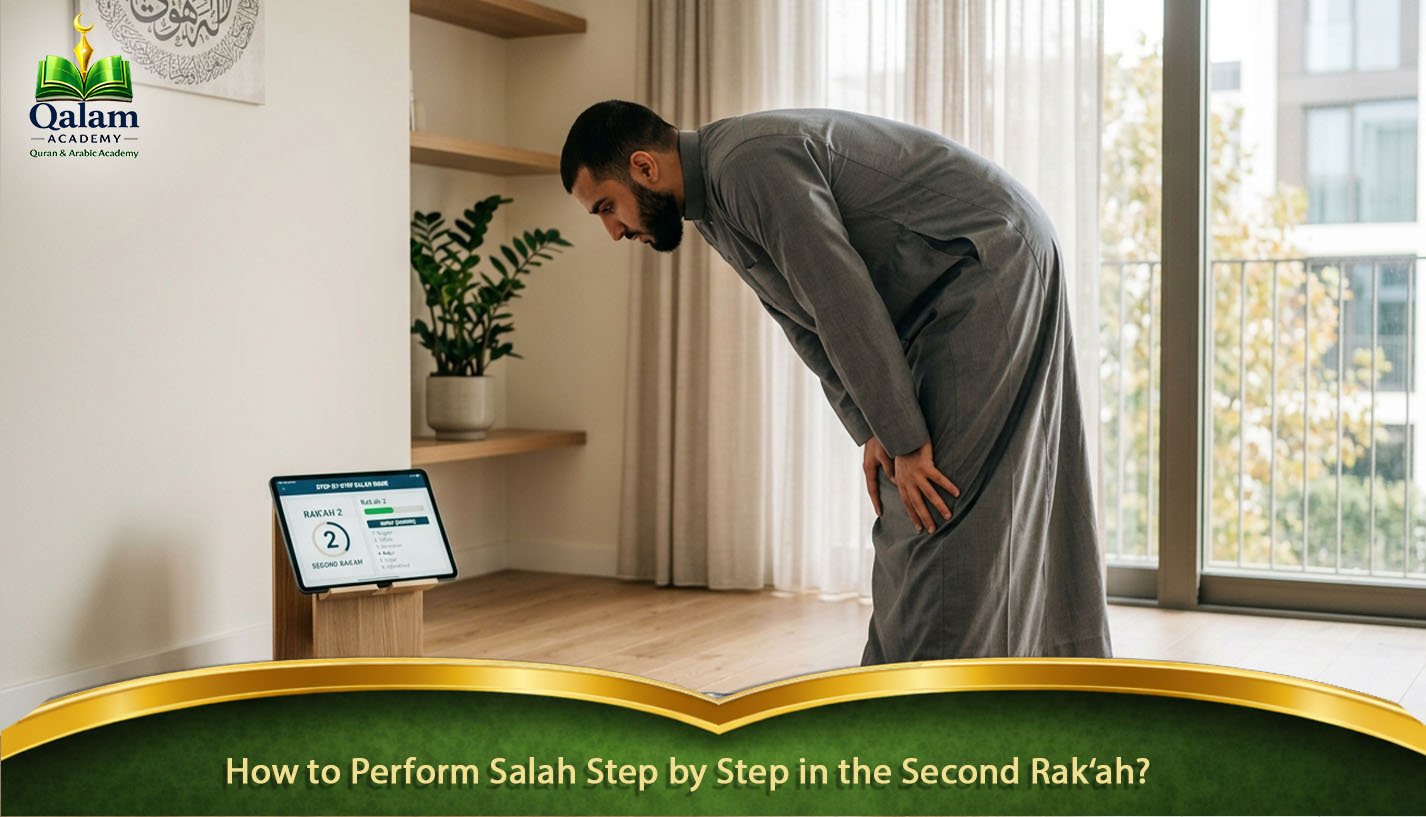
After the second sujud of the first rak‘ah, stand for the next rak‘ah while saying:
Allahu Akbar
The second rak‘ah follows the same general sequence. Stand and recite, then perform ruku, return to standing, complete the first sujud, sit briefly, and perform the second sujud.
Recitation practices can differ depending on the prayer and jurisprudential school. Therefore, beginners should follow a reliable teacher instead of combining instructions from unrelated sources.
For anyone learning how to perform salah step by step, repeating the same basic sequence builds confidence.
Once you complete the second rak‘ah, sit for Tashahhud.
How to Perform Salah Step by Step With Tashahhud?
Tashahhud forms the sitting portion after two rak‘ahs in the appropriate prayers.Sit and recite the established words of Tashahhud. The recitation includes praise of Allah, peace upon the Prophet Muhammad, and testimony to the oneness of Allah and the prophethood of Muhammad.
A commonly taught text begins:
At-tahiyyatu lillahi was-salawatu wat-tayyibat…
Learn the complete wording from a qualified teacher or reliable Quran and Sunnah resource so you can check both pronunciation and wording.
Raise the index finger according to the practice you follow. Because Muslims differ on some details, beginners should not assume that every variation they see represents an error.
After Tashahhud, either continue into another rak‘ah or move toward the end of the prayer. The next step depends on whether the prayer contains two, three, or four obligatory rak‘ahs.
How to Perform Salah Step by Step for Three-Rak‘ah Prayers?
Maghrib contains three obligatory rak‘ahs. The first two rak‘ahs follow the normal sequence. After the second rak‘ah, sit for the first Tashahhud.
Do not end the prayer at this point. Instead, stand for the third rak‘ah. Complete the third rak‘ah according to the appropriate recitation and movement pattern. After its two prostrations, sit for the final Tashahhud.
This distinction matters for beginners because sitting after two rak‘ahs does not always mean that the prayer has ended.
If you remain unsure about the sequence, practice with a teacher who can demonstrate the prayer slowly and explain when you should stand and when you should remain seated.
How to Perform Salah Step by Step for Four-Rak‘ah Prayers?
Dhuhr, Asr, and Isha each contain four obligatory rak‘ahs. Complete the first rak‘ah and then the second rak‘ah. After the second rak‘ah, sit for Tashahhud and then stand for the third rak‘ah.
Next, complete the third rak‘ah and move into the fourth rak‘ah. After completing the fourth rak‘ah, remain seated for the final Tashahhud.
This structure can initially seem complicated. However, remembering the pattern makes it much simpler:
- Rak‘ah 1: Complete the normal sequence.
- Rak‘ah 2: Complete the sequence and sit for Tashahhud.
- Rak‘ah 3: Stand and complete the next unit.
- Rak‘ah 4: Complete the final unit and sit for the final Tashahhud.
- Finish: End the prayer with Tasleem.
Consequently, beginners do not need to memorize five completely different prayers. Instead, they need to understand how the same basic rak‘ah structure works across different prayers.
How to Perform Salah Step by Step During the Final Tashahhud?
After the final rak‘ah, sit for the final Tashahhud. Recite Tashahhud and then send blessings upon Prophet Muhammad according to the established prayer formula.
One commonly taught portion is the Salat Ibrahimiyyah, which begins with:
Allahumma salli ‘ala Muhammad…
Learning this portion accurately can take time. Therefore, break it into short phrases and repeat each phrase until you remember it confidently.
At this stage, do not rush simply because you want to finish the prayer. The final sitting forms an important part of salah, so complete it calmly.
For students following Qalam Online Quran Academy, structured practice with a teacher can make memorizing Tashahhud and other essential recitations easier because the teacher can correct pronunciation during practice.
How to Perform Salah Step by Step With Tasleem
The final stage in how to perform salah step by step is Tasleem. After completing the final sitting and required supplications, turn your head to the right and say:
Assalamu ‘alaykum wa rahmatullah
Then turn toward the left and repeat the greeting. This action marks the end of the prayer.
Once you complete the Tasleem, the formal salah ends. You can then make personal dua and engage in other permissible activities.
For beginners, memorizing the ending separately can help the complete prayer feel more familiar.
Common Mistakes When Learning How to Perform Salah Step by Step
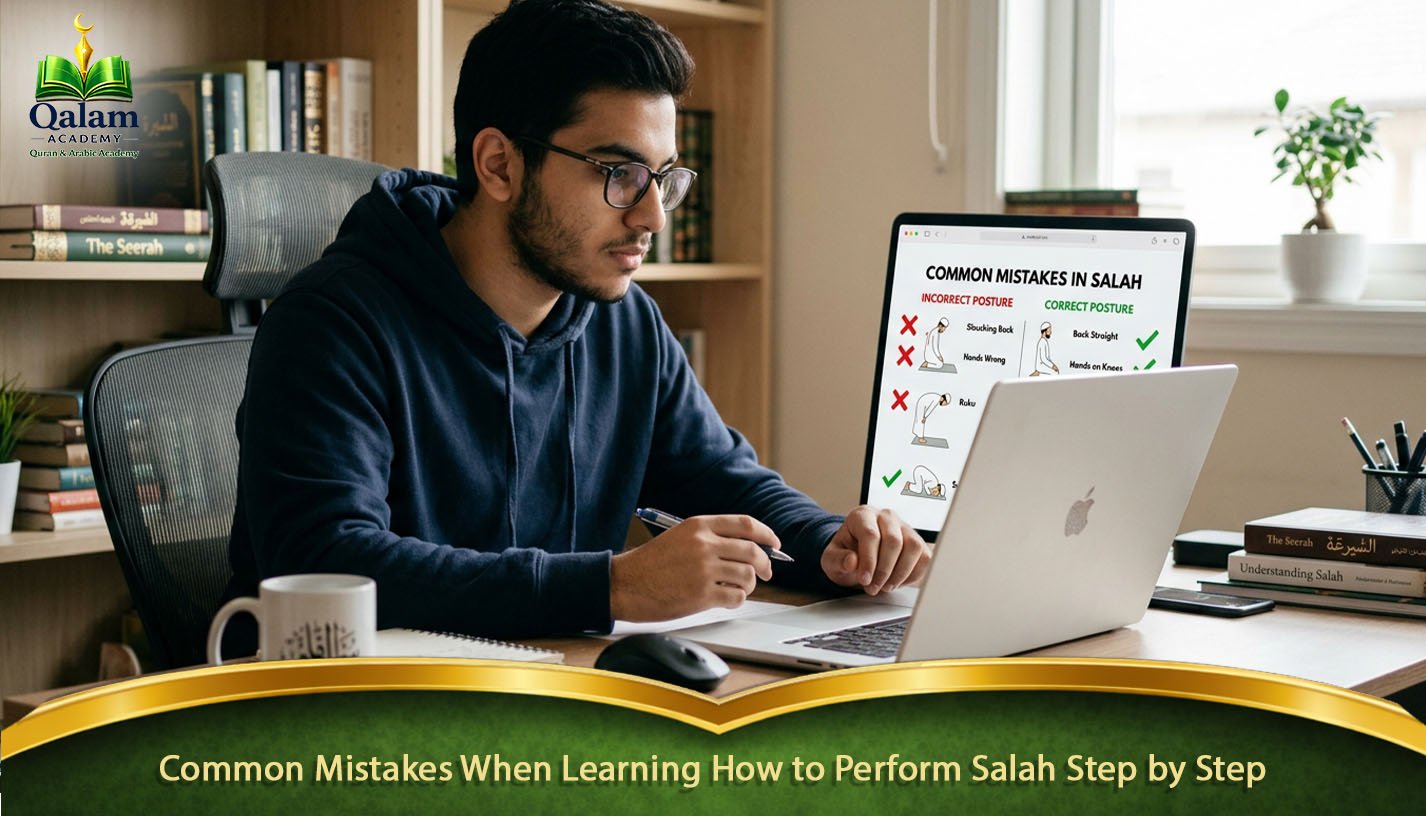
Learning how to perform salah step by step becomes easier when beginners recognize habits that can interfere with their progress. Understanding the purpose of prayer and learning gradually can also help new Muslims build confidence.
Those who are beginning their Islamic journey may also benefit from reading about how to convert to Islam step by step before developing a regular prayer routine.
1. Rushing Through the Movements
Moving too quickly can make it difficult to maintain composure. Allow each position to settle before moving to the next one.
2. Focusing Only on Physical Movements
Prayer involves more than physical movement. Try to understand the meanings of the verses and supplications you recite.
3. Trying to Memorize Everything at Once
A better approach involves learning the opening Takbir, Al-Fatihah, basic glorifications, Tashahhud, and ending gradually. You can also expand your Islamic knowledge over time by learning about the 99 names of Allah and their meanings and reflecting on their significance.
4. Becoming Confused by Minor Differences
Muslims may follow different recognized schools and teachers. Therefore, differences in hand position or certain movements do not automatically mean that someone has prayed incorrectly.
5. Ignoring Pronunciation
Quranic Arabic requires careful pronunciation. Regular correction from a qualified teacher can prevent pronunciation mistakes from becoming habits.
6. Losing Focus Because of Perfectionism
Beginners naturally make mistakes while learning. Instead of becoming discouraged, identify the specific part that needs improvement and practice it.
How to Improve Concentration When Learning How to Perform Salah Step by Step?
Understanding how to perform salah step by step represents only one part of developing a strong prayer routine. Concentration provides another important part of that process.
Before prayer, reduce distractions whenever possible. Put away unnecessary devices, choose a quiet place, and give yourself enough time so you do not begin the prayer while feeling rushed.
It can also help to learn the meanings of the passages you recite. When you understand that Al-Fatihah contains praise, worship, and a request for guidance, the recitation can become more meaningful.
Additionally, remember that concentration develops gradually. Some days may feel easier than others. The goal is to keep returning your attention to Allah whenever your mind wanders.
A structured learning program can also help. Qalam Online Quran Academy can provide learners with an organized environment for improving Quran reading, pronunciation, and foundational Islamic knowledge. If you are exploring whether digital learning can meet your needs, consider can you can really learn Quran online effectively before choosing a suitable learning approach.
How to Learn How to Perform Salah Step by Step as a Beginner?
A simple learning plan can make how to perform salah step by step much less overwhelming. Start with the structure of one rak‘ah. Learn where you stand, when you bow, when you prostrate, and when you sit.
Then focus on the essential recitations. Learn Al-Fatihah first because it plays a central role in the prayer. Afterward, learn the short supplications used in ruku and sujud.
Next, memorize Tashahhud and the final prayer portions. Finally, practice combining everything into the complete Fajr prayer before learning the differences between the longer prayers.
A helpful routine could include:
- Practice one movement at a time.
- Listen to accurate Arabic pronunciation.
- Repeat short phrases every day.
- Practice the complete sequence regularly.
- Ask a qualified teacher to correct mistakes.
- Learn the meanings of the words you recite.
- Review previously learned material instead of constantly adding new material.
This gradual approach can help both children and adults who are beginning from scratch. It also reinforces the value of guided learning, especially when students wonder Can you memorize Quran without a teacher and want to understand the advantages of receiving direct instruction.
Why a Qualified Teacher Can Help You Learn How to Perform Salah Step by Step?
Although written guides can explain the basic process, they cannot always show whether your posture, pronunciation, or sequence needs correction.
A teacher can observe your recitation and movements and provide immediate feedback. This support becomes particularly valuable when you learn Quranic pronunciation because small differences in Arabic sounds can affect accuracy.
Online learning can also provide flexibility for families and adults who cannot attend regular in-person lessons. Qalam Online Quran Academy can support learners who want structured Quran education from home while receiving guidance from a teacher.
However, students should continue practicing independently between lessons. Combining direct instruction with regular personal practice can produce better results than relying on either method alone. Once learners become comfortable with Quran study and prayer, they may also explore other forms of Islamic worship, including how to perform Umrah step by step.
How to Perform Salah Step by Step? A Quick Review
For quick revision, remember the basic pattern of a rak‘ah as follows:
- Make the intention.
- Stand for prayer.
- Say the opening Takbir.
- Remain standing and recite.
- Perform ruku.
- Return to standing.
- Perform the first sujud.
- Sit briefly.
- Perform the second sujud.
- Stand for the next rak‘ah when required.
- Sit for Tashahhud at the appropriate point.
- Complete the final Tashahhud.
- End with Tasleem.
Learn the exact recitation details and physical practices according to the recognized method you follow.
The key is to understand the overall sequence first. Once the structure becomes familiar, memorizing individual recitations becomes considerably easier.
How Does Qalam Online Quran Academy Support Salah Learning?

Learning salah should remain a gradual process rather than a source of unnecessary stress. Students often need help with pronunciation, Quran recitation, memorization, and understanding the order of movements.
Qalam Online Quran Academy can provide a structured option for learners who prefer online Quran education. Studying with a teacher allows students to ask questions, practice recitation, and receive corrections instead of relying exclusively on written instructions.
For children, structured lessons can also help parents establish a consistent learning routine. Adults can benefit from flexible scheduling that allows them to continue Quran education alongside work and family responsibilities.
The main objective is to develop confidence while maintaining accuracy and respect for the prayer.
Frequently Asked Questions About How to Perform Salah Step by Step
The following questions address practical concerns that beginners may have when starting their prayer journey.
1. How long does it usually take a beginner to learn salah?
There is no fixed period because learning speed depends on previous Quran knowledge, Arabic pronunciation, memorization ability, and regular practice. Someone who practices consistently may learn the basic sequence quickly, while memorizing all required recitations can take longer.
2. Can a new Muslim learn salah without knowing Arabic?
Yes, a new Muslim can begin learning the prayer while gradually developing Arabic recitation skills. However, learning the Arabic words used in salah should remain an important goal because the formal prayer includes established Quranic and supplication texts.
3. What should I do if I forget part of a recitation during prayer?
The appropriate response depends on what you forgot and the circumstances of the prayer. Because rulings can differ according to the situation and school of jurisprudence, consult a qualified scholar or teacher for specific cases instead of relying on a general internet answer.
4. Is it better to learn salah alone or with a teacher?
Self-study can introduce the basic sequence, but a qualified teacher can identify pronunciation and movement errors that may remain difficult to notice independently. For beginners, combining a reliable guide with direct instruction can provide greater confidence and accuracy.
In conclusion, learning how to perform salah step by step becomes much easier when you divide the prayer into manageable parts. Start by understanding the rak‘ah structure, then gradually learn the required recitations and sitting portions.
Remember that salah involves more than completing a series of movements. It is an act of worship that brings a Muslim closer to Allah and creates regular moments of remembrance throughout the day.
Therefore, beginners should focus on accuracy, patience, understanding, and consistency. Do not become discouraged by early mistakes. With regular practice and qualified guidance, the sequence becomes more familiar and the recitations become easier to remember.
For learners who want structured Quran education, Qalam Online Quran Academy can provide a supportive learning environment where students can progressively develop Quran reading, pronunciation, memorization, and foundational Islamic knowledge.
Most importantly, approach salah with sincerity. As your knowledge increases, continue improving your recitation, posture, concentration, and understanding. With steady practice, what initially seems complicated can become a familiar and meaningful part of everyday life.