


The best way to learn Arabic Conversation Online depends on how effectively a learner combines listening, speaking, vocabulary, pronunciation, and regular interaction. Arabic conversation cannot be developed through memorizing isolated words or studying grammar rules alone. Instead, learners need opportunities to hear natural Arabic, respond to questions, build sentences, and receive useful corrections.
For many students, online learning provides a convenient way to practice these skills without changing their daily routine. A well-organized program can also help learners move from basic expressions to longer conversations at a comfortable pace. Rather than trying to memorize everything at once, students can develop communication skills through repeated exposure and guided practice.
At Qalam Online Quran Academy, learners can approach Arabic communication as a gradual process. The goal is not simply to recognize vocabulary but to understand how words work together in meaningful situations. Therefore, a useful learning plan should connect vocabulary, pronunciation, listening, grammar, and speaking from the beginning.
What Is the Best Way to Learn Arabic Conversation Online?

The Best Way to Learn Arabic Conversation Online starts with active communication rather than passive study. Reading a vocabulary list may introduce new words, but using those words in a conversation makes them easier to remember and retrieve later. A practical online learning routine usually includes several connected activities:
- Listening to clear Arabic conversations.
- Repeating useful expressions aloud.
- Practicing questions and answers.
- Learning vocabulary through everyday situations.
- Building complete sentences.
- Receiving corrections from a teacher.
- Reviewing previously learned expressions.
- Gradually increasing conversation difficulty.
This approach gives learners a reason to use Arabic instead of simply studying it. For example, learning words related to food becomes more useful when the student practices ordering a meal, asking about ingredients, and responding to a waiter.
Moreover, conversation practice should match the learner’s current level. Beginners need short exchanges and familiar vocabulary, while intermediate students can discuss experiences, preferences, and daily activities. Advanced learners can gradually move toward detailed explanations, opinions, and spontaneous discussions.
Start Learning with Qalam Online Quran Academy Today
Take the first step toward a stronger connection with the Quran and Islamic knowledge. At Qalam Online Quran Academy, our qualified teachers provide personalized one-on-one classes for children, adults, and beginners.
Enjoy flexible schedules, interactive lessons, and a supportive learning environment designed to help you achieve your goals. Begin your Quran learning journey with confidence.

Why does Online Arabic Conversation Practice Work?
Online learning can create a direct connection between instruction and communication. Instead of spending an entire lesson listening to explanations, students can divide their time between learning new material and using it.
The main advantage is consistency. A learner who practices speaking several times each week has more opportunities to turn passive vocabulary into active language. Consequently, words that initially require conscious effort can become easier to retrieve.
Another benefit is individualized feedback. During a live lesson, a teacher can notice pronunciation problems, unclear sentence structures, or repeated grammatical mistakes. The learner can then correct the problem before it becomes a deeply established habit.
Online lessons can also make practice more focused. A teacher may introduce a specific situation, such as introducing yourself, asking for directions, discussing family members, or describing a daily routine. The learner then uses relevant vocabulary within that context.
For this reason, successful online conversation learning should not depend on watching lessons alone. Students need to speak, listen, make mistakes, receive feedback, and try again.
Best Way to Learn Arabic Conversation Online Through Listening
Listening is one of the foundations of spoken Arabic. Before learners can respond naturally, they need to become familiar with Arabic sounds, common expressions, sentence patterns, and different speaking speeds.
A strong listening routine does not require understanding every word. Instead, learners can begin by identifying the main idea and recognizing familiar expressions. With regular exposure, their ability to distinguish individual words usually becomes stronger.
For example, a beginner might listen to a short dialogue about introductions. The first attempt may focus only on recognizing greetings. During the second listening, the learner can identify names, countries, or occupations. Finally, the student can repeat the dialogue and answer similar questions independently.
This process turns listening into active preparation for speaking.
Students should also listen to material that is appropriate for their level. Content that is far beyond their ability may create frustration rather than useful practice. On the other hand, material that is slightly challenging can encourage gradual improvement.
At Qalam Online Quran Academy, learners can use guided instruction to connect listening with speaking practice rather than treating these skills as completely separate activities.
How Speaking Practice Improves Arabic Conversation?
Speaking requires a different type of knowledge from recognizing Arabic on a page. A learner may understand a sentence while reading it but still struggle to produce a response quickly.
That difference is normal. Speaking requires the brain to retrieve vocabulary, organize grammar, pronounce sounds, and communicate an idea at the same time.
Therefore, regular speaking practice is essential. A productive lesson can include:
- Short question-and-answer exercises.
- Guided conversations.
- Role-playing everyday situations.
- Description activities.
- Vocabulary challenges.
- Pronunciation correction.
- Short presentations.
- Follow-up questions.
Initially, learners may depend heavily on prepared sentences. Gradually, they can replace those sentences with their own ideas. This progression is important because real conversations rarely follow a memorized script.
For example, a student may first learn how to say where they live. Later, the teacher can ask why they like the area, what they do there, or how long they have lived there. Such follow-up questions encourage spontaneous communication.
That is why the Best Way to Learn Arabic Conversation Online involves controlled practice first and increasingly natural interaction later.
Building Everyday Arabic Vocabulary for Conversation
Vocabulary becomes much more useful when learners organize it around situations rather than memorizing unrelated lists.
Instead of studying dozens of disconnected words, students can build vocabulary groups around topics such as:
- Daily Activities: Learners can practice words and expressions related to waking up, eating breakfast, going to work, studying, shopping, exercising, and relaxing.
- Family and Relationships: Conversation practice can include describing family members, discussing responsibilities, asking about relatives, and explaining family routines.
- Travel and Transportation: Students can learn how to ask for directions, purchase tickets, discuss destinations, and describe transportation problems.
- Shopping and Food: Useful expressions can cover prices, quantities, preferences, ingredients, ordering food, and asking for assistance.
- Time and Scheduling: Learners can practice talking about days, appointments, routines, plans, and deadlines. This contextual approach makes vocabulary easier to retrieve because every expression is connected to a practical situation.
Furthermore, students should learn complete phrases alongside individual words. A phrase can show how a word behaves in a sentence, which makes later speaking more natural.
Best Way to Learn Arabic Conversation Online With a Teacher
A teacher can make online conversation practice more purposeful by controlling the difficulty and giving immediate feedback.
However, the teacher’s role should not be limited to explaining grammar. Conversation lessons should give the learner enough time to speak. A useful lesson might follow this structure:
- Review expressions from the previous lesson.
- Introduce a small set of new vocabulary.
- Explain pronunciation or grammar where necessary.
- Model a short conversation.
- Let the learner practice with guidance.
- Introduce variations of the same situation.
- Correct important errors.
- Finish with independent speaking practice.
This structure creates a clear progression. The learner first receives support, then gradually becomes responsible for producing language independently.
Qalam Online Quran Academy can be presented as a learning option for students who want structured online instruction while developing their Arabic communication skills. The important point is that learners should choose a program based on their level, goals, schedule, and preferred learning approach.
How to Choose the Right Arabic Conversation Program?
Finding an online Arabic program requires more than looking at a course title. Learners should consider how the program actually supports speaking development. Before joining a course, ask:
- Does the program include live speaking practice?
- Can the teacher correct pronunciation?
- Is the curriculum suitable for your current level?
- Are lessons focused on practical communication?
- Can you ask questions during the lesson?
- Does the program provide opportunities for spontaneous speaking?
- Is the schedule compatible with your routine?
- Can the learning pace be adjusted when necessary?
These questions help separate conversation-focused instruction from courses that mainly emphasize passive study. Learners who also want to develop practical religious communication may benefit from resources such as how to perform salah step by step, particularly when they want language practice connected to familiar Islamic situations.
A beginner may need a different structure from someone who already understands Arabic but cannot speak comfortably. Similarly, a student learning Arabic for travel may have different priorities from someone interested in understanding Islamic texts.
Consequently, the right program is one that matches the learner’s actual objective.
Best Way to Learn Arabic Conversation Online for Beginners
Beginners should avoid trying to speak about complicated subjects too early. A stronger approach is to build confidence through simple, repeatable conversations. The first stage can focus on:
- Greetings and introductions.
- Names and personal information.
- Numbers and basic time expressions.
- Family vocabulary.
- Common classroom phrases.
- Food and drinks.
- Simple questions.
- Basic daily routines.
At this stage, repetition has an important role. However, repetition should not mean repeating the same sentence endlessly. Instead, learners can change one part of the sentence each time.
For instance, after learning how to say where they live, students can replace the city, country, or reason for living there. This creates several new sentences from one basic pattern.
Beginners should also expect mistakes. Errors are a normal part of developing spoken ability. The objective is to identify recurring problems and gradually reduce them rather than expecting perfect Arabic from the first lesson.
With steady practice, simple responses can become longer exchanges. Learners studying Arabic alongside Quran reading can also become familiar with the etiquette of reading the quran, which provides useful cultural and religious context for students encountering Islamic Arabic.
Moving From Basic Sentences to Natural Conversations
Once a learner becomes comfortable with basic questions, the next challenge is connecting ideas.
Instead of answering with one sentence, students can practice giving a reason, adding a detail, or asking a question in return. For example:
- Question: What do you like to do in your free time?
- Basic answer: I like reading.
- Expanded answer: I like reading because it helps me relax. I usually read in the evening.
The second response requires more vocabulary and grammar, but it also sounds more natural.
Teachers can encourage this development by asking follow-up questions. Students then learn that conversations involve interaction rather than isolated answers. At an intermediate level, learners can practice:
- Describing experiences.
- Comparing two options.
- Explaining preferences.
- Discussing plans.
- Retelling a simple story.
- Giving directions.
- Expressing agreement or disagreement.
- Explaining a problem.
These activities prepare learners for conversations that cannot be predicted in advance. Students interested in Islamic contexts may encounter vocabulary related to purification, prayer, and worship, making questions such as Is it permissible to read quran without wudu useful as examples of language connected to everyday religious discussions.
Best Way to Learn Arabic Conversation Online Through Role-Play
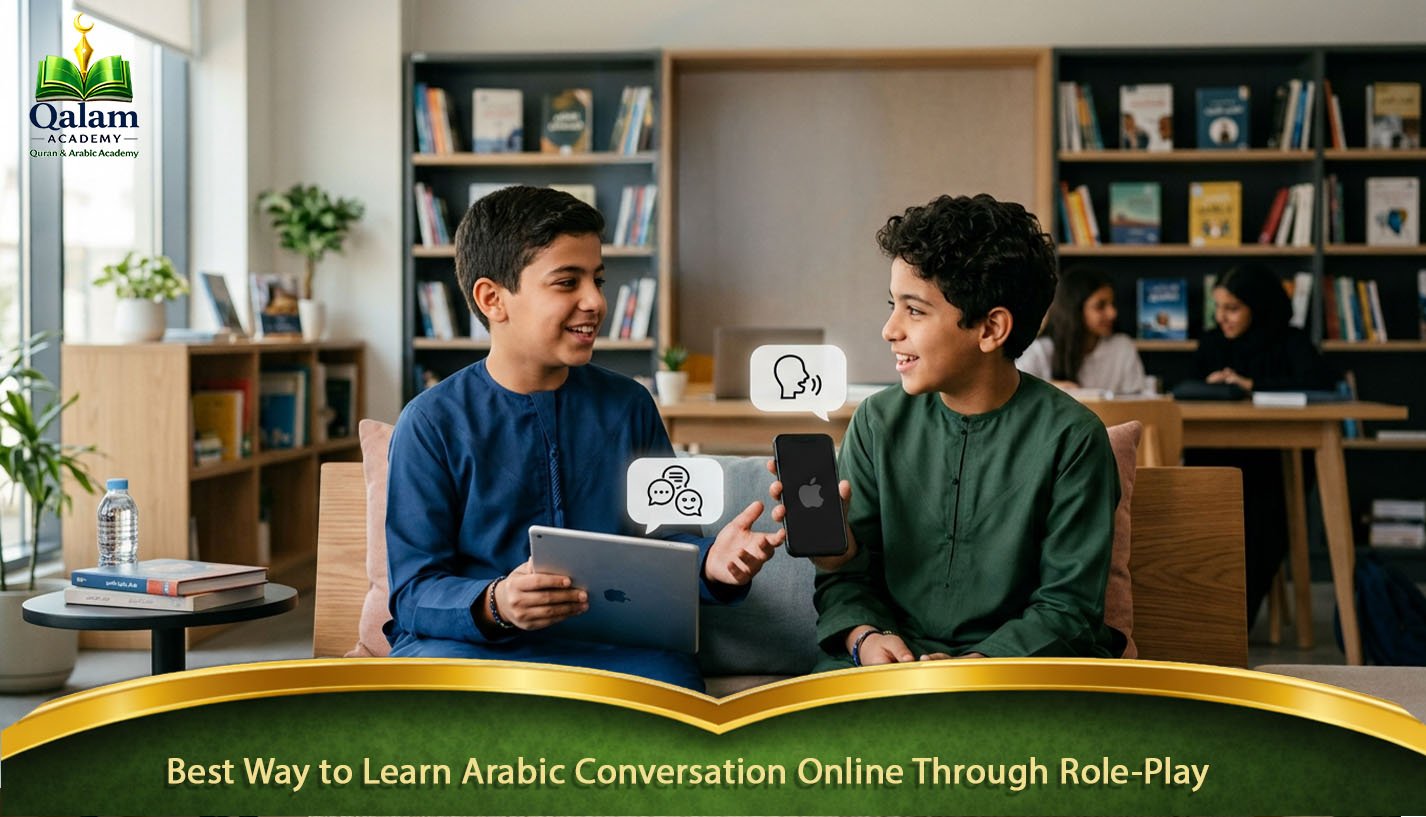
Role-play is particularly useful because it allows students to practice realistic situations without the pressure of an actual social interaction.
A lesson could simulate a conversation at a restaurant. The student might order food, ask about ingredients, request the bill, and respond to additional questions.
Another lesson could involve traveling. The learner may need to ask where a station is, confirm a destination, purchase a ticket, or explain that they need assistance. Other useful role-play situations include:
- Meeting someone for the first time.
- Visiting a doctor.
- Shopping for clothes.
- Booking accommodation.
- Talking to a colleague.
- Making a phone call.
- Asking for directions.
- Discussing a daily schedule.
The value of role-play comes from repetition with variation. Students should encounter similar situations with different vocabulary and unexpected questions.
That method helps them become more flexible speakers. For learners practicing Arabic with children or family members, topics connected to Quran memorization can also provide meaningful conversation practice. A resource such as how to help a child memorize quran with a weak memory can introduce vocabulary related to learning, practice, memory, and family support.
Learners can also use religious occasions as conversation topics. For example, discussing Friday practices can introduce useful vocabulary and questions while giving students a familiar subject to describe, such as the virtue of Surah Al-Kahf on Friday.
Improving Arabic Pronunciation During Online Lessons
Pronunciation can affect both confidence and understanding. Some Arabic sounds may be unfamiliar to learners whose first language does not contain similar sounds.
Therefore, pronunciation practice should begin early rather than being postponed until advanced levels. A teacher can help students notice:
- Differences between similar Arabic sounds.
- Correct vowel pronunciation.
- Word stress and rhythm.
- Clear articulation.
- Common pronunciation mistakes.
- The difference between careful and natural speech.
Learners should listen carefully before attempting difficult sounds. Then they can repeat short words, phrases, and sentences.
Recording your own voice can also be useful. When students compare their pronunciation with a teacher’s model, they may notice differences that were difficult to recognize while speaking.
Importantly, pronunciation improvement takes time. A learner should focus on consistent progress rather than expecting immediate native-like speech.
Using Grammar Without Interrupting Conversation
Grammar is important, but conversation practice should not become a long grammar lecture.
Students need enough grammar to create understandable sentences. Nevertheless, they also need opportunities to use those structures without stopping after every sentence to analyze every rule.
For example, a teacher may introduce a useful sentence pattern and then provide several situations where the learner can use it. Corrections can focus on mistakes that affect meaning or repeatedly appear.This approach keeps grammar connected to communication. As learners progress, they can work with:
- Verb forms.
- Gender agreement.
- Singular and plural forms.
- Pronouns.
- Question structures.
- Negation.
- Past and present expressions.
- Prepositions.
- Sentence connectors.
Rather than memorizing rules in isolation, students can encounter them repeatedly during meaningful conversations.
Best Way to Learn Arabic Conversation Online With a Daily Routine
A consistent routine can make a major difference even when study sessions are relatively short. For example, a learner might divide practice into four parts:
- 10 minutes: Review previously learned vocabulary.
- 10 minutes: Listen to a short Arabic dialogue.
- 15 minutes: Speak using the day’s vocabulary.
- 5 minutes: Write down mistakes or difficult expressions.
The exact schedule can change according to the student’s circumstances. What matters most is regular exposure.
On days without a live lesson, learners can still practice by describing their surroundings, speaking about their plans, answering imaginary questions, or repeating useful expressions aloud.
Small daily activities can reinforce what was learned during formal lessons. Furthermore, reviewing older vocabulary prevents students from constantly replacing previous knowledge with new material.
How to Measure Progress in Arabic Conversation?
Conversation progress should not be measured only by the number of words a learner knows. Instead, students can evaluate several practical abilities:
- Can you introduce yourself without reading?
- Can you answer common questions?
- Can you ask follow-up questions?
- Can you describe your daily routine?
- Can you explain a simple problem?
- Can you understand the main idea of a short conversation?
- Can you speak for several minutes about a familiar topic?
- Can you recover when you forget a word?
These measurements provide a clearer picture of communication ability. A learner may still make grammatical mistakes while successfully maintaining a conversation. Likewise, someone may know many vocabulary items but struggle to use them quickly. Therefore, progress should consider both accuracy and communication.
Common Mistakes That Slow Arabic Conversation Progress
Some study habits can make speaking development harder than necessary.
- Memorizing Without Speaking
Vocabulary memorization is useful, but it does not automatically create conversational ability. Words need to appear in sentences and real communication. - Studying Only Grammar
Grammar provides structure, yet conversation requires active use. Learners should balance explanation with speaking. - Avoiding Mistakes
Trying to avoid every mistake can make students hesitant. Speaking practice naturally includes errors, corrections, and improvement. - Using Material That Is Too Difficult
Advanced content can be interesting, but beginners may gain more from shorter and clearer conversations. - Practicing Irregularly
Studying for several hours once every few weeks is usually less practical than maintaining shorter, regular sessions. - Translating Every Sentence
Constantly translating from English into Arabic can slow spontaneous speaking. Over time, learners should practice thinking directly in Arabic for familiar topics. Avoiding these habits can make the learning process more efficient.
Best Way to Learn Arabic Conversation Online at Intermediate Level
Intermediate learners often face a different problem from beginners. They may understand basic conversations but struggle to keep speaking when the topic changes.
At this stage, students should expand beyond predictable questions. Useful activities include:
- Giving personal opinions.
- Explaining advantages and disadvantages.
- Telling stories.
- Summarizing something they heard.
- Comparing experiences.
- Discussing everyday problems.
- Describing plans.
- Asking detailed follow-up questions.
The teacher can also introduce unfamiliar vocabulary while encouraging the learner to continue speaking.
If a student forgets a word, they can describe it instead of immediately switching to English. This skill is especially valuable because real conversations do not stop whenever a speaker forgets one expression.
Developing communication strategies therefore becomes as important as learning more vocabulary.
Advanced Arabic Conversation and Spontaneous Speaking
Advanced learners need opportunities to communicate ideas rather than simply answer prepared questions.
At this level, conversation can involve social issues, personal experiences, cultural topics, education, work, travel, or Islamic subjects according to the learner’s interests and goals. Students can practice:
- Defending an opinion.
- Explaining a complicated idea.
- Summarizing an argument.
- Comparing viewpoints.
- Telling detailed stories.
- Responding to unexpected questions.
- Reformulating a sentence when misunderstood.
The goal is greater flexibility.
A strong speaker does not need to know every Arabic word. Instead, the learner should know how to keep communication moving, clarify meaning, ask for repetition, and explain an idea using different words.
That ability develops through extensive interaction.
How Qalam Online Quran Academy Can Support Arabic Learning
Qalam Online Quran Academy can be relevant for learners who prefer structured online education and want to develop their Arabic abilities through guided instruction.
When evaluating an academy, students should still consider the specific course structure and whether it matches their goals. A useful learning environment should give learners opportunities to listen, speak, ask questions, and receive corrections.
For Arabic conversation, the learning process should remain practical. Students benefit when lessons connect vocabulary and grammar with situations they may actually encounter.
A structured program can also help learners avoid jumping randomly between unrelated resources. Instead, each lesson can build on previous knowledge and introduce the next level gradually.
Most importantly, students should remain active participants. Even a well-designed course cannot replace individual speaking practice between lessons.
Best Way to Learn Arabic Conversation Online With Independent Practice
Independent practice can strengthen the skills developed during live lessons.
Students can create simple speaking tasks based on their daily lives. For example, they can describe what they did during the day, explain what they plan to do tomorrow, or summarize a short video.
Another useful method is the question-and-answer technique. Write five questions about a familiar topic, answer them aloud, and then create one additional question after each answer.
Learners can also keep a personal vocabulary notebook. However, instead of recording only individual words, they can write:
- The word.
- Its meaning.
- A useful phrase.
- A sentence they created.
- A related question.
This format makes vocabulary more usable during conversation. Additionally, students can revisit difficult expressions several days later rather than studying them only once.
Creating a Practical Arabic Conversation Study Plan
A simple weekly plan can combine several skills without becoming overwhelming.
- Three Days of Speaking
- Dedicate part of each session to answering questions, describing topics, and creating spontaneous sentences.
- Two Days of Listening
- Use short Arabic conversations and focus on understanding the main idea, familiar expressions, and pronunciation.
- One Day of Review
- Return to vocabulary, grammar patterns, and mistakes from previous sessions.
- One Flexible Day
- Use Arabic for an activity you enjoy. You might describe pictures, talk about a hobby, review a simple story, or practice a realistic conversation.
The schedule can be adjusted according to personal availability. The key is to maintain regular contact with the language.
Qalam Online Quran Academy can fit into this kind of structured routine when the learner uses formal lessons as the foundation and independent practice as reinforcement.
Best Way to Learn Arabic Conversation Online for Long-Term Improvement
Long-term progress requires patience because conversational ability develops through repeated exposure.
Learners should expect different stages of improvement. At first, they may recognize individual words. Later, they may understand short sentences. Eventually, familiar conversations can become easier to follow without translating every word.
Speaking often develops unevenly as well. A learner may communicate comfortably about family but struggle when discussing work or unfamiliar subjects. This does not mean progress has stopped. It simply shows which areas need more practice.
Setting practical goals can help. Instead of saying, “I want to speak Arabic fluently,” a learner might set goals such as:
- Hold a five-minute conversation about daily life.
- Introduce yourself without notes.
- Ask and answer ten common questions.
- Describe an experience.
- Explain a preference and give a reason.
- Understand the main idea of a short Arabic dialogue.
Specific goals are easier to practice and measure.
How to Stay Motivated While Learning Arabic Conversation?

Motivation can change over time, especially when progress feels slow. For that reason, learners should create small milestones rather than relying entirely on enthusiasm.
Recording short speaking samples every few weeks can reveal improvements that are difficult to notice from day to day. Students may discover that they speak faster, pause less, or use more vocabulary than before.
It also helps to choose conversation topics that have personal meaning. Discussing hobbies, travel plans, family routines, food, or work can make practice more engaging.
Another useful strategy is to celebrate communication success rather than perfection. Successfully explaining an idea with a few mistakes is still meaningful progress.
Most importantly, learners should continue using Arabic even when they do not feel completely ready.
Frequently Asked Questions
Answers to common questions about the best way to learn Arabic conversation online, including speaking practice, listening skills, vocabulary, and choosing the right learning approach.
How many Arabic words do I need before starting conversation practice?
You do not need to memorize a specific number of words before speaking. Once you know basic expressions and vocabulary for familiar situations, you can begin practicing short conversations and expand your vocabulary through use.
Can I learn Arabic conversation if I cannot read Arabic yet?
Yes, you can begin developing listening and speaking skills before becoming a strong Arabic reader. However, learning the Arabic script alongside speaking can eventually help you recognize vocabulary, pronunciation patterns, and written forms more independently.
How can I stop translating Arabic in my head?
Start with familiar subjects and short expressions. Instead of translating every word, connect common Arabic phrases directly with their meaning. With repeated exposure, familiar expressions can become easier to understand without mentally converting them into English.
What should I do when I forget a word during an Arabic conversation?
Do not stop immediately. Try describing the missing word, using a simpler expression, asking for help, or explaining the idea differently. These communication strategies help you continue speaking while gradually improving vocabulary.
In conclusion, the best way to learn Arabic Conversation Online is not based on memorizing the largest vocabulary list or completing the greatest number of grammar exercises. Instead, effective progress comes from combining listening, speaking, useful vocabulary, pronunciation, grammar, feedback, and consistent practice.
Beginners can start with simple conversations about familiar subjects. As their confidence grows, they can move toward longer answers, spontaneous questions, role-play, opinions, and detailed discussions. Meanwhile, regular review helps turn newly learned expressions into active language.
Online learning can make this process more accessible because students can receive structured instruction while practicing from home. However, the learner’s active participation remains essential. Speaking aloud, listening carefully, accepting corrections, and returning to difficult material all contribute to gradual improvement.
Qalam Online Quran Academy can be considered by learners looking for organized online instruction, especially when they want a structured environment for developing language-related skills. Before joining any program, students should make sure that its teaching approach, level, schedule, and conversation practice match their individual objectives.
Ultimately, Arabic conversation grows through use. The more consistently learners listen, respond, experiment with new expressions, and communicate despite occasional mistakes, the more comfortable Arabic can become. A practical routine, patient progression, and meaningful speaking opportunities can turn online study into a genuine path toward better Arabic communication.