


Online Quran classes in France offer Muslim children, teenagers, adults, and families a practical way to learn Quran recitation, improve Tajweed, and develop a consistent connection with the Quran. Students can access lessons from home without travelling to a physical learning centre or reorganising their entire daily routine.
For Muslim families living in Paris, Lyon, Marseille, Toulouse, Lille, Strasbourg, and smaller French communities, finding suitable Quran lessons can sometimes be challenging. School schedules, professional responsibilities, transportation, and family commitments may leave limited time for traditional classes.
Online education provides another way to organize Quran learning around everyday responsibilities. Students can communicate with teachers through live sessions, practice their reading, and work towards learning goals that reflect their current abilities.
However, choosing suitable lessons involves more than finding an available appointment. Parents and adult learners should consider the teaching approach, curriculum, teacher communication, lesson structure, and opportunities for regular practice.
This guide explains what students can learn, how families can evaluate online Quran education, and what to consider when exploring Qalam Online Quran Academy.
Why Choose Online Quran Classes in France?

Learning the Quran requires consistency, suitable guidance, and opportunities to practice. Nevertheless, attending regular in-person lessons may not always fit comfortably into a family’s weekly schedule.
Online learning can address several practical difficulties while allowing students to study from a familiar environment.
1. Attend Online Quran Classes in France Without Travelling
One important advantage of online learning is avoiding unnecessary journeys. Families living far from Islamic centers or Quran teachers may otherwise spend considerable time travelling to weekly lessons.
This can become difficult when parents work full-time or have several children attending different activities. With online Quran classes in France, students can participate from a suitable place at home.
This arrangement may be particularly useful for:
- Families living outside major French cities.
- Parents managing several children’s schedules.
- Adults balancing employment and religious learning.
- Students who prefer studying in a familiar environment.
- Learners who find travelling to fixed-location classes difficult.
2. Organize Quran Lessons Around Your Daily Routine
French families often manage different responsibilities throughout the week. Children attend school, adults work, and parents organise household activities. Therefore, a fixed lesson schedule may not suit everyone.
Online learning allows families to discuss available lesson times and identify arrangements that fit their circumstances. Evening sessions, weekend appointments, and other available periods may make regular Quran study easier to maintain.
However, families should confirm actual teacher availability before choosing a schedule. They should also consider the student’s energy and concentration rather than selecting a time simply because it is available.
3. Learn in a Comfortable Home Environment
Some students feel more confident learning from home, especially when they are beginners. A familiar environment may encourage children to read aloud and help adults who feel uncomfortable attending traditional classes.
Parents can prepare a quiet study area and help younger learners get ready before each session. Adults can also organise their learning materials without carrying books or equipment to another location.
Nevertheless, studying at home still requires concentration. Background television, conversations, and mobile notifications may interrupt lessons. A quiet space and a predictable routine can make online study more productive.
4. Follow Individual Learning Goals
Students do not begin their Quran journey with identical abilities. One child may recognise Arabic letters but struggle with pronunciation. Another may already read short surahs and need more advanced Tajweed instruction.
Similarly, adults returning to Quran learning may require a different starting point from learners who have never studied Arabic.
Before beginning, identify what the student wants to achieve. Clear learning goals help students and teachers understand which skills need attention and make it easier to review progress.
Start Learning with Qalam Online Quran Academy Today.
Take the first step toward a stronger connection with the Quran and Islamic knowledge. At Qalam Online Quran Academy, our qualified teachers provide personalized one-on-one classes for children, adults, and beginners. Enjoy flexible schedules, interactive lessons, and a supportive learning environment designed to help you achieve your goals. Begin your Quran learning journey with confidence.

Who Can Join Online Quran Classes in France?
Online Quran education can suit learners at different stages of life. However, the teaching approach should reflect each student’s age, previous knowledge, and ability to concentrate.
Online Quran Classes in France for Children
Children often need a gradual introduction to Quran learning. Those who have never studied Arabic may begin by recognising letters, learning their sounds, and combining them to read simple words.
As their reading develops, they can move towards short Quranic passages and guided recitation practice. The teacher should explain unfamiliar sounds clearly and give children enough opportunities to repeat them.
Parents can support this process by:
- Preparing the child’s learning space before the lesson.
- Keeping the Quran and learning materials within reach.
- Encouraging regular attendance.
- Allowing time for short practice sessions between lessons.
- Communicating with the teacher about difficulties the child experiences.
Children also benefit from realistic expectations. Learning to read the Quran accurately takes time, and mistakes are a normal part of developing a new skill.
Quran Lessons for Teenagers in France
Teenagers may already know how to read Arabic but want to improve fluency, pronunciation, or memorisation. Their school responsibilities and changing daily schedules can also affect lesson attendance.
A suitable learning plan should consider examinations, homework, extracurricular activities, and personal commitments. Teenagers may benefit from specific goals, such as practicing selected Tajweed rules or reviewing a particular portion of the Quran.
These goals provide direction without making the learning routine unnecessarily demanding.
Online Quran Learning for Adults in France
Adults may begin Quran study for several reasons. Some want to correct mistakes in their recitation, while others wish to return to learning after a long break.
A beginner does not need to feel embarrassed about starting with the basics. Revisiting Arabic letters, pronunciation, and reading foundations can help adults develop confidence before moving to more advanced material.
Adults should consider their current ability rather than comparing themselves with other learners. Someone who can already read Arabic may need focused recitation practice, whereas a person with limited experience may require a gradual programme.
Family Quran Learning Through Online Lessons
Several family members may want to improve their Quran knowledge. Although they share the same general goal, their individual abilities can differ considerably.
For example, parents may want to improve Tajweed while their children are learning Arabic reading foundations. Each learner should have suitable goals rather than following an identical program simply because they belong to the same household.
Families can also establish a shared routine at home, such as setting aside a regular time for Quran reading.
What Can You Learn in Online Quran Classes in France?

The subjects available depend on the program and the student’s learning objectives. Before enrolling, families should check which subjects are actually offered and whether they match the learner’s current level.
Noorani Qaida and Arabic Reading for Beginners
Noorani Qaida is commonly used to introduce beginners to Arabic letters and reading foundations. It can help learners understand letter shapes, sounds, vowel marks, and basic combinations.
A beginner may study several skills during this stage:
- Recognizing Arabic letters individually.
- Identifying letters in different word positions.
- Learning short vowel sounds.
- Reading combinations of letters and vowel marks.
- Practicing longer sounds and basic reading patterns.
- Applying learned rules when reading simple Arabic words.
Students should not rush through these foundations. Accurate recognition and pronunciation are important because early reading habits influence later Quran recitation.
Quran Reading and Recitation Lessons in France
After developing basic reading skills, students can work on reading Quranic verses more accurately. This stage involves recognising words, connecting letters correctly, and practising the sounds used in Quranic recitation.
Reading practice should include correction rather than repetition alone. A student may repeat a verse several times without noticing a pronunciation error. Specific feedback helps identify the sound or reading habit that needs attention.
Students can also benefit from reading short passages regularly. Gradually increasing the length of selected passages may help them develop fluency without sacrificing accuracy.
A structured Quran recitation course may be relevant to learners whose main goal is to improve their reading and recitation. Families should review the course details to confirm its actual content and suitability.
Online Quran Tajweed Classes in France
Tajweed concerns the rules and proper manner of Quran recitation. Students who already read Arabic may study Tajweed to understand how letters should be pronounced and how recitation rules apply.
Depending on the student’s level, lessons may address:
- Makharij al-Huruf: The articulation points from which Arabic letters are pronounced.
- Sifat al-Huruf: The characteristics that distinguish the sounds of letters.
- Noon Sakinah and Tanween: Rules governing specific recitation situations.
- Meem Sakinah: Rules related to the pronunciation of meem sakin.
- Madd: Rules concerning the lengthening of sounds.
- Qalqalah: The echoing quality associated with particular letters under specific conditions.
Students should learn these rules with practical examples. Memorising definitions alone does not necessarily mean that a learner can apply Tajweed correctly while reciting.
Quran Memorisation for Children and Adults
Hifz involves memorising Quranic passages while maintaining accurate recitation and reviewing previously learned material. The amount a student memorises should reflect their ability, available time, and consistency.
A balanced memorisation routine generally includes three activities:
- New memorisation: Learning a manageable portion of new verses.
- Recent revision: Reviewing passages memorised during previous lessons.
- Older revision: Returning to earlier portions to strengthen retention.
For beginners, starting with shorter passages may be more manageable. Students with previous memorisation experience may need a different revision structure.
It is important to distinguish between memorising quickly and retaining what has been memorised. Regular revision helps students identify weak areas before moving forward.
Adults interested in this subject may also benefit from understanding the challenges adults face when learning Hifz online. Recognising these difficulties can help learners prepare realistic goals and organise their revision time.
Quran Understanding and Islamic Studies Online
Some learners want to develop broader religious knowledge alongside Quran reading. Depending on the subjects available, they may look for lessons covering Quran meanings, Islamic manners, or foundational Islamic knowledge.
Parents should check the actual subject content before choosing a programme. The term Islamic studies can refer to different topics, so it is useful to ask which subjects are included and what level they address.
For example, families looking for guidance about Islamic manners and etiquette for kids may want to explore how children can learn appropriate behaviour alongside their Quran education.
Students should also understand that reading a translation is not the same as studying the Arabic text. Translations can support understanding, but they represent the meanings of the Quran in another language.
How to Choose the Best Online Quran Classes in France?
Choosing suitable lessons requires careful consideration. A convenient timetable is useful, but families should also examine teaching methods, communication, lesson expectations, and the student’s learning needs.
Choosing the Right Quran Teacher in France
A teacher should be able to explain lessons clearly and recognise the student’s current level. For Quran recitation, accurate pronunciation and the ability to identify reading mistakes are especially important.
Before enrolling, families can ask relevant questions:
- What teaching experience does the teacher have?
- Can the teacher assess a beginner’s reading level?
- How are pronunciation mistakes corrected?
- Does the teaching approach change according to the student’s age?
- What language is used to explain unfamiliar concepts?
- How can parents or adult students discuss learning difficulties?
Qualifications and experience should be checked rather than assumed. Families should avoid relying on broad promotional descriptions without understanding what they mean in practice.
Evaluating Online Quran Teaching Methods
A useful lesson should give students opportunities to participate. Listening to an explanation is important, but Quran learning also requires reading aloud, repeating sounds, and applying rules.
During an introductory discussion or assessment, ask how a typical lesson is organised. Does the student read directly to the teacher? How are mistakes explained? Is there enough time to practise difficult passages?
A suitable teaching approach should make the learning process understandable. Students should know what they are practising and why a particular correction matters.
Checking Lesson Schedules for Students in France
Lesson timing is an important consideration for families living in France. Students may have different availability during school days, weekends, and holiday periods.
When discussing the timetable, confirm:
- The available days and lesson times.
- Whether the schedule accommodates school or work commitments.
- The lesson duration.
- The procedure for changing an appointment.
- What happens when a student cannot attend.
- Whether the time is confirmed in the France time zone.
Families should also remember that France changes between standard time and daylight saving time. If the teacher is based in another country, confirm the time difference when arranging lessons.
Assessing Student Progress in Quran Lessons
Progress should be evaluated through the skills the student is actually learning. For a beginner, this may include recognising letters and reading simple words. For a more advanced learner, it may involve applying Tajweed rules or improving fluency.
Useful progress indicators include:
- Reading accuracy.
- Recognition of previously studied material.
- Improvement in specific pronunciation difficulties.
- Ability to apply learned Tajweed rules.
- Retention of memorised passages.
- Consistency in completing assigned practice.
Students should not be judged only by the number of pages they complete. Accuracy, understanding, and retention are also important parts of Quran learning.
Communication and Learning Support
Clear communication helps families understand lesson expectations and address problems when they arise. Parents may need to discuss a child’s concentration, attendance, or reading difficulties. Adult learners may want to ask questions about their progress or revision plan.
Before joining a programme, find out how communication is handled. Ask whom to contact about scheduling, technical problems, and academic questions.
It is also useful to understand whether learning feedback is provided regularly. This helps students know what they are doing well and which skills need further attention.
Online Quran Classes in France for Non-Arabic Speakers
Some Muslims living in France speak French as their first language and have limited experience with Arabic. Others understand spoken Arabic but struggle to read the Quran accurately.
These learners may need explanations that connect Arabic pronunciation with sounds they already recognise. However, Arabic letters should be learned through their actual pronunciation rather than relying entirely on French or English spelling.
Learning Arabic Pronunciation Through Quran Lessons
Arabic contains sounds that may not have direct equivalents in French. Consequently, learners sometimes substitute a familiar sound when pronouncing an unfamiliar Arabic letter.
Listening and guided repetition are therefore important. Students should hear the correct pronunciation, attempt the sound themselves, and receive specific feedback.
A helpful learning process may include:
- Listening carefully to the teacher’s pronunciation.
- Observing the mouth position when the sound is explained.
- Repeating the letter slowly.
- Practising the letter with different vowel marks.
- Reading words that contain the letter.
- Revisiting difficult sounds during later lessons.
Progress may differ from one student to another. Learners should focus on improving accuracy rather than trying to master every sound immediately.
Understanding Quranic Arabic for French Speakers
Students who speak French may need explanations in a language they understand comfortably. This can make unfamiliar terminology and grammar concepts easier to follow.
Nevertheless, learning Quranic Arabic involves more than translating individual words. Students may need to understand vocabulary, sentence structure, and the context of a passage.
Families should ask which language is used during explanations. They should also clarify whether the programme focuses on recitation, Arabic language, Quran meanings, or a combination of these subjects.
Choosing the Right Language for Quran Explanations
The language of instruction can influence how easily a student understands a lesson. A child who mainly speaks French may need simpler explanations than an adult who already understands Arabic.
Before choosing a programme, ask whether the teacher can explain difficult concepts in a language the learner understands. Also, confirm whether the student will gradually become familiar with Arabic learning terminology.
The objective is to support understanding while developing the ability to read and recite the Quran accurately.
Online Quran Classes in France and the French School Calendar
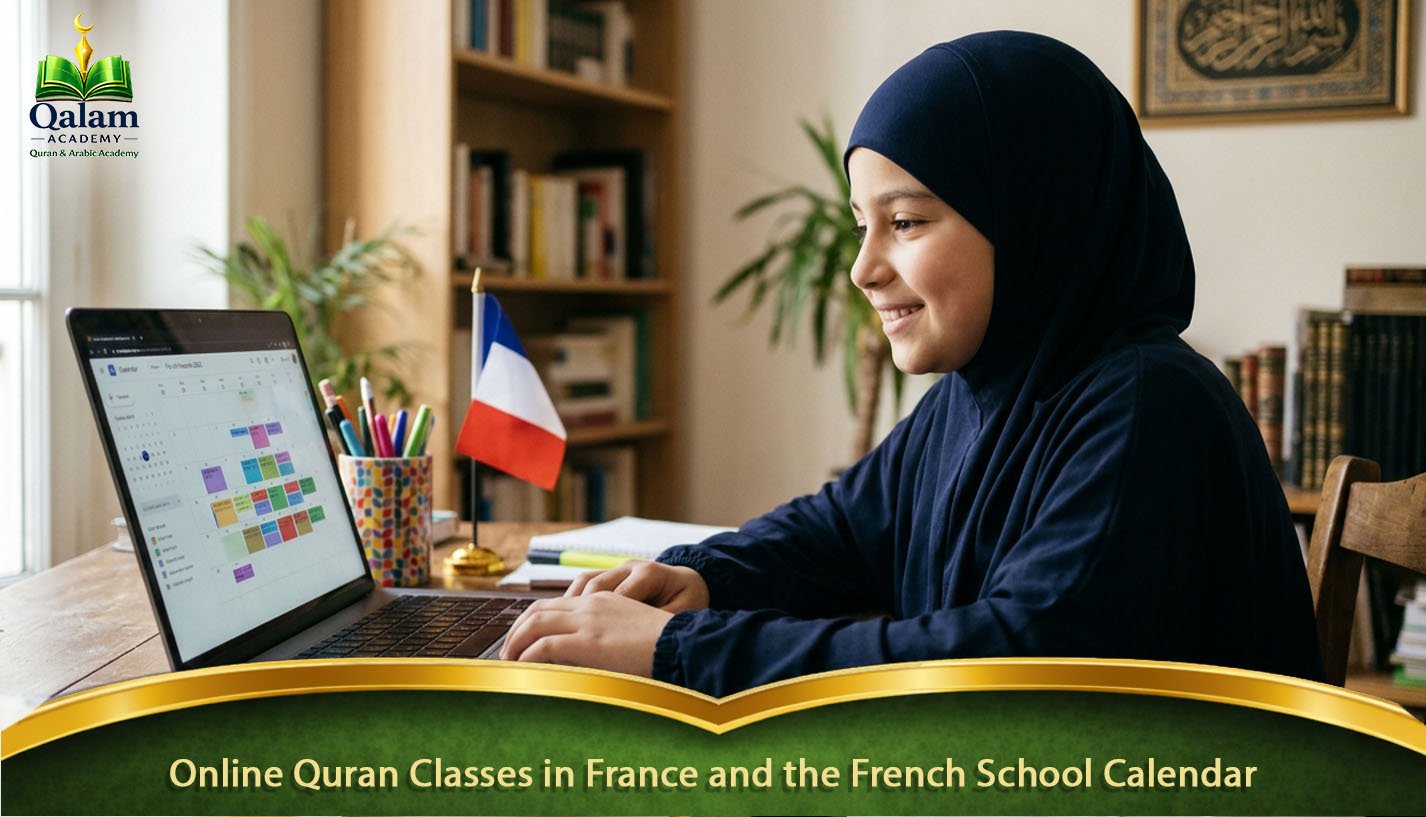
A suitable Quran learning schedule should fit around the student’s existing responsibilities. For children, school hours and homework are usually major considerations. Adults may need to account for work, family commitments, and other regular activities.
Scheduling Quran Lessons After School
After-school lessons can be suitable for children who have enough time and energy to concentrate. However, some students may feel tired after a full school day.
Parents should consider the child’s routine before selecting a lesson time. A short break after school may help the child prepare, while an excessively late appointment could affect sleep or concentration.
The best schedule is one that supports regular attendance without creating unnecessary pressure.
Wednesday and Weekend Quran Lessons in France
Some families may find Wednesdays or weekends more convenient than regular school days. However, availability depends on the student’s activities and the programme’s actual timetable.
Before selecting these days, consider family outings, sports, homework, and other commitments. A schedule should leave enough time for rest as well as learning.
Planning Lessons Around French School Holidays
School holidays can change a family’s usual routine. Some students may have more free time, while others travel or spend time with relatives.
Families should discuss holiday arrangements before lessons begin. In particular, confirm whether classes continue during school breaks and how missed lessons are handled.
Planning ahead can reduce interruptions. It also helps students maintain a reasonable connection with their learning goals when their daily routine changes.
How to Create an Effective Quran Learning Routine?
Regular practice is an important part of Quran education. Even when students attend lessons consistently, they may need additional time to review what they have learned.
Setting Weekly Quran Learning Goals
Weekly goals should be specific and realistic. A beginner might aim to practise a group of Arabic letters, while a student studying Tajweed may focus on applying one rule during recitation.
Examples of manageable goals include:
- Reviewing previously studied Arabic letters.
- Reading a short passage aloud several times.
- Practising selected pronunciation difficulties.
- Revising a memorised surah.
- Applying a recently learned Tajweed rule.
Students should review their goals at the end of each week. If a target was too difficult, they can adjust it rather than abandoning the routine.
Daily Practice for Online Quran Students
Short, regular practice sessions may be easier to maintain than occasional lengthy sessions. The appropriate duration depends on the learner’s age, ability, and available time.
A simple routine can include reviewing the previous lesson, practising a difficult sound, and reading a short passage. Students memorising the Quran can divide their time between new material and revision.
Importantly, practice should follow the teacher’s guidance. Repeating an incorrect pronunciation without correction may reinforce an unwanted habit.
Preparing Children for Online Quran Lessons
Children may need help preparing for Online Quran classes in the UK, particularly when they are unfamiliar with video lessons.
Parents can make the process easier by:
- Checking the internet connection before the lesson.
- Preparing the device and learning materials.
- Choosing a quiet place.
- Helping the child join on time.
- Reducing nearby distractions.
- Staying available if the child needs technical assistance.
As children become more familiar with the routine, they may gradually take greater responsibility for preparing themselves.
Encouraging Children During Quran Learning
Learning to read and recite the Quran requires patience. Some children progress quickly through basic reading exercises, while others need more repetition.
Parents can encourage children by recognising effort and consistency. They should avoid comparing siblings or expecting every child to progress at the same pace.
It is also helpful to make mistakes part of the learning process. When children understand that corrections help them improve, they may become more comfortable reading aloud.
Qalam Online Quran Academy: Online Quran Learning in France
Families considering Qalam Online Quran Academy should begin by identifying the student’s learning needs. The most appropriate programme depends on whether the learner is a beginner, wants to improve recitation, or has a specific Quran memorisation goal.
Rather than choosing a course based only on its title, ask for details about the subjects covered and the expected starting level. This helps families understand whether the lessons match their requirements.
Choosing a Quran Programme at Qalam Online Quran Academy
Before selecting a programme, prepare a clear description of the student’s current ability. Explain whether the learner recognises Arabic letters, reads connected words, or already recites Quranic passages.
When contacting Qalam Online Quran Academy, families can ask which learning options are suitable for that level. They should also explain the student’s age, preferred language of instruction, and main learning objective.
This discussion can help clarify:
- Which subject is appropriate for the learner.
- Whether an initial level assessment is available.
- What the lessons are expected to cover.
- Which lesson times may be suitable.
- How students receive feedback about their learning.
Questions to Ask Before Enrolling
Asking questions before enrolment helps avoid misunderstandings. Families should understand the teaching arrangements rather than relying on assumptions about how online lessons operate. Consider asking Qalam Online Quran Academy:
- Which Quran subjects are currently available?
- Are there suitable options for complete beginners?
- How is a student’s reading level assessed?
- What language can be used for lesson explanations?
- Which days and times are available for students in France?
- How are pronunciation mistakes corrected?
- How can students or parents communicate about progress?
- What is the procedure for missed or rescheduled lessons?
The answers should give families a clearer picture of the learning arrangements. If something remains unclear, request an explanation before making a decision.
Finding Suitable Online Quran Lessons
The choice of lessons should reflect the student’s actual needs. A child beginning with Arabic letters may require a different learning path from an adult who wants to improve Tajweed.
When discussing enrolment with Qalam Online Quran Academy, explain the student’s goals and previous learning experience. This information can help the academy understand what the learner is looking for.
Families should also confirm the practical details, including lesson timing, communication arrangements, and the subjects covered. Once these points are clear, they can decide whether the proposed learning arrangements suit their expectations.
Technical Requirements for Online Quran Classes in France
Online learning depends on basic technical preparation. Students do not necessarily need complicated equipment, but they should have a reliable way to join lessons and communicate with their teacher.
Equipment Needed for Online Quran Lessons
Before the first lesson, check that the student has access to:
- A computer, tablet, or suitable smartphone.
- A stable internet connection.
- A working camera, if video is required.
- A microphone that allows clear communication.
- Headphones, if they improve listening quality.
- A Quran or the learning materials requested by the teacher.
Test the equipment before the lesson begins. This can help prevent avoidable interruptions and allow more time for actual learning.
Creating a Suitable Learning Space at Home
A quiet study area can help students concentrate. It does not need to be a separate classroom, but it should be comfortable and reasonably free from distractions.
Position the device so the student can see and hear the teacher clearly. Keep learning materials nearby and reduce background noise where possible.
For younger children, parents may need to supervise the learning environment. They can also help the child become familiar with joining the lesson independently over time.
Online Safety for Children
Parents should consider online safety whenever children use digital learning platforms. They should understand how lessons are accessed, who can communicate with the child, and how personal information is handled.
Before enrolment, ask about communication arrangements and any available parental supervision options. Use appropriate privacy settings and avoid sharing unnecessary personal details.
Parents should also explain basic online safety rules. Children should know not to share passwords, home addresses, or private information during online interactions.
Common Challenges in Online Quran Classes in France
Online Quran learning offers convenience, but it also requires preparation and consistency. Understanding common challenges can help students and parents respond to difficulties before they affect the learning routine.
Improving Concentration During Online Lessons
Some students find it difficult to remain focused when studying through a screen. Notifications, background noise, and unrelated websites can interrupt their attention.
To improve concentration, prepare the learning space before the lesson. Close unnecessary applications, silence notifications, and keep the required materials nearby.
For younger learners, parents can help by establishing a predictable routine. Short breaks between activities may also help children remain engaged.
Maintaining Regular Quran Practice at Home
Students sometimes attend lessons but struggle to practise independently. This can make it harder to remember previously studied material.
A simple practice schedule can address this problem. Set aside a regular time for revision and keep the daily target manageable.
Students should also record difficult words or pronunciation points to discuss during their next lesson. This makes practice more focused and helps them use teacher feedback effectively.
Overcoming Fear of Recitation Mistakes
Some learners feel uncomfortable reading aloud because they are worried about making mistakes. This concern may be particularly noticeable among adults returning to Quran study after a long break.
However, mistakes provide useful information about what needs improvement. Students should receive clear corrections and enough opportunities to practise difficult passages.
Parents can support children by responding positively to effort. Similarly, adult learners should remember that developing accurate recitation is a gradual process.
Solving Technical Problems During Online Lessons
Internet interruptions or audio problems can affect a lesson. Although not every technical issue can be prevented, basic preparation can reduce the likelihood of disruption.
Try the following steps:
- Check the internet connection before the scheduled lesson.
- Test the microphone and speakers.
- Keep the device charged or connected to power.
- Close applications that use unnecessary bandwidth.
- Know how to reconnect if the session is interrupted.
- Ask about the procedure for handling a lesson affected by technical problems.
If an issue happens repeatedly, discuss it with the relevant support contact. Reliable communication can help families understand what to do next.
How to Enrol in Online Quran Classes in France?

Enrolment is easier when families understand their requirements before contacting a provider. The following steps can help students prepare for a more informed decision.
Step 1: Define Your Goals for Online Quran Classes in France
Start by identifying what the student wants to learn. The goal may be reading Arabic, improving recitation, studying Tajweed, or memorising Quranic passages.
Avoid choosing a programme simply because it appears popular. A suitable option should address the learner’s actual needs.
Step 2: Assess Your Reading Level Before Starting Online Quran Classes in France
Consider what the student can already do. Can they recognise Arabic letters? Can they read connected words? Do they recite Quranic passages but struggle with pronunciation?
A clear description of the current level helps the provider understand the student’s starting point. If an assessment is available, ask how it works and what it covers.
Step 3: Contact Qalam Online Quran Academy for Online Quran Classes in France
Once the learning goal is clear, contact Qalam Online Quran Academy to ask about relevant learning options.
Explain the student’s age, previous experience, preferred language, and main objective. Ask which subjects are available and whether they match the learner’s needs.
Students who prefer live remote lessons can also review the information about Learn Quran online via Zoom and confirm the current lesson arrangements directly with the academy.
Step 4: Confirm Your Schedule for Online Quran Classes in France
Discuss the available timetable and confirm all lesson times in the France time zone. Consider school hours, work commitments, family activities, and the time needed for independent practice.
Before agreeing to a schedule, clarify the arrangements for missed lessons and appointment changes. This can help prevent confusion later.
Step 5: Establish a Consistent Routine for Online Quran Learning
After arranging lessons, prepare the study area and organise the learning materials. Set aside time for revision and follow the teacher’s recommendations.
Consistency is more important than creating an unrealistic routine. A manageable schedule gives students a better opportunity to practise regularly and work towards their learning goals.
Frequently Asked Questions About Online Quran Classes in France
Find clear answers to common questions about online Quran classes in France, including lesson options, suitable ages, schedules, and learning requirements.
Can Beginners Join Online Quran Classes in France?
Yes, beginners can look for lessons designed to introduce Arabic letters and basic reading skills. They should explain their current ability before enrolling so the teaching approach can match their starting level.
Can Parents Observe Their Children’s Quran Lessons?
This depends on the provider’s teaching arrangements and policies. Parents should ask whether observation is permitted and how they can receive information about their child’s learning progress.
What Happens If a Student Misses an Online Quran Lesson?
The procedure depends on the provider’s attendance and rescheduling policy. Before enrolling, ask whether missed lessons can be rearranged and whether advance notice is required.
Are Online Quran Lessons Suitable for Students with Disabilities?
Online lessons may be suitable for some students with disabilities, depending on their individual needs and the available teaching arrangements. Families should discuss accessibility requirements, communication methods, and any necessary adjustments before enrolment.
Conclusion
Choosing Online Quran classes in France requires attention to the student’s age, reading level, learning goals, and daily schedule. Families should also consider teaching methods, communication, technical requirements, and opportunities for regular practice.
Children may need structured reading foundations, while teenagers and adults may focus on recitation, Tajweed, or memorisation. In every case, a realistic learning routine and clear feedback can help students understand their progress.
Before enrolling, compare the available arrangements and ask questions about the subjects, timetable, and teaching approach. Qalam Online Quran Academy can be one of the options families explore when looking for online Quran learning. The important step is to confirm that the available lessons match the student’s needs and expectations.

